Sunday, May 23, 2010

False analogies

Pray for the welfare of the government, for without the government, people would eat each other alive.
— Pirkei Avos

My rabbi once told me that the worst thing is false analogies.

In the comment thread on the post on Liberia, one of the comments says:
Over Shabbos I was contemplating the two countries, and I came to the following conclusion: when Pirkei Avos said what it did about Government, it was talking about this situation. North Korea, for all its many evils, is at least a (semi) functioning country. It may be starving its citizens, but at least people there live slightly normal lives. Contrast this to Liberia, where without a government, people literally eat each other. It's crazy. They may be much more western in their outlook, but without government? It's horrific.
Well, admitedly, I don’t know what’s worse: to live in North Korea or in Liberia. I would say — North Korea, because in Liberia, you still have a chance to get out of poverty, even though it’s very difficult. And even though there was a good chance you could be killed and eaten during the civil war, if North Korea starts a war, there is a good chance one can get vaporized by a nuclear attack.

Also, as I said to someone else, however many people General Butt Naked killed and ate, Hitler, Stalin or Mao each killed many more.

But even if what the comment says is true, therefore what? It seems that the thesis is: without the government, in Liberia people literally eat each other; therefore, we need the government to provide law and order. (Again, in Liberia there is government, but never mind that.)

Well, if you watch the third video (graphic alert) in the post, you will see right at the beginning that Liberians living in Westpoint, the largest slum of their capital Monrovia, go to bathroom right on the beach in front of their houses since the sanitation system is broken. Actually, one of the Liberian journalists blames the government. In fact, the video begins with the journalists going to see “what the government and UN are doing to rebuild Liberia”. And “the government does nothing about the lack of sanitation. In fact, the Commissioner himself sometimes goes on the beach, squats and [...] together with the people.”

Now, following the logic of the comment, living in North Korea is better than in Liberia — at least you have toilets there (actually, I am not completely sure what they have in Korean villages). Yes, the government may be a necessary evil, but at least it’s necessary to provide us with the toilets. I mean, no way would the market be able to provide us with the sanitation system if not for the government.

Right?

Also, for instance, when the people of medieval Iceland decided to be independent from Norwegian king and formed a nearly-anarchic society (mind you, not completely anarchic), everybody just spontaneously started going to the bathroom to Greenland Sea or Atlantic Ocean, since the king wasn’t there to provide them with chamberpots (or law and order), right? (That is, when they weren’t busy eating each other.)

As I said, in my opinion, it has nothing to do with either anarchy or government. It has to do with the culture. For instance, when the hurricane Katrina hit New Orleans, a lot of local residents were sitting on the roofs screaming, while one Russian journalist living in the area somehow managed to blog about what was going on around him, and when the water hit the attic of his house, he built a boat and just left (literally).

(There was another story of a couple with kids running out of gas in some forest in Oregon after taking a wrong turn. After about a week of waiting for the help to come, the father decided to go look for it by himself. He got lost and froze to death. All the time being a few miles away from civilization. The family was rescued. When my mother heard the story, she didn’t believe it. She couldn’t believe people could have so few survival skills. I mean, everybody knows, in such a situation, you just go up the hill to see better what’s around you.)

What is really wrong with socialism?

http://www.davno.ru/posters/1954/img/poster-1954b.jpg

In his famous two essays on the anarchist model of law and defense, Robert Murphy gives a good summary of libertarian critique of socialism while also explaining not just the advantage but the necessity of capitalism:

* * *

The traditional opponents of socialism argued that it had insufficient incentives for the average worker; without tying pay to performance, people would shirk and output would be far lower than in a capitalist economy. Only if a new “Socialist Man” evolved, who enjoyed working for his comrades as much as for himself, could a socialist system succeed.
     Although valid, this criticism misses the essence of the problem. It took Ludwig von Mises to explain, in a 1920 paper, the true flaw with socialism: Without market prices for the means of production, government planners cannot engage in economic calculation, and so literally have no idea if they are using society’s resources efficiently. Consequently, socialism suffers not only from a problem of incentives, but also from a problem of knowledge. To match the performance of a market economy, socialist planners would not need to be merely angels, committed to the commonweal—they would also need to be gods, capable of superhuman calculations.
     At any time, there is only a limited supply of labor, raw materials, and capital resources that can be combined in various ways to create output goods. A primary function of an economic system is to determine which goods should be produced, in what quantities and in what manner, from these limited resources. The market economy solves this problem through the institution of private property, which implies free enterprise and freely floating prices.
     The owners of labor, capital, and natural resources—the “means of production”—are free to sell their property to the highest bidder. The entrepreneurs are free to produce and sell whatever goods they wish. The ultimate test of profit and loss imposes order on this seeming chaos: If a producer consistently spends more on his inputs than he earns from selling his output, he will go bankrupt and no longer have any influence on the manner in which society’s resources are used.
     On the other hand, the successful producer creates value for consumers, by purchasing resources at a certain price and transforming them into goods that fetch a higher price. In the market economy, such behavior is rewarded with profits, which allow the producer in question to have a greater say in the use of society’s scarce resources.

None of this is true in the socialist state. Even if they truly intended the happiness of their subjects, the government planners would squander the resources at their disposal. With no test of profit and loss, the planners would have no feedback and would thus be operating in the dark. A decision to produce more shoes and fewer shirts, or vice versa, would be largely arbitrary. Furthermore, the individuals to ultimately decide the fate of society’s resources would be selected through the political process, not through the meritocracy of the market. [Ad kan.]

* * *
Sometimes people blame the failure of socialism in Russia on the dictators. But what did the violation of human rights have to do with the economy (besides the fact that they had to force people into socialism, just like today in the US people are forced into being taxed, so that US auto industry can be bailed out)? Killing off the intelligentsia did not cause the great famines of 1920’s and 30’s. Collectivization of the farms did. Suppressing freedom of speech was terrible, but it wasn’t the reason why the Soviet Union had to import grain from Canada after the Virgin Lands disaster (and other similar campaigns).
One adviser to Khrushchev was Trofim Lysenko, who promised greatly increased production with minimal investment. Such schemes were attractive to Khrushchev, who ordered them implemented. Lysenko managed to maintain his influence under Khrushchev despite repeated failures; as each proposal failed, he advocated another. Lysenko's influence greatly retarded the development of genetic science in the Soviet Union. In 1959, Khrushchev announced a goal of overtaking the United States in production of milk, meat, and butter. Local officials, with Khrushchev's encouragement, made unrealistic pledges of production. These goals were met by forcing farmers to slaughter their breeding herds and by purchasing meat at state stores, then reselling it back to the government, artificially increasing recorded production.

In June 1962, food prices were raised, particularly on meat and butter (by 25-30%). This caused public discontent. In the southern Russian city of Novocherkassk (Rostov Region) this discontent escalated to a strike and a revolt against the authorities. The revolt was put down by the military who opened fire on unarmed demonstrators. According to Soviet official accounts, 22 people were killed and 87 wounded. In addition, 116 demonstrators were convicted of involvement and seven of them executed. Information about the revolt and the massacre was completely suppressed in the USSR, but spread through Samizdat and damaged Khrushchev's reputation in the West.

Drought struck the Soviet Union in 1963; the harvest of 107,500,000 short tons (97,500,000 t) of grain was down from a peak of 134,700,000 short tons (122,200,000 t) in 1958. The shortages resulted in bread lines, a fact at first kept from Khrushchev. Reluctant to purchase food in the West, but faced with the alternative of widespread hunger, Khrushchev exhausted the nation's hard currency reserves and expended part of its gold stockpile in the purchase of grain and other foodstuffs.

Friday, May 21, 2010

Liberia

Some pretty graphic stuff. Don’t watch, oh you, faint of heart. (Seriously.)

I am trying to figure out whether this is a result of the State, of anarchy, or [censored].

“Liberia is civil war on steroids. Child soldiers smoking heroine. Cross-dressing cannibals. Systemic rape.”


The first video is more graphic.


After watching the third video, I started thinking it has nothing to do with either the State or anarchy.


I have to say, seeing the picture of Obama and “yes we can” just cracked me up. What an appropriate context.

You will learn for the State

Continued from the last post.


Interesting comments from YouTube:

2:56 --> ACK! It's like the Small World ride in Disney World! All animatronic puppets O_O
It's gonna be a great day and a sad, sad day when this oppressive sway over these people is finally broken. Great, because they will at last be free, but sad because the reality of their "great" country's true "standing" in the world, and the fact that no one outside North Korea holds their Dear Leader in any regard, will be a brutal slap in the face for them


The absolute LAST thing that South Korea wants is for North Korea to dismantle and go out of existence. That means they would have about 30+Million refugees flooding the south. The same thing happened when the wall fell in Germany. "You know why Chinese peple are so happy?!? They still have a wall" -Joke told to me by a German tour guide as we were on our way to Amsterdam, Holland.

The tea girl

“State” at its best.


From a bunch of undercover journalists filming the great successes of socialism in North Korea.

I like the song and the clip at the beginning, because it reminds me of Russia, except Asian communists are like Russians that had their souls sucked out of them. Actually, a bit like Germans. Russians were just a bunch of shlemazels who hated the fact that nobility oppressed the peasants. Asians took Marx and put him on the conveyor belt.


To me the above video represents the complete destruction of what human spirit is. But the thing is: the idea of doing what’s best for the society vs. individuals is that destruction.

The tea girl:


Luckily, playing ping pong is all that she has to do.

One comment on YouTube said:
God I feel like I'm being brainwashed just watching this. What an awful, awful country. I feel sorry for the people.


Now, this is absolutely my favorite episode. I think Barrage is the symbol of governmental involvement in the society.

Monday, May 17, 2010

Serves him right

Nice.

And you know what else? Language is not inborn.

Regarding the nature of time


The source:


Ich bin Zeitreisender. I guess that phrase is not found in too many German books for foreign tourists.

Sunday, May 16, 2010

And now for something completely different

One of the greatest scenes in the history of cinematography.


A little less exciting:


Of course, Russian movies also had good stuff:

Disinclination to work

In the present instance, going back to the liver-pill circular, I had the symptoms, beyond all mistake, the chief among them being "a general disinclination to work of any kind." What I suffer in that way no tongue can tell. From my earliest infancy I have been a martyr to it. As a boy, the disease hardly ever left me for a day.
— Jerome K. Jerome, Three Men in a Boat


I know I am posting too many things at one time, but this bit that I have just read is too brilliant to pass by. The Conservatives and Classical Liberals are oftentimes accused of being heartless pigs who do not care for the poor. Figures are oftentimes cited to reveal the levels of unemployment and poverty. And the solution is more free soup, more governmental charities.
        In his book, The Worldy Philosophers (hardly a work of libertarian economic philosophy), Robert L. Heilbroner writes (p. 24 in the 7th ed.):
Sir William Petty, an astonishing seventeenth-century character (who was in his lifetime cabin boy, hawker, clothier, physician, professor of music, and founder of a school named Political Arithmetik), claimed that when wages were good, labor was “scarce to be had at all, so licentious are they who labor only to eat, or rather to drink”. And Sir William was not merely venting the bourgeois prejudices of his day. He was observing a fact that can still be remarked among the unindustrialized peoples of the world: a raw working force, unused to wagework, uncomfortable in factory life, unschooled to the idea of an ever-rising standard of living, will not work harder if wages rise; it will simply take more time off.
        The idea of gain, the idea that each working person not only may, but should, constantly strive to better his or her material lot, is an idea that was quite foreign to the great lower and middle strata of Egyptian, Greek, Roman, and medieval cultures, only scattered throughout Renaissance and Reformation times and largely absent in the majority of Eastern civilizations. As a ubiquitous characteristic of society, it is as modern an invention as printing.
        Not only is the idea of gain by no means as universal as we sometimes suppose, but the social sanction of gain is an even more modern and restricted development. In the Middle Ages, the Church taught that no Christian ought to be a merchant [good news for the Jews, eh?], and behind that teaching lay the thoughts that merchants were a disturbing yeast in the leaven of society. In Shakespeare’s time the object of life for the ordinary citizen, for everybody, in fact, except the gentility, was not to advance his station in life, but to maintain it. Even to our Pilgrim forefathers, the idea that gain might be tolerable — even a useful — goal in life would have appeared as nothing short of a doctrine of the devil.
Now, I must point out, from my experience of having lived in New Orleans for four years, that the attitude described in the first paragraph of the quote is not unique to the “unindustrialized people of the world” — it is prevalent among many sub-cultures of American society as well.
        I know a Jew from Manhattan who was in real estate business in New Orleans. He would buy apartment buildings and renovate them to rent out. He employed one man who, according to my friend, was a very talented craftsman. Gaining his services, however, was very difficult. First, to find him, one had to cross a bayou on a boat. Second, even if found, the guy was most of the times in a state of intoxication from various substances. Third, even if employed, he more often than not would not show up to work.
        Now, if one personally wishes to stay poor, that’s his business (and there is a difference between “advancing one’s station in life” to the point of being able to buy a yacht vs. to the point of being able to buy two pairs of tefillin for each son and send all children to good schools, and maybe buy some Jewish books and invite a few guests for Shabbos). But if he wishes to help other poor people, he must encourage them to help themselves and provide them with economic means to do so, not encourage the government to hand out free soup to keep the poor barely alive.

Two worlds

According to the explanation of Chabad Rebbeim, two ways of approaching the teachings of Baal Shem Tov exist — the emotional and the intellectual, Chagas and Chabad. Such a distinction does not imply that one lacks in intellect, while the other lacks in emotions, G-d forbid. Rather, it is a question of emphasis. One is the approach of a fiery explosion of longing. The other is the approach of internalization and direction.

To me personally, these two pieces of music (both of which I very much like) and manner of their execution by the musicians (both very famous in their respective musical worlds) illustrate these two approaches. I will not tell you which one is which, allowing you to guess for yourself. (Again, it’s not a question of liking or disliking; just the appreciation of different approaches.) Watch untill the end.

Keith Jarett, “Summertime”:


Vladimir Horowitz, Alexander Scriabin’s Etude Op. 8, no. 12:

The fourth approach (or, Tradition, tradition! (Part 6)

I am often accused of stereotyping, labeling, and general bigotry. Well, alright, not so often, from time to time, but in any event, I try to attend to the rebuke (why, incidentally, does the End button never work on Macs?) and correct myself.
     How much more depressing, therefore, when the members of the groups that I practice my bigotry against act to strengthen the basis for it! (My complaint is not dissimilar to that of Douglas Adams recalling the cases when one meets a German lacking sense of humor. Here you were, working on this stereotype that you had held the whole life, and then, when you feel you almost succeeded overcoming it, comes a German with a sense of humor similar to that of a cork. Anyway, this is actually a very serious post, so enough about humor.)
      In any event, over this Shabbos I started reading Maimonides: Torah and Philosophical Quest by David Hartman. The author starts discussing "what options are available to someone who, while living within [religious] tradition, is exposed to different world views" from the society (especially, its intellectual elements) around him. He provides four options:
  1. The way of insulation: ignoring that the secular views exist and thus not allowing them to contradict the tradition by submitting one's intellect to the tradition and community. "My thoughts are not your thoughts"; therefore, no contradiction can happen. "Thus has G-d spoken" and no other view can exist.
  2. The way of dualism: being a Jew on the street and an intellectual in private; i.e., behaving according to the tradition, but knowing, in the privacy of one's mind, that rationality disagrees with Torah. This, according to the author, is a way of elitism, of aristocracy. Those holding to it sacrifice their intellect to their body, and their body to the community.
  3. The way of rejection: unable to sacrifice one's mind, one rejects the community and the tradition (r"l).
  4. The way of integration: an attempt to integrate rationality and tradition into one whole.
     It is this last approach that I wish to quote verbatim from the book. Although I may be accused of stereotyping again, I should like to say that this approach -- and the agenda born of it -- is rather stereotypical of the approach I have seen from most members (that I have encountered) of the school of thought within Orthodox Judaism to which the author belongs. For myself, I shall not say that I believe this approach is treif gomur, but I do believe that it is treif v'toiv loi (I wonder how many people will get the pun). I quote, again, verbatim, only omitting certain passages and hyphenating G-d. At first it's all theory, but then the author gets to practice (if you wish to skip the theory -- although I advice against it -- see the label "practice").

Friday, May 14, 2010

A little socialism never hurt anyone

You don’t say... (And if you tell me this could happen only in Russia and never in UK, Canada or US, I will answer that I saw similar things in public hospitals in Brooklyn, in Coney Island.)
I recall the case of a fourteen-year-old girl from my district who died of acute nephritis in a Moscow hospital. She died because a doctor decided that it was better to save "precious" X-ray film (imported by the Soviets for hard currency) instead of double-checking his diagnosis. These X-rays would have disproven his diagnosis of neuropathic pain.
Instead, the doctor treated the teenager with a heat compress, which killed her almost instantly. There was no legal remedy for the girl's parents and grandparents. By definition, a single-payer system cannot allow any such remedy. The girl's grandparents could not cope with this loss and they both died within six months. The doctor received no official reprimand.

[...]

The appalling quality of service is not simply characteristic of "barbarous" Russia and other Eastern European nations: it is a direct result of the government monopoly on healthcare and it can happen in any country. In "civilized" England, for example, the waiting list for surgeries is nearly 800,000 out of a population of 55 million. State-of-the-art equipment is nonexistent in most British hospitals. In England, only 10 percent of the healthcare spending is derived from private sources.

Britain pioneered in developing kidney-dialysis technology, and yet the country has one of the lowest dialysis rates in the world. The Brookings Institution (hardly a supporter of free markets) found that every year 7,000 Britons in need of hip replacements, between 4,000 and 20,000 in need of coronary bypass surgery, and some 10,000 to 15,000 in need of cancer chemotherapy are denied medical attention in Britain.

Age discrimination is particularly apparent in all government-run or heavily regulated systems of healthcare. In Russia, patients over 60 are considered worthless parasites and those over 70 are often denied even elementary forms of healthcare.

In the United Kingdom, in the treatment of chronic kidney failure, those who are 55 years old are refused treatment at 35 percent of dialysis centers. Forty-five percent of 65-year-old patients at the centers are denied treatment, while patients 75 or older rarely receive any medical attention at these centers.

In Canada, the population is divided into three age groups in terms of their access to healthcare: those below 45, those 45–65, and those over 65. Needless to say, the first group, who could be called the "active taxpayers," enjoys priority treatment.

Liberty and Charity

From here:
* * *

One of [the sneaky little hobbitses’] most effective weapons in swaying public opinion is the claim that people are selfish, so that charity requires government coercion. Some version of the “need” for mandatory charity underlies arguments on both sides of the fiscal ledger, from the innumerable free or heavily subsidized expenditure programs that exist (and the long list of new ones always being proposed), to estate taxes and progressive income taxes.

However, because the selfishness claim has been around a long time, it has also been effectively debunked. Unfortunately, most people are almost completely unaware of those arguments, because it is “history” whose relevance they fail to see. As a result, they continue to fall prey to specious arguments in this area.

That is why it merits revisiting the largely unknown “other side” to the coercive charity argument. And few have done that better than F.A. Harper, who Lew Rockwell called “one of the most important figures in the anarcho-capitalist wing of libertarianism” roughly half a century ago. Harper was a Cornell University professor and member of the Mont Pelerin Society, who helped start up the Foundation for Economic Education, co-directed the William Volker Fund and founded the Institute for Humane Studies. Chapter 4 of his 1949 book, Liberty: A Path to Its Recovery, titled “Liberty and Charity”, decimates the charity argument against liberty.

Consider an abbreviated version:

Dear Imperialist Swine


Why is this so difficult to understand? Anarchists are not against groups of people assembling together. They are against monopoly on law and order by one particular organization. Anarchists say: just like TV or Internet service can be provided by different private organizations competing for customers in a free-market environment, the same can be said about law and order. Private organization competing for customers can provide those in a free-market environment.

See this post for an explanation.

Yet, I suppose, yelling at a taxman is not the worst that people in the US have done. At least he wasn’t tarred and feathered (I won’t link to a particular clip from John Adams series).

Actually, following Kentucky and Virginia Resolutions, two lawyers sued the state of Georgia over a pre-Revolutionary bond in Supreme Court. (See Chisholm vs. Georgia.) Georgia argued that it was a sovereign state that could not be sued without its permission. Supreme Court supported the plaintiffs. The court of Georgia, however, found the decision unconstitutional; furthermore, the House passed the bill that “any federal agent attempting to execute the order would be guilty of felony and shall suffer death without benefit of closure by being hanged”. See 12:10 here.

(After which the 11th Amendment was passed making it unconstitutional to sue a state without its permission.)

Long Dark Tea-Time of the Soul

Those of you who believe in intellectual property, don’t go here.

And don’t click here:

“Would you condemn Hamas?”

Interesting video.

Thursday, May 13, 2010

Decisions, decisions...

Please answer the new two polls.

In the first poll, it’s very important to know that I am not talking about Halacha (of course, preserving your health is Halacha, but the question here is how to do it most effectively). For example, in many works of Chassidus it says that signal transduction between the brain and the foot takes no time. Modern science says that it does, and this has been shown beyond any shadow of doubt. If you have to make a decision (for yourself or others) between, say, two courses of treatment: one assuming that there is no time lag, and one assuming that there is, which one would you choose?

(If you don’t care about works of Chassidus, pick something in Gemara or something in the words of Rishoinim or Acharoinim, etc.)

In the second poll, I am asking for the deepest possible answer. Obviously, a person could have all four motivations in mind — I am asking which one is the most important. Also, when I say “it’s morally wrong”, I mean something which is objectively and naturally wrong — whether or not there was a gezeira from Hashem telling you it’s wrong (and whether or not you know that Hashem will be pleased, if such an arrangement is possible). And, I am asking you to give a realistic answer about yourself — i.e., what your motivation is. Not what it should be.

Wednesday, May 12, 2010

Prime Minister

So, UK and the Queen have a new Prime Minister who is a Tory. What can I say? Good for them.

I wonder if he's going to do the dance (some music and not necc. appropriate music, so keep it muted until the end) —


This reminds me. See this scene (frumkeit-friendly). Perhaps there were times when chivalry was in some currency. I have to say, I dislike Christian imagery, but the part with "Jerusalem has come" is quite impressive. (If you want to skip blood and gore, go to 5:13.)

This is also interesting. The concept of law (natural or otherwise) certainly differed between the ages.

Tuesday, May 11, 2010

Stephan Kinsella on Intellectual Property


Mr. Kinsella discusses the opposition to Intellectual Property from libertarian point of view and gives a general introduction of what Libertarianism is.

Ignore the anarchist vs. minirchist stuff. Focus on intellectual property argument. Hear him until the end. I genuinely believe he makes sense after having listened to his essay.

See also an excellent essay “Against Intellectual Property” by Mr. Kinsella (also available as a series of audio-lectures for those who don’t have time to read).

Brotherly love


(click on the image to enlarge)

There are many “modern” ways to read into the deeper meaning of this ancient, proud Slavic song, but we shall stick to the traditional interpretation: that cossacks valued friendship and a warrior’s duty over love (and I use the last word in a very general sense).

The song is sung in a slow or quick tempo (the translation is not the best, but it will do):

From beyond the wooded island
To the river wide and free
Proudly sailed the arrow-breasted
Ships of Cossack yeomanry.

On the first is Stenka Razin
With his princess by his side
Drunken holds in marriage revels
With his beauteous younger bride.

From behind there comes a murmur
"He has left his sword to woo;
One short night — and Stenka Razin
Has become a woman, too."

Stenka Razin hears the murmur
Of his discontented band
And his lovely Persian princess
He has circled with his hand.

His dark brows are drawn together
As the waves of anger rise;
And the blood comes rushing swiftly
To his piercing jet-black eyes.

"I will give you all you ask for
Head and heart and life and hand."
And his voice rolls out like thunder
Out across the distant land:

"Volga, Volga, Mother Volga
Wide and deep beneath the sun,
You have never seen such present
From the Cossacks of the Don.

So that peace may reign forever
In this band so free and brave
Volga, Volga, Mother Volga
Make this lovely girl a grave."

Now, with one swift mighty motion
He has raised his bride on high
And has cast her where the waters
Of the Volga roll and sigh.

"Dance, you fools, and let's be merry
What is this that's in your eyes?
Let us thunder out a chantey
To the place where beauty lies."

From beyond the wooded island
To the river wide and free
Proudly sailed the arrow-breasted
Ships of Cossack yeomanry.

Now, amongst the historians there is a great degree of disagreement regarding the question of whether Stenka Razin really did drown the Persian princess (whom he held as a hostage) and if he did, what his reasons might have been. I have just perused a work analyzing this important chapter in Russian national history. It quotes different sources, going back to such authorities as Jan Jansen Streiss (1630–1694), Dutch “sailing master” working on a Russian ship, and Louis Fabricius (1648–1729), Dutch emissary to Persia. Let me tell you: the answer is not so simple.

Besides the traditional view presented in the mighty hymn above, another opinion says that she jumped herself after discovering that she was pregnant, but a careful analysis from military historians pointing at the time when the princess might have been captured debunks this view.

Some sources present a view that she was sacrificed to the cossack deity that was associated with either Caspian sea or Volga (like most Christians, the cossacks were rather liberal in their religious beliefs and were not bothered by the conflicts of mono- and polytheism; of course, when the time came to kill someone else for his religious beliefs, they became rather orthodox). You see, before the cossacks departed on a raiding expedition to Caspian sea (as all Russians know, river Volga flows into Caspian sea¹) they would bring sacrifices to both the river and the sea — oftentimes human ones. For Halachic reasons, I cannot tell you the name of their maritime deity, but what I can say is that it is also the name of one American hurricane of the past.

In any event, this wouldn’t be the first time someone sacrificed his (or her) family for religious beliefs. Although a counter-argument states that if Razin had a Persian princess as a newly-acquired captive, he would be sailing up river Volga, away from the Caspian sea and Persia, not towards them.

In reality, eastern Cossacks did capture Persian women and even settle in a colony called Persiánovka, where they started off families with their captives. Due to the mobile nature of their enterprise, however, the colony did not endure.

After the Shvuos, I will present, iyH, the different musical versions of the song.

______________
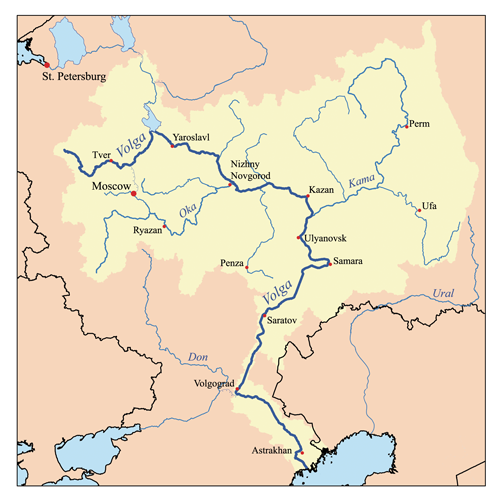
¹ “And Volga flows into Caspian sea” is a Russian way of saying “duh” — i.e., stating an obvious (and sometimes useless) fact. This map confirms this fact. Also, it shows how long the river is: it starts north of Moscow and goes all the way to Caspian sea, north of Iran. Russia in general is known for its long rivers.

By the way, these cossacks were known as Don Cossacks, because the river Don was their main base of operation. Don and Volga are two of the three mighty Russian rivers (the third one is Dnepr). There is a place where Don and Volga come close to each other. It is a site of the city called today Volgograd, although back in the day it was called Stalingrad and was the place where one third of the whole Nazi army was encircled and destroyed by the Soviet forces.

(Of course, the three mighty rivers are those just on the European side. Siberia also sports quite a collection of long and wide waterways. One of them is called Lena and was the source of the nickname of the first leader of the Soviet Union.)

I actually wonder how a Russian version of Three Men in a Boat (telling of a journey up or down Volga, for instance) would look like.

Monday, May 10, 2010

Speak your own language


As everyone knows, the native language of all Ashkenazic Jews is Yiddish. It says that the source of Loshen Koidesh is Malchus of Atzilus. But the source of Yiddish is Malchus of Attik — even higher. (Incidentally, that is also the source of Moshiach.)

John Adams and George III


Very interesting scene. One of my favorite. Comments to follow tomorrow. But watch until the end — hear the hope that King George III expressed. How silly such a concern of his sounds now! Equally silly do the concerns about the desired lack of a strong government in the present times sound to those exposed to more enlightened ideas of the proper political structure of a secular society.

A great scene:


A good selection of scenes with Thomas Jefferson:


Letters between John Adams and Thomas Jefferson:

Sunday, May 9, 2010

Regarding Moshiach...

From Derech Mitzvosecho, Mitzvas Minui Melech, perek gimmel.

Tzemach Tzedek explained before that talmidei chochamim don’t really need a king, since the role of the king is to inspire the nation to be bottul to Hashem, and talmidei chochamim are already bottul to Hashem. So, the king is only for simple people, whose role in life is dealing with gashmius. Which is why Shmuel didn’t want the Jews to have a king, since he wanted them all to be on the level of talmidei chochamim.

This part explains why the Jews will need a king in the times of Moshiach, and why Moshiach will be called a king, if indeed the whole nation of Jews will be on the level of talmidei chochamim.


ג) אך עדיין צ"ל מהו שהמשיח ג"כ יהי' מלך דלפי משנת"ל פ"א קשה כי בזמן ביאת משיח בב"א יהיו כל בנ"י ת"ח כמ"ש ומלאה הארץ דעה את ה' (ישעי' י"א ט') וכתי' ולא ילמדו עוד איש את רעהו (ירמי' ל"א ל"ג) וא"כ למה צריכים למלך. וכן קשה על המצוה שבתורה למנות מלך בישראל והלא תורה א' לכולנו וא"כ גם ת"ח נצטוו בכך וא"כ קשה לפי משנת"ל פ"א. אך הענין דבאמת שייך בחי' מלוכה גם על ת"ח הגם שמשכילים בתורת ה' ואינן נצרכים להיות בבחי' ביטול כעבד ע"ד הנ"ל פ"א אלא שהיא בחי' מלוכה יותר נעלית
והענין כי התורה היא בחי' בלי גבול וכמאמר ילכו מחיל אל חיל (תלים פ"ד ח') שיש בחי' מדריגות אין קץ ותכלית הכל בבחי' עילוי אחר עילוי באופן השגת התורה, והנה לע"ל יהי' גילוי אלקות בהשגת פנימי' התורה והיינו ע"י משיח שהוא ילמוד פנימי' התורה לכל העם גם מה שהי' כעת בהעלם, אכן אעפ"כ בודאי הוא בעצמו יכיר יותר כי לא כל מה שמשיג בעצמו יכול לגלות וללמד לכל העם כי לא יוכלו להשיג והנה מחמת בחי' זו נק' מלך, דכמו ענין המלוכה שלמטה הוא רק בחי' הביטול היינו מה שהוא למעלה מהגבלת שכלו כי לדבר שמתיישב בשכלו בטוב טעם ודעת אין צריך ע"ז לפקודת המלך שהרי גם בלא מצותו נכון הדבר מצד עצמו וטוב הוא בעיניו אלא הפקודה הוא רק על דבר שהוא נגד שכלו והוא פלאי ממנו שאעפ"כ מצד הפקודה והגזירה מוכרח לקיים אותה ומבטל רצונו לרצון המלך כי אינו יודע לב המלך (וטעמו הכמוס) וה"ז בחי' ביטול לגבי למעלה מן החכמה שלו שאע"פ שאינו מתיישב בשכלו שומע לגזירת המלך שאצלו נכון הוא ויש לו טוב טעם

ועד"ז יובן ג"כ בענין התורה שיש בה מצות וחוקים המצות הם המושגים כמו ציצית ותפילין, והחוקים הם כמו פרה אדומה ושעטנז שצמר ופשתים כל חד לחודי' שרי וכן כל א' מהם עם משי רק צמר ופשתים יחדיו לא תלבש כו'. והנה טעמי תורה יתגלו לע"ל ע"י המשיח אכן לו בעצמו יתגלה הרבה יותר לאין קץ ותכלית ממה שיוכל הוא לגלות לעם וכמ"ש בו הנה ישכיל עבדי ירום ונשא וגבה מאד (ישעי' נ"ב י"ג) והם ה' עליות ישכיל מאברהם כו' וגבה מאד אותיות אדם שיהי' למעלה גם מאדה"ר שהוא ח"ע כי למשיח יתגלה יותר, ולכן יהי' משיח ג"כ מלך על ישראל הגם שיהיו אז כולם במדריגת ת"ח עד שגם טעמי התורה יתגלה להם מ"מ הרי לא כל מה שיתגלה למשיח יתגלה להם אלא יהא בחי' מקיף עליהם ומצד זה נק' בשם מלך עליהם שהמלוכה היא מה שלמעלה מן השכל של המקבל

ועפ"י הקבלה הוא כך כי הנבראים דבי"ע יש עליהם מלך תתאה מל' דאצילות שנעשה עתיק לבריאה והיינו בחי' עתיק הוא מה שלמעלה מהשכל מלשון המעתיק הרים (איוב ט' ה') שנעתק ונבדל מן השגת הנבראים שבג' עולמות בי"ע אלא הוא בבחי' מקיף עליהם כמשל גזירת המלך על העבד שהעבד מבטל רצונו כי הוא למעלה מהשגתו כו' ונק' זה בשם מל' דאצי' על בי"ע, אבל לגבי הנשמות דאצי' הנק' אחים לזו"נ אין זה בחי' מקיף והעלם כלל שהרי נק' אחים ממש להספי' כנ"ל ומ"מ הרי גם עליהם יש בחי' מקיף והוא מה שמל' דא"ק נעשה עתיק לאצילות פי' עתיק דאצי' מה שמתנשא מימות עולם הם יומי' עילאי' שהם מדות דאצי' ונעתק ונבדל מהם והגבה מאד נעלה מהשגתם הוא בחי' המל' דא"ק על אצילות

ושם יהי' שרש המשיח וזהו וגבה מא"ד שנאמר בו ועליו נאמר חיים שאל ממך נתתה לו (תלים כ"א ה') ולא כמו בדוד שהי' ממל' דאצי' שקבל חיים מאדה"ר והאבות שהם הספי' דאצילות כנ"ל פ"ב משא"כ במשיח נתת אתה הא"ס בעצמו כו' ומצד זה יהי' בחי' מלך על ישראל הגם שיהיו ת"ח והגם שיתגלו טעמי מצות אבל לא כל מה שיתגלה לו. ולכן נק' רב ומלך מפני מה שיגלה טעמי מצות בהשגה לישראל יהי' נק' רב ומפני מה שישאר בבחי' מקיף עליהם נק' מלך ועד"ז יובן ג"כ עוד ענין מל' דא"ס כתר לא"ק כו' והמ"י

The brief explanation is that although all Jews will be like talmidei chochamim, and the role of Melech HaMoshiach will be to teach the inner aspects of Torah and the reasons for mitzvos, the levels of Torah are infinite, and his knowledge will always remain greater than the knowledge of all the Jews, in the encompassing manner (makif), which is the essence of who a king is.

This shows that if you accept someone as a king, you follow his directions even if you don’t understand their true and complete motivation. Because you recognize that he, in relation to you, is on the level of makif — encompassing. If you were following his directives because they made sense, he would be on the level of a rav, a teacher (which will be one of the levels of Moshiach).

But if you accepted him as a king, you must do what he says regardless of your understanding — in fact, precisely because you do it with recognition that his understanding is above your understanding, and you’re obeying him just because he said so, you make him and recognize him as a king.

It also says that unlike Dovid HaMelech, who received (as Tzemach Tzedek previously explained) his life force from Adam HaRishoin, Avraham Avinu, Yakov Avinu and Yosef HaTzaddik (who constituted all various level of Atzilus, from Chochma to Yesoid), Moshiach will receive the life force from the Essence of Ein Soif — the Essence of G-d Himself.

[ǃɡx, ǃɡ͡ɣ, ǃɡʱ]

Someone asked me today what the last syllable of my first name sounds like. It’s actually an interesting philosophical question, which has to do with topics of religion, ethnohistoriography, nationalism, linguistics and epistemology. I won’t talk about any of these things now, however. Suffice it to say that a picture is worth a thousand words, and a moving picture is worth a thousand moving words.

One of the sounds pronounced in this short clip (~frumkeit friendly) is a part of my first name. Watch almost until the end (the whole clip is great, but the essence starts at 2:40):


(This is not to detract attention from my super-serious anarchist post. Please read that and comment.)

Is it immoral to break the law?

Oftentimes, I hear or read statements such as the following:
There should be an instinctive, irrational emotion of disgust to breaking the law of the country, even if it is not right.
What can I answer to that? First of all, I sympathize with the sentiment. I was raised believing the same, and it is still possibly the natural, irration, emotional response in me — a response which I believe, nevertheless, is not intellectually justified. I have a similar response of emotional respect to the "ways of the land", i.e., the customs and manners of the particular community. This is something completely different from the law, and I will not address it in the post, but suffice it to say that I am more sympathetic to such a sentiment.


Secondly, I believe that what, for the most part, determines something to be moral or immoral is G-d's Law, Halacha. Therefore, if something is against Halacha, it is considered to be immoral. I believe I can find sufficient sources (such as Tosfos) to back up my opinion that the halachic principle of dina d'malchusa dina ("the law of the land is the law") applies only to monetary issues. (And even then there are nuances, such as in the cases when the law is clearly unjust — as, one could argue, is the case with the majority of taxes.)

The possibility when something is not against Halacha but is conventionally or logically considered to be immoral is interesting to consider, but is outside the scope of this post. In here, I am going to argue, briefly (since I have devoted many posts to the topic already) that not only is going against the law of the land not immoral, but in fact, in most cases, the idea of the law of the land, as practiced today in most countries is by itself logically, naturally immoral.

Here is my response to the above statement:

* * *


Why should there be an immediate instinctive disgust to breaking the law of the country? I really don’t see it. I disrespect the idea of the government and the laws in general, unless they exist as an extension of people’s natural rights (e.g., to protect themselves — from which you get the government, whose function is to protect people, and the laws, whose goal is to protect people).

I naturally, instinctively, rationally, emotionally abhor tyranny and violation of privacy. I am disgusted by someone telling me whom I should do business with. It violates my natural, G-d–given rights (the idea upon which this country was founded, by the way — so, by supporting this idea, one goes against the fabric of this country’s society, as our current president’s goal is, according to one of his radio interviews from earlier days).

What separates me from anarchists is the belief that minimal government and enforcement (internal and external) are necessary to provide universal protection of the citizens of the society (the idea in support of which the Federalists argued in their Papers, defending Constitution; their opponents, by the way, argued that the Constitution would lead to the circus that exists nowadays, when we live under semi-camouflaged totalitarian regime).

In other words: what I personally disrespect is the idea that one adult can tell another adult how to live his life (unless these instructions come from G-d; but, we are operating outside of Halacha here, right?). Now, the only time that can be permissible is if the second adult is infringing upon the first adult’s rights. So, I don’t have a right to tell you how to dress. But I do have a right to tell you not to steal my pencil, please (that right extends from my right to my pencil). And since I have that right, I have a right to hire a guard who will keep an eye on my pencil to make sure you won’t steal it. If you try to steal it, the guard will prevent it. In this case, he is not telling you what to do with your own life, since you’re actually now infringing on my life.

Next step is both of us hiring the same guard and telling him to protect us from each other. That is the only function of the guard. Here be Rollo.

Now, imagine the guard starts suddenly telling us that we can’t wear clothes of the particular color. Or do business with someone? Or he will force us to educate our children certain way. Or, he will (by force) take money from us to give to someone else. What in the world? First of all, what right does he have? The only right he had to begin with to restrict you from stealing my pencil was my right to protect my pencil. I delegated my right to protect my property to the guard. But since neither I nor anyone else ever had a right to rob another person (or force him to do other things), nobody could delegate such a right to the guard. The guard cannot have such a right in principle. So, if he does any of the said activities, he is just a tyrant and a bully. And supporting him is immoral!


Note that I am not just saying: “eh, law, shmoh, who cares?” I am saying that following the law and government blindly is exactly opposite from a moral behavior.

I am hardly the first one to have such ideas*. There are whole schools out there which explain and defend these ideas, from philosophical to ethical to economic to historical points of view. See also this. [End of response.]

* * * 
Clicking on the label "libertarianism", one can open up many more posts that discuss this and other similar issues.

_________________
* In fact, apparently, this philosophy can be traced all the way to Aristotle and Thomas Aquinas. In recent times, it has been presented by a number of philosophers such as John Locke and really became the basis for the Declaration of Independence and Articles of Confederation, as well as the anti-Federalist (which was really federalist) sentiment in the US Constitution.

The first step is the most important one

I definitely agree this is the next big thing. Anybody who doesn’t see this is a heartless jerk.


“People want you to think a certain way. And this sport... actually allows you to push your horizons further.”

I think this is the first time I’ve ever heard something like this said about an athletic activity. Mountain climbing, skiing, scuba diving, jumping from airplanes without parachutes, sailing (well, sure, sailing does somewhat push your horizons, but in rather unimaginative, literal way) don’t even come close.

Democratic psak


Democracy is the worst form of government except all the others that have been tried
— Winston Churchill (aka Otto von Bismark) 

Tonight I have listened to a lecture on the philosophy of Plato, in which I heard that he famously proposed two types of societies:

1) An ideal city-state, which was ruled by philosopher kings who alone had access to the truth and intellectual tradition and were able to reason and derive ethical standards. (The other citizens of the polis were soldiers who enforced the laws and the rest of the citizens who weren’t intellectual. Plato used this model of society as a moshol for one’s mind which consists of intellectual, emotional and spiritual parts. Everyone knows he got the idea by reading Tanya.)

2) A more realistic polis, which was ran democratically. The role of the philosophers in such a polis was to come up with laws and explain them to the general public. All the people would then vote on the laws. (And by “people” I mean free men who were citizens of the polis. [And by “men” I mean “males”.])


Now, upon hearing this, I wondered: what if the system of halachic psak was more like the second model than the first one? What if Halacha was determined not by authorities (the king, the Sanhedrin, the talmidei chochamim having enough education, experience and authority to pasken), but democratically? The role of talmidei chochamim would be to explain the proposed piskei din and the halachic reasoning behind them, and then all the Jews in a particular community would vote, and the outcome would be incumbent upon all the Jews of the community.

Please share what you think in the comments or by voting in the poll on the right.

Friday, May 7, 2010

Evidence of the negative

Схема расположения войск во время Ледового побоища 

Reading a thread of comments in the post on Frum Satire's blog (the post on which I commented before and even wrote a post in response to; I must warn that I was a bit more harsh in those times of heated youth than I am now), in which TRS recently responded to a critique of his approach, I saw the following comment:
Both Orthodox Jews and Christian Fundamentalists firmly believe that God gave the Torah to his Chosen People, Israel, during the miraculous revelation at Mount Sinai. For Orthodox Jews this is the pivotal event in the history of the Jewish people. But modern archeology has dug up a great deal of compelling evidence to suggest that much of this history never happened—and certainly not as recounted in the Bible.
Sometimes one really does marvel at the progress of modernity. Not only did the modern archeology dig up evidence of something not happening, but it dug out evidence that something never happened as recounted in the Bible. One can only marvel at the advances in this field of science, pushing at the boundaries of not only human knowledge, but also human logic.

I mean, what's next? Modern astronomy finding evidence of stars and planets that do not exist (certainly not as recounted in the Bible)? Chemistry finding reactions that do not happen? (Although one must not go far for such discoveries; just look through an examination paper of your average organic chemistry student.) Perhaps, Psychology describing models of the human mind that are not true? (Wait, that's already happening.)

Thursday, May 6, 2010

Laws of falling bodies

[Re-posting this.]

http://www.bloomsbury.com/images/Authors/Small/1844.jpg

One my favorite pieces of literature. Not for those afflicted with ADD.

From: Die Geschichte von Herrn Sommer (The Story of Mr Sommer) by Patrick Süskind, translated to English by yours truly (I preserved the grammar, punctuation, style and the sentence structure — or what passes for it in this piece).

* * *

In the times when I still climbed trees — it was a long time ago, years and decades back, and I was barely above one meter tall, wore shoes of the twenty eighth size¹ and was so light that I could fly — no, I am not lying, I really could fly — or, at least, almost could fly, or let’s say it better: at that time it was certainly within my power to do so, if I were to very firmly desire it and try to do it, because... because I remember vividly how one day I almost flew, how it was in autumn, the same very year I started school and was returning on that day home, and the wind was so strong that I, without spreading my arms, could lean against it at the same angle as a skier, or even a larger angle, without fear of falling... and when I then ran against the wind, down the hill from the school mountain — for the school was on a small hill by the village — and slightly pushed away from the ground and spread my arms, the wind immediately caught me, and I could make without slightest effort jumps two-to-three meters high and ten-to-twenty meters long — or, perhaps, not quite so long and not quite so high, but what difference does it really make? — in any event, I was almost flying, and if only I unbuttoned my overcoat and took its tails in my hands and spread them out as wings, the wind would fully pick me up in the air, and I would with absolute ease glide down from the school mountain over the valley towards the forest, and then over the forest down to the lake, near which our house was standing, to the utter amazement of my father, my mother, my sister and my brother, who were already too old and too heavy to fly, then make an elegant turn over the garden only to glide back over the lake, almost reaching the opposite shore, and, finally, calmly coast back over the air and still be home in time for dinner.

But, I did not unbutton my overcoat and did not fly up in reality. Not because I was afraid to fly, but because I did not know how and where I would be able to land, and whether I really could land. The lawn in front of our house was too hard for landing, the garden was too small, the water in the lake was too cold. To lift off — that was no problem. But what about coming back down?

With climbing trees I had the same situation: climbing up was not problematic in the least way. I saw the branches in front of myself, I felt them in my hands and could test their hardness even before I lifted myself and then put my foot on them. But when I was climbing down, I did not see everything and was forced to find, more or less blindly, the branches below me, until I found a proper support — except, oftentimes, the support was not so firm, but rotten and slippery, and then I would slip or fall through, and if I did not have a chance to catch some branch with both hands, I would fall down as a stone does, according to the so-called laws of falling bodies, discovered already almost four hundred years ago by an Italian scientist Galileo but still acting even today. [...]

____________
¹ [My shoes are of 40th–41st size — APC.]

Liking fish

http://www.chef.com.ua/images/articles/273.jpg

Fish, as one Russian commercial said, is a girl’s best friend.

In any event, a small excerpt from Surely You’re Joking Mr. Feynman:
I had decided that I was going to live Japanese as much as I could. That meant eating fish. I never liked fish when I was growing up, but I found out in Japan that it was a childish thing: I ate a lot of fish, and enjoyed it. (When I went back to the United States the first thing I did was go to a fish place. It was horrible — just like it was before. I couldn’t stand it. I later discovered the answer: The fish has to be very, very fresh — if it isn’t, it gets a certain taste that bothers me.)

One time when I was eating at the Japanese-style hotel I was served a round, hard thing, about the size of an egg yolk, in a cup of some yellow liquid. So far I had eaten everything in Japan, but this thing frightened me: it was all convoluted, like a brain looks. When I asked the girl what it was, and she replied “kuri”. That didn’t help much. I figured it was probably an octopus egg, or something. I ate it, with some trepidation, because I wanted to be as much in Japan as possible. (I also remembered the word “kuri” as if my life depended on it — I haven't forgotten it in thirty years.)
The next day I asked a Japanese guy at the conference what this convoluted thing was. I told him I had found it very difficult to eat. What the hell was “kuri”?

“It means ‘chestnut’,” he replied.

The wall of death

Hearing some atheists speak on religion makes one smile (or puff in indignation, depending on one’s character) at the naivete. For them, everything is simple. Religion does not make sense; G-d cannot possibly care what we eat or drink, could not have possibly commanded us something; end of story.

The same is true, by the way, of religious fanatics. For them too everything is simple. The world is black and white.

Time and again, however, one is reminded that not everything is so simple in this here world. Take, for instance, as Patrick Suskind puts it, the “so-called laws of falling bodies, discovered already almost four hundred years ago by an Italian scientist Galileo but still acting even today”. Seemingly, the law is simple: objects fall down. Even if one brings a vulgar example of a helium balloon that does not, on most occasions, fall down, the explanation is simple: the air is heavier than the old balloon. The air particles, as a result, fall down around the balloon, pushing the balloon itself up. (The same can be observed by watching a bubble of air or carbon dioxide rise in a glass of water. The water particles are heavier than the air; they fall around the air, pushing the bubble up.)

So, even though the above example is already an illustration that not everything is simple, and not everything is how it looks, it does not, in and of itself, defy the force of gravitation. Even though the example below does not either, it is a good illustration that things that you thought were simple and “surely not!” (or “surely yes!”, depending on the occassion) oftentimes turn out a bit more complicated.


The video is frumkeit-friendly (except the massive bittul zman). And watch until the end (or until the middle, really).


Until the very last moment, I had no idea what the fellow was doing with the car. Surely, my brain was telling me, the car was not going to do the same feat. Well, the good old cranium turned out to be wrong again.

By the way, in the poll on the right, out of 19 people, only a single person gave the correct answer.

Wednesday, May 5, 2010

The wolf-dog and the beavers

A selection from a novel by James Oliver Curwood:

Soup?!

“You dare to presume upon a sick girl with soup?!”

I wish I could say this was the first time I have ever heard this line.

[video removed due to copyright reasons; therefore, a different one:]

With relish

O tell me where is fancy bred?
Or in the heart, or in the head?
— William Shakespeare

O tell me where is fancy bread?
At Rourke's the baker's, it is said.
— James Joyce


An excerpt:

English vs. French

Richard Sharpe: Those men who’ve fought in a big battle before, one pace forward.

[no one moves]

Richard Sharpe: This place is called Talavera. There’s going to be a battle here tomorrow. You’ll fight in it... maybe even die in it. But you won’t see it.

[explosion]

Richard Sharpe: There’s a lot of smoke in a battle. Our cannon, their cannon. Our shot, their shell. Our volleys, their volleys.

[shots]

Richard Sharpe: You don’t see a battle. You hear it.

Black powder blasting by the ton on all sides. Black smoke blinding you and choking you and making you vomit.

Then the French come out of the smoke — not in a line, but in a column. And they march towards our thin line, kettledrums hammering like hell and a golden eagle blazing overhead.

They march slowly, and it takes them a long time to reach you, and you can’t see them in smoke. But you can hear the drums. They march out of the smoke, and you fire a volley. And the front rank of the column falls, and the next rank steps over them, with drums hammering, and the column smashes your line like a hammer breaking glass... and Napoleon has won another battle.

But if you don't run — if you stand until you can smell the garlic, and fire volley after volley, three rounds a minute — then they slow down. They stop. And then they run away. All you’ve got to do is stand and fire three rounds a minute. Now, you and I know you can fire three rounds a minute. But can you stand?

Tuesday, May 4, 2010

Their hollow inheritance

Nolo putes pravos hominess peccata lucrari;
Temporibus peccata latent, sed tempore parent.
— Marcus Porcius Cato Uticensis

I am translating from a Russian translation of a Polish text. Therefore, it will most likely not do any kind of justice to the original. Plus, I am not sure I will translate the names of the locales correctly. If you have suggestions, please comment. An excerpt from Andrzej Sapkowski’s Lux Perpetua:
— My people, — she suddenly said after long silence, — come from Nadrein, under Ksanten. Almost everyone in the family was murdered in 1106. A crusade! Deus lo volt! The knights Emich and Gottshalk heard Pope Urban II’s call, and with enthusiasm turned it into life. They began the fight for Christ’s Coffin from butchering Nadrein Jews. In Ksanten, only one boy survived, Yehuda, probably because he converted.

Under the name of Guido Fonseca he settled in Italy, where he returned to the faith of the ancestors; in other words, as you people say it, he returned to judaica perfidia. His descendants, Jews again, were expelled from Naples in 1288. They spread throughout the world. Some of the family settled in Bern. In 1294, a child disappeared there. Without a trace, under unknown circumstances. A clear case: a ritual murder; the Jews must have kidnapped the kid and made a matza out of him. For this all Jews were expelled from Bern. My ancestor, a rabbi, carrying then the name of Mevorach ben Kalonimos, settled in Franconia, in Weinheim.

In 1298, in Franconian settlement of Rottingen someone apparently desecrated something. Poor knight Rindfleisch saw this as a sign of G-d. “The blasphemy was done by Jews” said the sign. Kill the Jews, you who has faith in the Lord. The faithful ones turned out en masse; Rindfleisch became the head of the murderers, with whom he started working on the Divine Plan. After the communities in Rottenburg, Vuzeburg and Bamberg were exterminated to the last person, came the turn of Weinheim. On September 20th, Rindflesch and his friends entered the ghetto. Rabbi Mevorach and his family, all Jews, women and children, were pushed into the synagogue and burned alive together with it. Only seventy five people. Not so many, considering that in Franconia and Schwabbia alone, Rindfleisch killed five thousand.

Some of them, using more creative methods than burning.

With the rest of relatives in the diaspora — same classical cases. Converted great-grandfather, Paolo Fonseca, was killed in 1319 in France, during the rebellion of Pastoureaux, the little shepherds. Pastoureaux killed, as a rule, the nobility, monks and priests, but the Jews and converts were taken care of with especial passion, oftentimes with the help of local population. Knowing what Pastoureaux did with women and children locked in the cellar of Verden-on-Haronne, great-grandfather Paolo with his hands smothered the great-grandmother and two children.

Grandfather Yitzchak Iohanon, who settled in Elzas, lost almost all of his family in 1338, during some of the famous massacres done by the peasant bands who called themselves as Judenschledger. One of my great-grandmothers, whom nobody was merciful enough to kill, was gang-raped many times. So, perhaps since those times I have some mix of Christian blood. You are not happy about it? I, imagine, am not either.

Riksa grew silent. Reinevan coughed.

— What was... next?

— 1349.

— The Black Death.

— Of course. The ones whose fault was in the starting and spreading of the disease were naturally Jews. It was a Jewish plan to kill all Christians. The rabbi of Toledo, Peirat, about whom you must have heard, sent emissaries throughout Europe to poison wells, springs and fountains. Then the good Christians began to punish the poisoners. On a large scale.

Many of my relatives were amongst the six thousand burnt alive in Meintz, two thousand in Strasburg, among the victims of massacres in Berne, Basel, Freiburg, Spire, Fulde, Rehensburg, Pfortzheim, Erfulte, Mahdenburg, and Leiptzig, and among some others, some three hundred destroyed communities of those times. My family was among those killed in Basel and in Prague, as well as in Niece, Bjegu, Gura, Olesnitsa, and Wrotzelav. I forgot to tell you that most of my family lived at that time in Silesia and Poland. It was supposed to be better there. Safer.

— Was it?

— In general, yes. But later, when the epidemic started receding. One pogrom in Wrotzelav in 1360. There was a fire, the Jews were blamed, killed and drowned. Thirty or fourty people. From my family — only two. More serious case was in Krakow, in 1407, the Tuesday after Passover. A killed Christian baby was found. He was killed of course for the blood for matza. Those at fault are, of course, Jews, were preaching the priests. Masses, moved by the speeches, ran for vengeance. Several hundred were murdered; several hundred were converted. In two years I was born a Christian, a daughter of converts.

I was washed over by the waters of baptism and named Anna, after a saint, whose church was in 1407 burnt by inertia by the enraged peasants of Krakow. Fortunately, I was Anna not for long, because in 1410, my family fled Poland to Silesia, to Stshegom, returning to judaica perfidia, to the faith of Moses. In Stshegom some of our relatives resided, and overall, one hundred forty people of our faith. Seventy three of them, including my father Samuel ben Gershom, lost their lives during the pogrom of 1410. The reason? The sounds of shofar on Rosh-ha-Shana were interpreted as a call for attack on Christians. My mother with the father’s sisters and me, one-year-old baby, fled to Javor. There, at the age of eleven, I saw the second pogrom with my own eyes. Trust me, it is an unforgettable sight.

— I believe you.

— I do not complain, — she raised her head sharply. — Take it into account. I don’t cry over myself, over those of my tribe. Over Jerusalem, over the Temple. Uwene Jeruszalaim ir hakodesz bimhera wejameinu! I know the words, but their meaning is lost on me. I am not going to sit and weep in front of Babylon’s rivers. I am not looking for sympathy of others, not even mentioning tolerance. But, you asked me whether it had an effect. Of course it did. Some things are better not to handle if you are paralyzed by fear of consequences, of what can happen. I am not afraid. I accumulated bravery for generations... No, not bravery. Immunity to fear. No, not immunity. Insensitivity.

— I understand.

— I doubt it. Better go to sleep. If your concoction works, we shall leave at dawn. If not, we shall leave at dawn anyway.

Stephen Fry on Catholic Church

I genuinely believe that the Catholic Church is not — to put it at its mildest — a force for good in the world.

— Stephen Fry


Now, many people will say that many things that he says apply to any religion — or to all religions, to the idea of religion in general. Perhaps there is some truth in that. It is a complicated question, with many nuances, from rational and logical to emotional. I do believe that Judaism stands out amongst all religions, both objectively and subjectively, and this is not so much a belief for me as knowledge. To a certain point, Judaism, the way I see it, is not a religion at all. But all this is not what matters at the moment.

Nor do I agree with Mr. Fry on many of his ideas (one could say probably most of his ideas). But that does not matter either.

What does matter to me personally, in the context of this topic, is that today, as far as I am concerned, such religions as Islam and Catholic Christianity are both false and evil. Incomparably to most other religions. They are false in theory, and they are evil in practice. And I see no possibility of religious or intellectual tolerance to the ideas and practices of these monstrosities. Nor, in my opinion, should anyone else.

Update: After having been sent by TRS a video of Christopher Hitchens and Stephen Fry discussing Ten Commandments, I want to clarify that I believe now and have always believed that most atheists (especially the liberal ones) don’t know what they are talking about when discussing religion. I only found the above video interesting, because it attacks Catholicism for the apparent and obviously stupid and evil things that it says and does.

And if you tell me it is not fair, well, sometimes things are true and proper and not fair. For instance, it is only fair to allow Iran to have nuclear weapons. If US, and Israel, and Pakistan have it, why not Iran? Unfair! Yes, true. But because a Muslim homicidal maniac is in charge of the country ruled by a bunch of Mulsim anti-semitic homicidal maniacs, it makes sense for the leaders of the free world (strictly speaking, that’s just the governor of New Hampshire, but I am using a more conventional definition here) to take all efforts to make this unfair thing happen.

(By the way, another thing that liberal atheists — Stephen Fry amongst them — have no idea what they are talking about is Israel.)

Quotes taken out of context

... are not nice, but sometimes difficult to just pass by. So, here goes:

“Yes, I know that speaking on a cell phone while driving is illegal. But so is shooting someone in the face! [...] Oh my G-d, we are ruled by idiots.” — Stephen Fry, “Compliance Defiance” podgram.

Monday, May 3, 2010

On relationships, investments and eggs


I listened to a talk recently (while driving through upstate NY and Connecticut countryside) based on a work of mussar by a famous godol. In this talk, the author (not the godol himself, but a well renowned rabbi, whose ideas and lectures I usually enjoy and respect very much) talked about the nature of relationships from the point of view of mussar.

On innovation in language

A very interesting podcast by Stephen Fry on pedantry in language vs. freedom to innovate and break rules. If you are a member of the totalitarian regime that takes it name from a certain fruit, you can download it here for free. Otherwise, you can listen to it (or download it) here:


Now, Stephen Fry (and I shall really write more about this later) can be seen as a bit of an authority on the subject because of his own — immediately apparent — superior command of English tongue. His vocabulary, grammar and style are remarkable, and not, at the same time, at the expense of clarity.

Therefore, what he says is all the more interesting: he is against pedantry in language. He confesses he had to break himself out of it, but, nevertheless, he intensely dislikes the people who complain about others being wrong in grammar, usage, punctuation or the like.

Not only because he himself believes it normal — even most wonderful — that the language changes, adopts to new cultures, environments and circumstances, but also because he is irritated that these people worship rules for their own sake, and no evidence points to them enjoying the language.


My thoughts on the talk?

First of all, I liked it very much. And I agree with its spirit. I do think myself that it is wonderful to use the language creatively and “own” it, as it were. At the same time, I personally think it absurd to say that you can ignore the rules, the convention and the tradition completely. Not because I worship these phenomena for their own sake (people who have been in close communication with me know this to be quite opposite from the truth), but because they are good tools which get the job done. Effectively. More effectively than lack of rules.

The famous quote by Picasso goes something like: “It took me twenty years to learn to paint like an artist. It took me a lifetime to learn to paint like a child.” But he had to learn how to paint like an artist first! One has to know the rules in order to know how to break them. There is a world of difference between a pianist who reinvents a work of Bach (within the boundaries of classical tradition — or not) to suit her own style, personality, as well as the thoughts and feelings on the particular work, and me just banging on the piano. In the first case it is a light that was allowed to become expressed in a new vessel. Something wonderful. Something new. A creation ex nihilo. In the second case it is just noise. Nonsense.

I really do think that understanding why passive voice is to be avoided (pun intended — twice) allows one to use one’s sentences more effectively. And, if one so desires, one can break this rule. But, he must know it first to understand what he is breaking and why. (And the same goes for starting sentences with conjunctions.) As Rabbi Paltiel once said, it is not quite the same for a cow not to know G-d and, lehavdil, for a tzaddik not to know G-d. The former is just a product of mere ignorance. The latter is a case of submission to something that goes beyond the structure and the fabric of reality.

My main point is: Stephen Fry is right. Language needs to be enjoyed. It is more than just a form of communication. It is an art. (Although, even if used only for the means of communication, when done creatively, language can be incredibly forceful.) Having said that, the rules exist for a reason — they are not mere tradition necessarily. They are a means for expressing thoughts more effectively.

And knowing how to balance innovation with tradition is both an art and a science. The way to acquire this skill is through study and practice. Not through ignorance.

A final thought: I think one will find that most great thinkers, movers, creators, shapers and leaders, both in the Jewish and, lehavdil, secular history, used the force and the momentum of the tradition, to which they added a spice of innovation to create the explosions of brilliance for which they are known (and which have become the meat and potatoes of Judaism).  At their times, they were criticized for being troublemakers and innovators. In our times, they are the rock of the tradition and a source of inspiration and guidance. Take anyone, from Rambam or Rabbi Yehuda Ha’Nasi, to Alter Rebbe, to the Rebbe, and see if this formula applies.

This same idea is expressed in the concept of Havaya hu ha’Elokim. G-dly Light must reach this lowly world — and for this purpose, it must be accepted and shaped by a vessel. But, in order to be a recipient for the Light, the vessel must be subservient to the Light’s purpose and message, the knowledge of where it is coming from.

Douglas Adams and technology

I like technology. I don’t worship it; nor do I believe it is appropriate for a Jew to do so, but I do respect it as a tool to improve our lives — and not just b’gashmius, but also very much b’ruchnius.

Here is Douglas Adams writing on technology, in his 1999 article “How to Stop Worrying and Learn to Love the Internet”. The article is interesting on multiple levels, as is all the writing of DNA and people like him (in Russia they used to be called intelligentsia, which meant at first the educated, intellectual class, then started to mean eidel, refined people; then it meant Jews, and now — especially if you live in Sheepshead Bay — refers to the people who are not necessarily racist and whose topics of discussion go beyond good places to find parking, brands of liquor, or very expensive chess boards).

I think the bit about trusting sources of information is brilliant and should be read and thought about by all Lubavitchers, frankly.

Sunday, May 2, 2010

On shlichus in Alabama

A report of Lag Ba’Omer experiences to follow soon. Meanwhile, a joke I heard on Shabbos:

There was a tzaddik who said that if any of his followers ever finds himself in a difficult place, he should call out the tzaddik’s name, and he will come to save his follower. So, sure enough, one of the tzaddik’s chassidim ends up in Gehennom and calls out the tzaddik’s name. The tzaddik shows up and pulls him out of Gehennom.

So, a Lubavitcher chossid who once heard this somehow ends up in Gehennom himself. He decides to call on the Lubavitcher Rebbe to pull him out. He calls out: “Rebbe, Rebbe!” The Rebbe shows up, sees the chossid and says, giving him a dollar: “Oh, you’re there? Good. I need someone there. Brocho and hatzlocho on your shlichus.”

And now on something completely different: