Showing posts with label tznius. Show all posts

Monday, April 12, 2010

Where does it say that in Halacha?

For yet another time I am re-posting the quote below.

The context (this time) is a statement on one of the blogs that a solution to the “shidduch crisis” is to pull down mechitza — figuratively and literally, except in the cases explicitly mandated by Halacha (i.e., davening). The author of the opinion says, for example, that mehadrin buses in Eretz Yisroel which separate men and women are counter-productive to healthy opportunities for young singles to meet. To my surprised response: “Do you want the singles to meet on a bus?”, the author responded along the lines of: “What’s the problem?” (Note that I am not endorsing the mehadrin buses themselves or the behavior of chareidim on them. That’s a separate issue.)

To me, the answer (of what the problem is) is rather clear from multiple perspectives. I consulted with my rabbis to make sure I am not nuts, and they confirmed that at least in this issue I seem to be within boundaries of reason. I.e., that it is certainly an authentic value in Judaism that tznius goes beyond a skirt length, and that separation between genders goes beyond davening. There are very clear reasons for this that are, moreover, very rational.

My point right now is not to discuss the issue of tznius and solutions to shidduch crisis. I wanted to express my opinion that stripping Judaism to the bare bones of Halacha is, in and of itself, past nisht. (More on the topic here.) Now the excerpt from the post on Circus Tent:
Today in the US we have a whole range of people under 60, American born, whose knowledge of Judaism is based exclusively on books, and those books are the Shulchan Aruch and Gemora. Most of these people had parents who I am sure were fine people but left behind the emotional attachment to echte Yiddishkayt in Europe. Here they belonged to Young Israel synagogues and became very acculturated and lost that special hergesh. In America, Judaism was reduced to learning and doing mitzvos by rote. These people include most MO Jews, the so-called Yeshiva community, and even some “Amerikane Chasidim”.

On the other side we have people whose view of Judaism was shaped by seeing how their parents acted, felt, laughed, cried, talked and walked. These people tended to have a genuine Mesorah. They saw Judaism as more than just book learning, and the book learning included Midrash, Chassidus, Sifrei Mussar, vechulu. This people tend to be Chassidic and a few Misnagdim who come from European homes. And in the background of all of this loomed the Holocaust, not Coney Island! To the first category Rabbonim are “machinove”, automated people who act in a mathematical way, and have no emotions.
The second category knows that Judaism is more than the dry letter of the law.
Even though it is not the main topic of my post, my rabbi points out that the so-called “shidduch crisis” seems to be affecting the groups listed in the first, not the second paragraph (the ones whose mechitza is barely there as it is).

Update: the point of my quoting the above passage is not to compare the two types of communities, but to compare the two approaches to Torah.

Monday, December 8, 2008

Tznius and guns in Victorian England

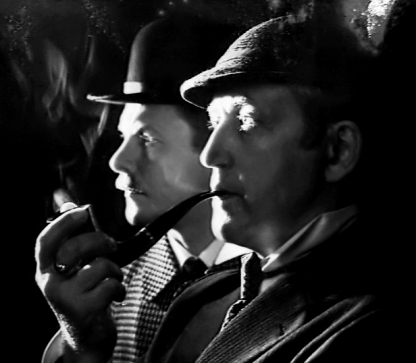
http://static.diary.ru/userdir/4/1/3/0/413061/17442263.jpg
(Dr. Watson and Sherlock Holmes in Soviet TV series on the book)

Arthur Conan Doyle’s Dr. Watson found it impossible — despite great curiosity — to ask Sherlock Holmes about his profession the first few weeks they were roommates. It was just not a proper thing to do — to ask someone what he does for a living. What business is this of yours? (Eventually he asked him inadvertently, when they were talking about Holmes’s article in a newspaper — and Holmes mentioned his work first.)

Obviously, women and men dressed more modestly than today. But modesty is much more than about dress — it’s about treasuring of privacy, as the example of Dr. Watson shows. That is why women in Judaism do not take such a public role — for them, privacy is much more precious than for men (for whom it is nevertheless also very important).

Nowadays, people do not find it problematic to ask you about what it is you do. The idea of privacy is not at all what it used to be. As a result, rabbis (or rebbetzins) have to explain to girls about the idea of tznius. Back in the day, it was self-understood, and nobody thought in terms of “How is this going to lead to sex?” Anybody (even a goy) from 19th century would find this question silly. After all, you refrain from walking outside in your underwear not because you’re afraid it will lead to undesired sex. It’s an issue of privacy.

The idea that the most important, most precious, most holy things are done and kept in private has existed in Judaism for millenia.

* * *

Also, Dr. Watson carried a gun with himself at all times. Carrying a gun for protection was normal in England until socialism, with the appropriate results:
The Mumbai massacre could happen in London tomorrow; but probably it could not have happened to Londoners 100 years ago.

In January 1909 two such anarchists, lately come from an attempt to blow up the president of France, tried to commit a robbery in north London, armed with automatic pistols. Edwardian Londoners, however, shot back – and the anarchists were pursued through the streets by a spontaneous hue-and-cry. The police, who could not find the key to their own gun cupboard, borrowed at least four pistols from passers-by, while other citizens armed with revolvers and shotguns preferred to use their weapons themselves to bring the assailants down.

Today we are probably more shocked at the idea of so many ordinary Londoners carrying guns in the street than we are at the idea of an armed robbery. But the world of Conan Doyle’s Dr Watson, pocketing his revolver before he walked the London streets, was real. The arming of the populace guaranteed rather than disturbed the peace.

That armed England existed within living memory; but it is now so alien to our expectations that it has become a foreign country. Our image of an armed society is conditioned instead by America: or by what we imagine we know about America. It is a skewed image, because (despite the Second Amendment) until recently in much of the US it has been illegal to bear arms outside the home or workplace; and therefore only people willing to defy the law have carried weapons.

In the past two decades the enactment of “right to carry” legislation in the majority of states, and the issue of permits for the carrying of concealed firearms to citizens of good repute, has brought a radical change. Opponents of the right to bear arms predicted that right to carry would cause blood to flow in the streets, but the reverse has been true: violent crime in America has plummeted.

There are exceptions: Virginia Tech, the site of the 2007 massacre of 32 people, was one local “gun-free zone” that forbade the bearing of arms even to those with a licence to carry.

In Britain we are not yet ready to recall the final liberty of the subject listed by William Blackstone in his Commentaries on the Laws of England as underpinning all others: “The right of having and using arms for self-preservation and defence.” We would still not be ready to do so were the Mumbai massacre to happen in London tomorrow.

“Among the many misdeeds of British rule in India,” Mahatma Gandhi said, “history will look upon the act depriving a whole nation of arms as the blackest.” The Mumbai massacre is a bitter postscript to Gandhi’s comment. D’Souza now laments his own helplessness in the face of the killers: “I only wish I had had a gun rather than a camera.”

Finally, every man obviously wore a hat.

On the other hand, the perverse custom of shaving was prevalent — although it’s not clear how negative a reaction to a full beard would be then comparing to now. In any event, Victorian England was definitely not a strange mixture of ultra-liberal, homosexual, pacifist society and a socialist police state that UK is today.