Showing posts with label Chabad. Show all posts

Monday, January 27, 2014

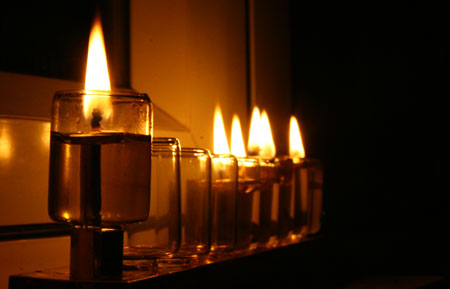
The Fifth Night of Chanukah


Normally, I would post this on my Facebook account, but this story is too long, so I'll do it here. I just heard a story from Rabbi Yossi Paltiel about a Jew (he was a nephew of someone called Rav Zemba) who came to the Rebbe's wedding in Warsaw.

At the farbrenging of the wedding, the Rebbe asked this Jew: "Why do we make such a big deal about Chanukah?" The Jew said he didn't know. The Rebbe said: "Because the fifth night of Chanukah cannot ever be Shabbos. So, it is the greatest darkness. And yet, the light of Chanukah is such that even the greatest darkness can be converted into the light — wherever you are, in Warsaw or in London."

So, this was a nice dvar Torah. The Jew went through the Holocaust and lost all his family. After the war, he came to New York and re-married to start a family anew. He met with the Previous Rebbe and told him: "You know, I've been by your middle son-in-law's wedding in Warsaw." The Previous Rebbe smiled and said: "Oh yeah? He is downstairs, you should go talk to him."

So, the Jew went and met the Rebbe, who, when he saw him, smiled and said: "Well, we meet again after twenty years. When two Jews who hadn't seen each other for a long time meet, they should say a dvar Torah. Now, do you know why we make such a big deal about the fifth night of Chanukah?"

The Jew almost fell from the surprise. The Rebbe continued: "Because the fifth night of Chanukah cannot ever be Shabbos. So, it is the greatest darkness. And yet, the light of Chanukah is such that even the greatest darkness can be converted into the light — wherever you are, in New York or in London."

After this meeting, the Jew moved to Canada and joined a Satmar community. He had children. And, living in Satmar community during the machloikes times, he heard the locals say that the Lubavitcher Rebbe mekarevs rishoim, and how terrible it is, etc. When it was time for his daughter to get married, he went to New York, to get a brocho from the Rebbe. The Rebbe's secretary didn't want to let him in, but the Jew insisted; he said he had already met the Rebbe twice, and that the Rebbe knew him and would be happy to see him. The secretary told him he can go in for one minute, but he should not ask any questions. Just get a brocho and leave.

So, the Jew comes in. And the Rebbe gives him a brocho for his daughter's wedding. The Jew then said that even though he was asked not to ask any questions, he had one question. The Rebbe replied: "Der Shver [the Previous Rebbe] sent you to me, so I have to answer any question you have." He wanted to know about what the Satmar Chassidim said about the Rebbe mekareving rishoim.

So, the Rebbe answered: "Look, if your neighbor's daughter does an aveira, will he abandon her, or will he say that she is his flesh and blood? All the Jews are the [Previous] Rebbe's children."

The Rebbe continued: "We meet again after twenty years. When two Jews who hadn't seen each other for a long time meet, they should say a dvar Torah. Now, do you know why we make such a big deal about the fifth night of Chanukah? Because the fifth night of Chanukah cannot ever be Shabbos. So, it is the greatest darkness. And yet, the light of Chanukah is such that even the greatest darkness can be converted into the light — wherever you are, in Toronto or in London."

The Jew returned to Canada. Some years later, he was planning to go to London to attend a wedding. And his neighbor came to him and told him that his daughter had ran away from the house and was living in London with someone not Jewish. So, when the Jew went to London, he contacted the local shliach, who got in touch with the daughter. She eventually replied that she wanted to come back, and wanted to get in touch with the Jew from Canada. He came in to the shliach's house and met the daughter, who was sitting there in a very emotional state. And when he looked up — he saw five Chanukah candles burning.

Ten years later, he went to the Rebbe, by the dollars, to get a brocho for his grand-daughter's wedding. He told the Rebbe the whole story. The Rebbe smiled and answered: "Der Shver [the Previous Rebbe] was looking far ahead."


Sunday, January 6, 2013

A ma'amor summary

GYROCOPTER | BY AUTO GYRO | Image

First, I changed my mind on moving to Tumblr.

Second, here is a ma'amor summary I wrote on Facebook:


Alter Rebbe says that people nowadays (meaning 18th/19th century — but this is true also today) think that the philosophers of old were fools. It is the philosophers of today that were able to develop wonderful new technological advances (the Alter Rebbe gives examples of cannons and air balloons) that are the geniuses.

In reality, he says, it's the opposite. People of old were geniuses, but they dealt with inyonim ruchniim — spiritual matters, or abstract concepts. The reason was that it was important to mekadesh (to make holy) the world from top to bottom. That is why the wise of the nations dealt with the abstract concepts, so that Yidden could mekadesh those concepts through their service.

Nowadays, the time has come to mekadesh the gashmius, the lowest aspects of the physical matter. This is why around the time of 17th-19th centuries, there was a revolution both in Chassidus (the ideas in Judaism that explain how dealing with physical things for the purpose of holiness creates "dira b'tachtoinim", Dwelling in the Lower Worlds for G-d) and in material sciences (natural sciences, medicine, economics, etc.) that allowed for more of the physical matter to be in use by the humans, more efficiently, and with greater benefit for the humanity. And economics is very important for this, because it allows literally the whole world to participate in creation of a single pencil.

Now this pencil (or an iPhone or an airplane) can be used for humanity's benefit and for avoidas Hashem. Through study of Chassidus, we are able to elevate the sparks even in the lowest aspects of the matter. Through study of natural sciences, we are able to make those aspects of the matter accessible for elevation. Furthermore, study of the world itself, combined with Chassidus, allows us to understand the greatness of G-d to a higher degree.

Sunday, December 2, 2012

Spiritual timelessness of Judaism. Special days of Kislev


A repost:

In one of his shiurim on Chanukah (listen also to this shiur on the whole month of Kislev), Rabbi Paltiel explains that time is also a creation. Besides the time that is bound to space (which Einstein’s theories of relativity talk about), there is a more general, “background” time. Every moment of this time has its unique spiritual energy — Sunday has one type of energy, Monday another, etc.

This explains why certain holidays in Jewish history came and went, and other holidays remained. The particular day on which a particular holiday happened had its unique spiritual energy. The holidays with “universal” spiritual energies are still celebrated by Jews. For instance, the 15th of Nissan (the day when Jews left Egypt) had an energy of liberation, redemption from slavery, overcoming of one’s limitations and so on. This is why Pesach is celebrated throughout generations — not (only) to commemorate the leaving of Egypt, but mainly because the day itself is liberating; the same spiritual energy that allowed Jews to leave Egypt many years ago on this day appears again every year.

This applies to any holy day on Jewish calendar. On Rosh HaShana (New Year), the source of energy that allows the world to exist is renewed. By celebrating Rosh HaShana, we are celebrating literal rebirth of the Universe.

Shabbos is not merely a day to commemorate the fact that G-d “rested” (i.e., did not create the world actively); on this day, the stretch of time itself (and as a result, the world that exists in this time) is holy. The same mode of creation that was during the first Shabbos — through “thought” as opposed to “speech” — happens every Shabbos. It is as if on Shabbos we did not exist “outside” of Hashem, but inside His “mind”.

Rabbi Paltiel gives another example. In Sha’alos veTeshuvos min haShomayim (“Questions and Answers from Heaven”), a book in which halachic questions are asked “beyond the Curtain” and answers are recorded, at the end of one such teshuva, it is written: “Today is 19th of Kislev, Tuesday, and it is a day for celebration”. For a thousand years it was not known why 19th of Kislev was a happy day — until 1799, when on a Tuesday, 19th of Kislev, the first Rebbe of Chabad Chassidus, R’ Shneur Zalman of Lyadi (“Alter Rebbe”) was released from prison. This day became known as “New Year of Chassidus”, and it is generally recognized amongst Chabad Chassidim as a day instrumental for dissemination for Chabad Chassidus, which is a recipe for bringing Mashiach.
Yud-Tes Kislev is a lot bigger than Chabad. It is not New Year of Chassidus Chabad; it is New Year of Chassidus. In Yud-Tes Kislev lies spiritual victory of Baal Shem Tov. Baal Shem Tov was a special soul that came from heavens to introduce new, special type of Judaism, and it was being judged. [...] And the miracle of Yud-Tes Kislev effected not just Chabad Chassidim, but all Jews. [Listen on for explanation.]
The same is true regarding Chanukah. The day of 25th of Kislev has the special spiritual energy of renewal and dedication of Beis HaMikdosh. When the Mishkan was built, it was ready to be dedicated on the 25th of Kislev. Moses was told by G-d to wait until Adar, but the energy of this day revealed itself when it came time (on the same day) to renew and rededicate Beis HaMikdosh after victory over Greeks.

So, it is true that we celebrate the historical occurence of each holiday, but this occurence is but a keili, a vessel for the spiritual energy behind the occurence. We are really celebrating the spiritual occurence of a particular day (that is happening on that day), but since we live in the physical world and cannot “grasp” the spiritual events in their purity (they are beyond this world) — nor should we do this, because the ultimate purpose of creation is making a dwelling place for G-d in this, physical world, — we “dress” the spiritual energy of a particular day in the “vessel” of a particular holiday, with its history, customs, special prayers, symbolism, etc.

That is why Purim, for instance, could be meaningful even for Jews in the middle of Holocaust. While the historical relevance of this holiday was seemingly distant and reversed by contemporary events, the spiritual relevance (Purim is higher that Yom Kipur, as the Lubavitcher Rebbe explains in one of his ma’amorim) was nevertheless there.

* * *

This brings me to the question often asked about the “reason” of mitzvos. I will give a relatively obscure example. At the end of having a meal, before saying the main after-blessing for the meal, it is customary to wash one’s fingertips and pass the fingers over one’s lips. Men do this (usually, using a special cup and plate that is passed around the table); women do not. The explanation given on a nigleh (“revealed” or legal) level is that this custom was instituted to protect someone who had just eaten from the salts present in the food that may be harmful for one’s skin.

The question why this customs does not apply to women has several answers. One of them is that traditionally, women were involved with preparing food and therefore washed their hands anyway. Another is that the act of publicly washing one’s hands at the table is an act of doing something normally private in public, with the table’s attention drawn to oneself. Because privacy is more important for women than for men, it is generally recognized to be improper for the former to participate in attention-drawing events (which includes other activities, in which women normally do not participate, such as holding a public office, being a Rav, getting an aliyah, etc.).

Today, if we see in this custom nothing but a medical warning, it may seem somewhat irrelevant, to say the least. It may be surprising why this custom survived, while other, seemingly more important customs of past did not. The same logic that applies to holidays, however, applies to customs and mitzvos. They have both physical (historical, ritual, pragmatic) and spiritual dimension. The former is but a vessel for holding the latter.

Indeed, regarding washing of one’s fingertips after the meal, we find in the commentaries of AriZal (Rabbi Itzchok Luria, the founder of the most comprehensive contemporary system of Kabbala we have today — on which Chabad Chassidus is based, by the way) that through washing of our fingertips after the meal, we dispell the forces of klipah (spiritual impurity) that may have been attracted to us (similar to how the same forces are attracted to our body during our sleep and linger in the fingertips after we wake up, making it neccessary for us to wash them). Indeed, this is the kavana (conscious intent) one needs to have while washing one’s hands after the meal — to get rid of these forces of impurity.

So, why don’t women wash their fingertips? Apparently, because the forces of impurity do not affect them in this case. How do we know this? Because women are not required halachically to wash their fingertips after a meal. The most important lesson that Chabad Chassidus teaches us is: we must realize that ein od milvado — there is nothing but G-d. There is absolute unity of G-d with His creation, both space and time. All events happen in time and in space when they are supposed to happen according to the grand design of creation. Spiritual at all times is connected to the physical, both in historical events and in Torah.

Therefore, if — for whatever historical reasons! — women were not obligated to wash their fingertips at the time that this custom was instituted, it must mean that whatever the spiritual dimension of this custom is, it did not apply to women but applied to men. Even if nowadays the particular physical causes of this difference (and the reason for the custom itself) no longer apply, their spiritual aspects still do, making it necessary for us to honor the custom.

Wednesday, October 31, 2012

Appearances deceive


The picture above is a good illustration of the concept that unless you know the deep meaning and context of a situation, you may misunderstand it. For most people in the West, this picture looks very strange: a few officially-dressed men staring intensely and what looks like a bunch of pebbles lying on a block of wood. In fact, of course, these are top players of the deep strategic board game of Go analyzing a situation.

The same goes for frum Jews in general and Chabad in particular. 99% of people (Jews and non-Jews) think that Chabad is just a very large soup kitchen with missionary inclinations. In reality, Chabad is all about making this world into a dwelling for its Creator. The soup kitchen is just one way to achieve this.

Wednesday, October 3, 2012

Willows of the brook


And you shall take on the first day the fruit of a beautiful tree, branches of palm trees, boughs of leafy trees, and willows of the brook, and you shall rejoice before the L-rd your G-d for seven days.
Vayikra, 23:40

Over the Yom Tov I read a beautiful sicho, in which the Rebbe's view of other Jews shines through.

The Rebbe notes that al pi Halacha, three out of the four species that we take on Sukkos need to correspond to their description from Torah: the fruit needs to specifically esrog and the palm branches have to be from a palm (and the fruit has to be beautiful in appearance), and the 'boughs' have to be 'leafy' (they need to have at least three leaves growing from the stem).

But the branch of the willow does not have to come literally from a 'willow of a brook'. I.e., the willow tree from which we cut the branch does not have to grow by a waterway. Why is that?

It is well known that the four species represent four kinds of Jews: those that perform mitzvos, those that learn Torah, those that do both, and those that do neither; these four categories correspond to the species that have good taste, good smell, both, and neither. The willow branch belongs to the latter category.

The willow thus represents the Jew who neither learns nor performs mitzvos. And that is why the willow does not need to grow specifically by the river.

The other three species are characterized by their mitzvos and their Torah. For both mitzvos and Torah to be 'valid', they need to be connected to a tradition: we cannot perform a mitzva willy-nilly; we must have received a tradition from our ancestors as to how to perform it. The same goes for Torah learning, especially learning Halachos. While to a certain extent innovation in Torah learning is allowed and even encouraged (especially interpretation of what Chumash teaches us in avoida), even that must happen within the context of an already-existing mesoira.

That is why the species that represent the Jews whose 'claim to fame' is observance of mitzvos and learning of Torah must themselves be validated by a tradition: they must correspond to their description in Torah. (Also, for instance, our Rebbeim note that we need to have a tradition for a specific sub-species of esrog, just like we need a tradition for a species of a bird to be kosher. That is why the Lubavitchers only get Calabria esrogim from Italy or Kfar Chabad.)

But what about the fourth Jew? What's good about him? Certainly not his 'external' aspects -- he has nothing to be proud of in his service of Hashem. But we still love him, because Hashem loves him. Because he is a Jew. He has in him Essence of Hashem. And that comes to the fore when the external aspects are diminished.

That is why the willow branches do not have to be specifically from the willows that grow by the river. As long as we know that they originate from brook willows, that in their essence they belong to the species, no matter where they are right now, they can still be part of the avoida of Sukkos.

Lacanian psychoanalysis of Chabad and Modern Orthodox Judaism


(Slavoj Žižek, post-modernist troublemaker)

I am going to try to analyze Chabad and Modern Orthodoxy using the psychoanalytic approach of Lacanian triad: 'the imaginary, the symbolic, and the real' (I'll explain below).

I want to do this because I have for a long time thought about the dichotomy of the 'real' and the 'imaginary' in the MO world. In addition, recently, I have read Iraq: the Borrowed Kettle by Slavoj Žižek (pronounced as 'Slah-voy Zhih-zhek'), a Marxist philosopher-psychoanalyst. I obviously disagree with many of Žižek's ideas and conclusions about capitalism and the Western world, but I find his analytic methodology entertaining. (So, keep this in mind as you read the bits of this post about the Iraqi war. What matters is not the contents, but the analysis.)

In Iraq, Žižek analyzed the motivations for the 2003 invasion of Iraq using Lacanian psychoanalytic triad:

1. The imaginary: the purpose of the war was to spread the ideals and the benefits of the Western democracy. This was the official propaganda line fed to the masses in order to garner their support.

2. The symbolic: the purpose of the war was to spread American political hegemony. This level is called symbolic because the invasion of Iraq really served a 'symbolic' purpose in the international diplomatic stance of the USA: it strengthened its roles as the international policeman and 'paved the way' for the possibility and acceptability of now starting the war on the 'imaginary' grounds, without support of the UN, and in a form of preemptive strikes.

3. The real reason for the invasion, according to Žižek, was economic control over Iraqi oil and, more generally, strengthening of US dollar against the euro. (Perhaps one can tie in the Keynesian motive for mythical 'stimulus' of the economy through defense spending.) This is classical of Žižekian analysis of political events: he envisions a nation-state, a government, or a culture (e.g., the USA) as an individual, and applies to it Freudian and Lacanian psychoanalysis, showing that (in his opinion) the sub-conscious drive is the real one.

Now, let me say at once that I do not necessarily agree with the above analysis of Iraqi war. Or, rather, I neither agree nor disagree. It is certainly the case that the invasion has failed on all three accounts: it did not help with spreading of democracy, either in the region or in the world; it has ruined US political image and led to diplomatic and military backlash, and it had an adverse effect on US economy on multiple levels, including, in the long-term, the current Great Recession. Of course, that doesn't mean that Zizek is wrong in his analysis of motivations.

As Kelsey Wood notes in Žižek: A Reader's Guide:
Žižek is careful to point out that in this Lacanian triad of imaginary-symbolic-real, each of these three levels has some degree of autonomy, and none of the is simply a mere semblance (Iraq, p.4). For example, ideological fantasy produces effects in people's behavior, and has an impact on people's lives. This indicates how fantasy is constitutive of symbolic reality. But again, with regard to the triad of imaginary-symbolic-real, 'it is not that one is the "truth" of the others; the "truth" is, rather, the very shift of perspective between them' (Iraq, p.6).
Again, I do not care whether or not Zizek's analysis is true. I care about using this method to analyse both MO and Chabad branches of 'frum' Judaism.

Let me start with Chabad, using davening as an example (I am crediting my wife for giving me this idea):

1. The imaginary: on this level, we look at davening through 'general' Orthodox Judaism. I.e., all the halachos of davening, the nusach, what davening consists of (the parts of davening), the zmanim, etc. Also, the purpose of davening as interpreted by Alter Rebbe: connection to Hashem.

The 'imaginary' level can also be termed 'ideal' or 'formal'. In a chess game, the 'imaginary' dimension of a chess piece is the rules by which it moves. A synonymous expression for 'imaginary' is 'make-belief', and that applies to the religious application of the Lacanian triad: the 'imaginary' aspect is not something that is not real (G-d forbid), but it is something one must believe in, or at least it's not something accessible to one's immediate experience; it is both a foundation and a goal, both of which must exist on the level of emunah-like commitment (you can read here more about the distinction between emunah and da'as).

2. The symbolic: when looked at through Chabad Chassidus, davening is not simply carrying out of the halachic obligation, but a path of self-development, literally an avoida ('service'). Again, I am using the 'symbolic' as merely Lacanian jargon. In an abstract sense, the act of prayer itself (i.e., what is literally a supplication) is a 'symbol' (an excuse, if you wish) for improving oneself and establishing a relationship with Hashem.

For that purpose, one must daven at length, with great concentration (oftentimes outside of the minyan), and, most significantly, one must learn Chassidus before davening, so that one can be hisboinen (contemplative, meditative) of the learned concepts (comprising either haskallah, the intellectual concepts, or avoida, the concepts of self-service, of Chassidus, or both). This has effect on the interpretation of Halacha (the first level), since, to fulfill the 'symbolic' aspect of davening, we must be lax with the zmanim, allow eating before davening, etc.

3. The real. In reality, you can find Shachris minyanim in 770 going on until almost after shkiah. Not because some chassidim use this much time to learn Chassidus, but because davening late has become a 'reality' of Chabad culture, independently of its 'imaginary' and 'symbolic' counterparts. The same goes for eating before davening (sometimes eating a quite substantial meal), etc.

Don't get me wrong: I am not saying that this is what happens to most Lubavitchers. (In fact, I don't really know what the numbers are.) I am just saying that this phenomenon (almost unique to Chabad) exists, and that's what its nature is.

Of course, it is also true that davening has become a completely different experience ('reality') in Chabad circles, both for the newcomers and the 'balabatim'. Many people would describe davening at Chabad as a richer, deeper, more vibrant experience, albeit annoying to the Jews belonging to other branches of Orthodox Judaism, whose 'imaginary' and 'symbolic' (and, as a result, 'real') expectations of davening are somewhat different.

The same analysis can be applied to many other aspects of modern Chabad 'culture', both in terms of shlichus and the 'Crown Heights' velt. I think it can also be used in a positive sense. For example: a person is stopped on the street and asked to shake lulav and esrog:

1. The imaginary: the person does the mitzva of lulav and esrog, the formal obligation he has to G-d. G-d's Will is carried out in this world.

2. The symbolic: the act of doing the mitzva connects to the essence of his neshama, revealing it (potentially). The act of doing the mitzva is important not because of its dry obligatory context, but because of what it accomplishes: the unification of G-d with this world through the act of mitzva and the subsequent creation of dira b'tachtoinim (the dwelling place of G-d in the lower worlds). I.e., the mitzva is not just a dry fulfillment of a contract, but a vehicle (a 'symbol') for the essential purpose of creation and revelation.

3. The real: it is possible that the person will become interested in Yiddishkeit and inquire about it (and, perhaps, about Chabad specifically) and this simple encounter will bring him 'back' (or, at least, closer) to frumkeit. In this, the circle of the purpose of mivtzoim is closed.


Now, let's use the same analysis in application to Modern Orthodoxy:

1. The imaginary: MO views itself as Orthodox Judaism. In fact, it does not view itself as a 'b'dieved Judaism', i.e., Judaism of a compromise. According to the MO philosophy, its path of Yiddishkeit is preferred. Torah is given to be lived, in this world. (Note that this is not the same as the Chabad concept of engaging 'der velt' in order to make dira b'tachtonim. For Chabad, 'der velt' is the goal. For MO, it's simply the status quo. When a Lubavitcher gets a job, he is being an idealist, at least as far as Chabad Chassidus is concerned. When a MO Jew gets a job, he is being a realist.)

Likewise, Torah is given to real human beings, with real desires and everyday circumstances; it was not given to the angels.

2. The symbolic: In order to accomplish the goal making Torah accessible to the modern mentality of the 'real, everyday' Jew living in the Western world in modern times, one must unite Torah with 'modernity'. Because this contemporary Jew is the one commanded with both performance of the mitzvos and learning of Torah, we must be able to interpret the meaning of the former and the content of the latter from today's, modern, perspective.

From here comes the MO view of Judaism. Mitzvos are patterns of behavior that bind us together in a Jewish community. Torah is G-d's revelation of His message of how to live a fulfilling and successful life in everyday world. The 'realism' of the mitzvos and of Torah is pushed to the shadows. It doesn't matter whether the world was created in Six Days, 5773 years ago. What matters is the message of the story to us, today. It doesn't matter whether I accomplish 'objectively' anything when I shake lulav and esrog. What matters is that that I feel and 'experience' something when I do it, that I focus on the symbolism of the act, in its historical and (constantly reinterpreted) everyday context.

3. The real: Having their significance reduced to merely symbolic context, mitzvos and Torah stop being religious phenomena and start being social ones. They are no longer an aspect of the Jew's (or the community's) relationship with G-d; they are an aspect of the Jew's relationship with other Jews and a way for him to see his own culture and self-identity on the national and international scale.

When a Chabad rabbi speaks before Musaf, he talks about avoidas Hashem and da'as Hashem. He uses some aspect of the parsha or the Yom Tov as an illustration of what our relationship with G-d must be, or how we can understand G-dliness -- G-d's revelation of Himself in the worlds, the purpose and design of His creation, etc.

When a MO rabbi speaks before Musaf, he talks about Israeli politics, using a symbolic interpretation of an aspect of the parsha (reduced almost to an anecdote). Or, perhaps, he talks about how we must approach our everyday work environment or a project: the parsha can teach us about successful interpersonal relationships or work ethic and give us peace of mind.

The interpretation of the mitzvos also suffers from the symbolic approach. Because hair covering is looked at from the symbolic point of view, not either strictly legal (as a Litvish Jew might look at it) or 'realistic' -- i.e., having a real, objective purpose outside of one's perception (a Chabad Jew's perspective), it is only important insofar as it binds a Jewish woman to a particular community of hair-covering women, or if it adds anything to her personal experience. Otherwise, it is discarded.

The same goes for many other mitzvos. The tendency of make Torah 'livable', armed with always-ready ability to assign a symbolic interpretation to a mitzva, allows one to be as meichel as one possibly can (or as Rav Moishe allows), and then perhaps some more.

In reality, therefore, MO Judaism is 'Orthodox' in name only. In practice, both its theoretical view of Judaism and its practical observance is almost closer to Conservative Judaism, from which, after all, it has evolved (as one MO rabbi said, a bit tongue-in-cheek, 'if the Hareidim build mechitza up to the ceiling, and the Conservative don't have a mechitza at all, the Modern Orthodox mechitza will be exactly half-way').


I don't know what my conclusion might be. Writing of this post was mostly self-therapeutic in nature and perhaps may be of some help to those whose encounters with MO Judaism (or Chabad, for that matter) were frustrating.

Next project: psychoanalysis of the 'yechi' culture. Just kidding!..

Thursday, September 6, 2012

Chai Ellul


There is a Chassidic saying that 18th of Ellul, "Chay Ellul", the birthday of the founder of Chabad movement, Alter Rebbe, brings chayus, life, into the month of Ellul.

What does this mean? It means that teachings of Chabad allow one to have his Ellul with chayus, with life and energy. Ellul stands for "ani l'doidi v'doidi li" -- "I am to my beloved, and my beloved is to me", which corresponds to our relationship with G-d. This relationship, expressed in Judaism, must be done with chayus, with life and energy.

A person must realize that Torah and mitzvos are not a "lifestyle". They are a living, breathing relationship with the Creator of the world. Every time a person does a mitzva, every time he learns Torah, he must not do it as a habit, as a rote, as a part of his "lifestyle" or "identity", but as an aspect of an ongoing relationship with the Eibeshter.

And the same way, every aspect of his life, from his work and his hobbies to his family to, obviously, his davening and learning and mitzvos, one must strive to connect to G-d. When something happens to a person, or when a person does something during his day, no matter how mundane, he must ask: "How is this a part of my relationship with Hashem?" And if he doesn't know the answer, he must search for it.

There is a story told about Mitteler Rebbe, Alter Rebbe's son. One year, Alter Rebbe was away for the reading of the Torah portion where all the curses that would befall the Jews if they did not keep Torah were listed. When he heard the curses being read out loud, he fainted and fell so ill that it wasn't clear if he would be able to fast on Yom Kippur.

People eventually asked: "What happened? You hear your father read the same Torah portion every year." He answered: "When my father reads this, I only hear blessings."

What's the point of this story? One of the major ideas expressed through the teachings of Alter Rebbe is that G-d is benevolent towards us. There are many mystical and philosophical ways of understanding it, and one must learn them all, but the bottom line that one must keep in mind every day is that anything that happens to one is a direct gift from G-d, whether or not it is a revealed blessing or a blessing in disguise.

May we be worthy of reaching very soon the time when our relationship with Hashem is revealed in this world on all levels.

Friday, May 11, 2012

E pluribus unum

It is said that even if Hashem did not give us the land of Israel and the Holy Temple, just bringing us to Mt. Sinai would be enough. The famous question is asked: what do you mean, it would be enough? The whole point of bringing us to Har Sinai is to give us Torah, which we would keep in Eretz Yisroel. The answer is that it would be enough, because when Jews received Torah, they were unified as one person. (We learn that Jews were tired before receiving of Torah. Why were they tired? Because it took them an effort to become unified. We learn from this that Jews get their strength from argument, which is why the main pastime of a frum Jew is to learn Gemara and argue.)
        Being unified “would be enough”, because unity amongst Jews results in the unity between the holy Names of G-d, between Him and His Presence, and between Him and this world. (For a detailed kabbalistic explanation of this process, see Derech Mitzvosecha, mitzvas Ahavas Yisroel. Suffice it to say that each Jewish soul contains sparks from all the other Jewish souls, and unification “below” draws forth the unification “above”.)
        This is why it is said that loving your fellow as yourself is the basis of the whole Torah. The point is not so much that the purpose of Torah is to bring peace amongst people (how exactly does putting on tefillin result in peace?), but that all Torah mitzvos accomplish the same thing that the single mitzva of ahavas Yisroel accomplishes: unity between G-d and His Presence in this world. And this is the whole purpose of creation and giving of Torah.

Now, the concept of unity is a tricky one. How can two separate entities become unified? This problem of disunity existed throughout the history of creation and of Jewish people. It all started from shviras ha’keilim, the breaking of the vessels of the chaotic world of Tohu (don’t worry, I won’t talk about that in detail now). The sfiroes of Tohu did not get along, couldn’t cooperate, each thinking of itself as the most important one — and kabloom! Chernobyl b’ruchnius.
        And the story repeated itself many times and indeed still goes on today. The theme of disunity is the theme of Omer. As everyone knows, the students of Rabbi Akiva quaralled, had no respect to each other, and a plague sent by G-d and augmented by socialized healthcare system killed many of them, r"l, in this very period of time.
        But what does it mean that they quarreled? These were the greatest sages of their generation, and they couldn’t get along? What were their disagreements about? What were the disagreements of the Jews in the desert about that they had to put aside to receive Torah? Now that we are writing a string of questions, what was the deal with the sferoes of Tohu? We shall examine these answers after the commercial break.


The Rebbe writes in the sicho devoted to Lag B’Omer that you can’t really blame the Jews in the desert, the spheroes, the students of Rabbi Akiva. They were not arguing about petty matters. They were not practicing sinas chinum. They didn’t care about chitzoinius (“your shtreimel looks worse than my hat”). Each of them had a shitta. Each of them had a job to do, a role that they played. And they took that job seriously.
        Think about it: if Chessed is merciful, and it’s taking its own job as the source of mercy seriously, how can it tolerate Gevurah? What do you mean, gevurah? Chessed! And Gevurah had the same attitude. In order to “live and let live”, to “agree to disagree”, one has to take a slightly mild view of one’s own shitta. Look at it with a bit of sense of humor. And these guys couldn’t afford doing that. They were responsible agents of their missions. The sages really believed, each of them, that they were right. Of course, each one of them was, but it’s all nice and good for us, sitting here in our b’dieved armchairs, to say “eilu v’eilu”. For these people, their shittos were their whole world.

So, what is one to do? Well, says the Rebbe, this is a serious problem. This is not just a problem for the sages or spheroes or the Jews in the desert. This is a problem for any two people that are trying to create a relationship. Any kind. Two friends, two colleagues, a husband and a wife, a parent and a child, etc. How can two people become one? What do you mean, one? If I am X, I am X. I cannot be Y. I can tolerate Y. I can respect Y. I can agree to disagree, even, but to be absolutely completely unified with Y? But then what happens with my identity, my “job” (which I take seriously) of X?
        Elsewhere (Inyanei Toras HaChassidus), the Rebbe explains that giluim (revelations) of G-dliness are always in conflict with each other. Because, as explained above, in order for each gilui to be itself, it must be itself and nothing else. Gevurah is Gevurah. End of story. That is why we can’t eat meat with milk. Meat is Gevurah; milk is Chessed. They don’t mix well.
        But the Essence of G-d, says the Rebbe, does not have that problem. Because the Essence includes all the revelations in itself (in potential). So, when the Essence is brought into play, no threat to the identities of individual revelations happens — and they can co-exist. Which is why G-d Himself can disobey rules of logic and do things that are mutually exclusive. Which is why, when Moshiach comes and G-d’s Essence is revealed (may it happen now), there will be no contradiction between the fact that G-d is revealed (which, under normal circumstances, would destroy this world) and, at the same time, the world exists and is a world, with its physical matter. (And, incidentally, we shall be allowed to eat meat and milk together.)

So, what’s the solution to disunity? Bring G-d into the equation. When the spheroes gain the awareness that each of them is not just Chessed or Gevurah, but Chessed and Gevurah that are each doing a job for G-d, this awareness allows them to co-operate, since each of them is doing essentially the same thing (serving G-d), albeit in a different way. The deepest identity of Chessed is not its vessel, but its Light, and the whole point of the Light is the idea that it’s on a mission from G-d (“light reveals the luminary”). Furthermore, this co-operation allows them to do their jobs better. And voilá, the world of Atzilus (aka Tikkun) is here. Jews are given Torah. Sages stop dying.
        And two people become one. This is the only way. In order for a relationship to be that of true, absolute unity, not just tolerance, one needs to bring G-d into it. G-d in the relationship is what allows the two people to become completely one and at the same time each retain his-or-her unique identity.

Gutt Yom Tov, y’all. May we merit to see speedily the time when the greatest unity of all possible is achieved: that between G-d and His nation, with the coming of Moshiach.

Friday, November 11, 2011

Importance of Akeidas Yitzchok — spiritual perspective


(limit at infinity)

In an earlier post, I covered logical arguments concerning akeidas Yitzchok. This event, however, has a very important spiritual lesson, which Avraham had to learn: we can define G-d’s expression in this world, but we cannot define His Essence.

In parshas Lech Lecha, Torah tells us that Avraham circumcised himself. In parshas Vayeira, he receives news of Sodom’s and Gamorra’s planned destruction and argues with G-d that some righteous individuals may live in them. Later, Yitzchok is miraculously conceived and born, and later yet (fast-forward thirty-odd years), G-d orders Avraham to sacrifice Yitzchok. What’s the connection between these events?

Initially, Avraham understood G-d as the Creator of the Universe. He deduced necessity of G-d’s existence from the fact that Universe functioned in an obvious order, which necessitated the source — only one — of that order. He preached monotheism and eventually received revelation of G-d, who told him to go to Eretz Kna’an to become an ancestor of a great nation. Before G-d’s revelation, Avraham’s understanding of G-d was limited to that of a Creator, after revelation — to whatever aspect of Himself G-d chose to reveal to Avraham. His understanding of G-d also was limited by his own nature. Avraham was kind and thus perceived G-d from this point of view, as a source of kindness in the world. Next came the circumcision. Chabad-Chassidic commentary on parshas Vayeira states:
When, as a young boy, Sholom DovBer of Lubavitch learned [the verse “G-d appeared to him”], he came in tears to his grandfather, Rabbi Menachem Mendel of Lubavitch (the Tzemach Tzedek), and cried, “If G-d appeared to Abraham, why doesn’t He appear to me, as well?” In reply to his little grandson’s anguished question, the Tzemach Tzedek told him that Abraham merited having G-d appear to him because, although he had indeed refined himself enough to attain very sublime levels of Divine consciousness, he at the same time knew that G-d is infinite and that therefore there were still an infinite number of levels of Divine consciousness to attain. This recognition left Abraham feeling grossly inadequate, as though he were still encrusted by layers of insensitivity to Divine awareness that needed to be removed — to be “circumcised” — in order to bare his heart before his Creator.
So, we see a gradual progression of Avraham’s understanding of G-d’s nature. He started with definition of G-d as a creator. Then he progressed to understanding of G-d as one who does kindness, chessed — from the “right” pillar of the kabbalistic tree of Divine Attributes. After his circumcision, Avraham achieved a level of being able to see the whole tree, with left side present. He was able to perceived that G-d is also a judge (as can be seen from his arguing with G-d about destruction of the Cities of the Plane: “Shall the Judge of the whole world not judge fairly?”). Birth of Yitzchok pushed the definition even further: not only was G-d the source of the world’s order, of Nature, but He was able to do miracles, transcending definitions of natural laws.


So, what did ordering Avraham to sacrifice Yitzchok accomplish? It elevated Avraham to understanding that G-d is beyond any definition or limitation whatsoever. Not of a Creator, not of a Kind Creator, not of a Just Creator, not even of someone who promised Avraham to become a father of a chosen nation. Avraham was not allowed to place any kind of limitation on G-d: natural, intellectual, emotional or logical. This new level Avraham achieved through an act of bittul, nullification of one’s ego and its importance. When being kind, Avraham related to the level of G-d’s Kindness (chesed). When asking for justice, Avraham asked for the level of G-d’s Justice (gevurah). When raising Yitzchok to become an ancestor of the Jewish nation that would proclaim G-d as King, Avraham was relating to the level of G-d’s Kingship (malchus). But what to do to relate to G-d’s undefinable Essence? Only through an act of sacrifice, nullification, removal of all definitions.

In our lives, we must do kindness, be just, keep all the mitzvos that make us G-d’s nation. While doing all this, however, we cannot allow any definitions or barriers to limit our relationship with Torah and G-d (as the Rebbe teaches). We must live in a constant act of self-sacrifice of our lives, our self-interests, our pleasures to G-d, reaching up to His Essence.

The final part of the story teaches us another lesson. In the end, G-d did not allow Avraham to slaughter his son and showed that He intended to keep his promise. Although G-d does not have to be limited by any characteristics, definitions of promises, he chooses to do so. He chooses to continue creating the world which defies His Oneness. He chooses to be the source of Kindness and Justice (and other eight spheros, whose vessels limit and define G-d’s Infinite Light). He chooses to continue having Jews as a chosen nation.

Giving us His Torah, G-d defied His own Infinity by limiting Himself to 613 commandments, to the physical world through which they are kept, to a specific nation, to whom a promise was given. A promise G-d intends to keep: that Jews through their efforts will bring about an Era when G-d’s Essence will be revealed in the materiality of the physical world, the Era of Mashiach. May this happen speedily in our days.

P.S. This also means that Hashem’s choice of us is limited to the specific 613 mitzvos. We can’t just serve Hashem in any way we want.

Wednesday, October 26, 2011

Parshas Noach — floodgates of teshuva


On Shmini Atzeres we prayed for rain, which we received next day on Simchas Torah — the rain of Torah, which starts with the account of the creation of the world. This week we are reading the next parsha: about Noach and the flood. Because nothing in Torah is random, we should be able to examine the connection between all these ideas.

Torah is compared to water in many places. In Tanya, Alter Rebbe compares Torah to water that falls from high and cascades from level to level until reaching its final destination, down below. So does Torah originate in the Will and Essence of Hashem, beyond creation (Torah is one of the things said to precede creation), and cascades from one spiritual world to another, taking form of each world, along the chain of creation, until it reaches our lowly and physical universe and takes in it the form of physical laws regarding material objects.

The importance of this analogy is two-fold:

First, we need to understand that all the halachos of Torah (and the physical events described in Torah) are nothing but the superficial aspect of Torah, whose essence is beyond mere physical laws and forms. We must strive to understand the inner essence of the laws, always remember where they came from, and never allow our observance of mitzvos to take superficial, routine form of execution of rituals.

Second, just like water that originates from great heights is destined for the lowly valleys, Torah, despite originating from great spiritual heights is destined for this world — and once it reached it, it stays here.

All the spiritual foundations of our physical laws exist so that a Jewish soul can descend into this world and bind these spiritual and lofty phenomena with lowly material matter. We must be, therefore, extremely careful with Halacha and very respectful to even minute aspects of it — there are no “more” or “less” important mitzvos. Even the slightest, minute mitzvah closes a circuit connecting the matter of this world with infinitely removed spiritual heights.


In the first chapter of Torah, Bereishis, we learn about the creation of the world, whose center is human being. The energy sustaining our world’s existence has recently been renewed on Rosh HaShanah, commonly called “Jewish New Year”. The day of Rosh HaShanah, however, is not the first day of creation, but the day when human was created — because the purpose of creation is for human to transform the physical universe into G-dly world, to unite the infinite and the finite, revealing thus the Oneness of G-d.

Jewish sources describe Adam as extremely wise human with prophetic abilities. How could he sin then, knowing what his actions will lead to? The answer is: he knew the Ohm’s Law. If you raise resistance, you also raise voltage. If you connect to G-d through holiness, you are revealing G-dliness in light. If you are connecting to G-d through unholiness, you are revealing G-dliness in darkness, a much more intense revelation. In order to connect to G-d through darkness, he had first to know of light and of darkness, and he reached for the source of this knowledge.

Adam was right: the connection to G-d through darkness is much stronger. This is why this world, the world of darkness and concealment of G-d’s existence, was created, and that is why our souls descend into it. In order to know how to find life in death, however, one must first taste life. Adam first tasted death and was exiled…

In the generation that followed, Adam’s error became increasingly difficult to rectify. The world was exposed to sin, to darkness, but inner essence of darkness, the Hidden Light, was difficult to access, because this Light was not tasted a priori.

This is what the Flood accomplished. It erased the sin and made teshuva (repentance) — an act of transforming sin into mitzva — easier. The original plan was to taste Life first and, “cook” the physical world with it, enfusing it with this taste. The plan did not work — raw flesh of the deadly and dark world was tasted first. That taste had to be washed out with the Flood, and a new sequence had to be invented: humans would not come into darkness with a priori experience and knowledge of light; they would be born in the darkness and discover light hidden in it.

Mendy Deren, flanked by his father, gets on aliya to the Torah in 770 for his Bar Mitzva with the Rebbe watching * JEM/The Living Archive

It was not, however, until Avraham Avinu, when this process started. In his ma’amor Bosi LeGani, the Previous Rebbe of Chabad quotes medrash that explains that through the sin of Adam, Presence of G-d that was in this world departed. Through sins of following generations, it departed six more times, further and further.

Through actions of Avraham and his descendants, the Presence started to return, until It did so completely with the giving of Torah. The damage done by the sin of Avraham was reversed; the job of the Flood of teshuva has started. Now came the time to bring the world to its desired state: the state of unity between G-d and the world.

The sparks of Adam’s soul returned into this world in a form of Jewish souls to finish the job that he started: to do the collosal act of Great Teshuva: to return this world into the state of its oneness with G-d. Throughout the history, this process had success and had failure. Sometimes the end of Teshuva was near; sometimes it drew farther. Yet the Presence of G-d never departed this world again, as long as Jewish children were learning Torah.

Three centuries ago (as predicted beforehand by Kabbalah) the floodgates opened again. Not the floodgates of destruction, but the floodgates of life. The final act of teshuva started happening: the Essence of Torah was revealed in teachings of Chassidus — a recipe of how to complete the Return of the world to its source. At the same time, the floodgates in the material reason also opened, starting the era of discovery and increased understanding amongst the Nations. Today we have access to the deepest phenomena of the physical Universe that reveal the source (albeit incompletely studied and understood) of the physical phenomena. At the same time, we have access to teachings that reveal the source and essence of our Torah.

Just like a physicist can understand the classical phenomenon of friction better with knowledge of quantum mechanics, a Jew can understand — lehavdil — five classical levels of Torah knowledge (pardes — pshat, remez, drush, soid) much deeper with the help of essential level of Torah, Chassidus. More importantly, however, one has access to explanation of how to complete what was started in the first six days of Creation, what (after Adam messed up) was started by the Flood, by work of Avram Avinu and his descendants, by Exodus from Egypt, by giving of Torah, by building of the Temple — how to bring about the Era of Mashiach when the great teshuva of the world will be complete, and the revelation of G-d’s Oneness will be higher than it was before the physical world was created.

May this happen speedily in our days.

Monday, September 19, 2011

“We came to disperse the darkness”

Nadav Bachar (guitar) and Oren Tzur (violin):


(sourcedownload the video)

I’ve never seen before a violin being used like balalaika. Can you do this with all stringed instruments (play them with fingers)? Can you use bow on guitar?

Also, at the beginning of the video (0:07–0:09), is that a monkey, a cat or a squirrel sitting in the yard?

More by Nadav Bachar (and on MySpace):


(download)


Friday, August 12, 2011

Ein od milvado


"In the heavens above and on the earth below, there is nothing but Him."

It says that the heavens are mentioned first, because it is easier to conceive that there is only Hashem in the spiritual worlds, since they are far away from us conceptually, such that "the spiritual" is some abstract concept anyway, so that it's possible to imagine that all there is "up there" is just G-d or G-dliness or "mind of G-d" or some other such fuzzy idea.

But our world -- it's much more difficult to comprehend how it can be said about it that there is nothing but G-d. What about the sky, the leaves, the ground, the annoying construction company that will turn off the water in the area 11 pm to 5 am on Friday night? Surely, they exist!

So, many explanations can be brought from Kabbala, Chassidus, philosophy, but one can also think of it in a simple way, due to the contributions of modern science.

Modern science tells us that everything is emptiness. Not for the most part, but in reality. As the famous fantasy writer Terry Pratchet put it (I will find the exact quote later), most of the universe is empty, because most of its existence consists of keeping tabs on those parts which are not empty. And this doesn't just means the expanses of space between the galaxies. I mean, inside the chair you're sitting on, most of the space is just "instructions" on how the elementary particles should interact with each other.

But those "instructions" come themselves from the properties of the particles. (The way I put it to someone: let's say you have an observation of a law that if you have a skinhead and a hippy meeting in a street, they will always get in a fight. Now, is this law "imposed" on the hippy and the skinhead from the outside, or is it a sequence of their properties ["skinheads hate pacifists" and "hippies hate racists"]? It would seem the latter.)

And those properties -- what are they properties of? It seems that they are just properties of empty pieces of space. These properties interact with each other; they get assigned to other pieces of space; the pieces of space they were assigned to get other properties, and so on.

Now we have to bring in Chassidus and to say that everything is created every second ex nihilo, by G-d. So, every single moment aspect of space-time is created by G-d, and He assigns to every single aspect of space certain properties, which interact (according to the laws that He set up) with each other in time.

So, looking at this web-site, or the next time you're outside, in the fresh air, think about it: all of the Universe is filled with Dvar Havaya, the speech of G-d.

Thursday, August 11, 2011

Body and soul, part 3

brain, heart, soul, body

I am continuing my musings (including links from Chassidic texts) about body–soul relationship.

Part 1.
Part 2.

In this part, I would like to quote Mitteler Rebbe from prakim 10 and 12 of his Sha'ar HaYichud, the Gate of Unity.

Briefly, as a background, in Chapter 10, Mitteler Rebbe says that there are three levels of unity within the Essence of the Infinite Light. At the first level, it is impossible to say that there are 10 Spheroes "unified", because they exist in absolute simplicity. The Rebbe gives an example of the soul, which has power of kindness, power of intellect, power of sight, etc. But in the essence of the soul (Yechida), these powers are not unified; they exist in potential. I.e., you don't have many different forces rooming together in the essence of the soul. You have one phenomenon, which has a potential to be expressed in a number of different ways.

The second and third level involve estimation and preparation of a force to be expressed in action. On these two levels, one can say that different forces of the soul exist in unification with each other, since they are indeed distinct forces; it's just that they are still unified, because they have not yet been actualized.

What's interesting to me at this point is the language the Mitteler Rebbe uses when talking about the actualization of the soul's power (the brackets are from the translator and editor; I am not copying the Hebrew text, because it's a major pain to edit, but you can refer to the original in the above link):

[All of these three levels] are before anything came out into actuality. For example, in the power of movement, [this entire estimation] is before any actual physical movement. Or, in the spiritual force, [this preparation] is before it actually comes into a physical body. 
Then, there is a change from a spiritual existence to a physical existence, such as a physical movement and physical life force. The same is true in the example of the physical growth. 
For this [change of existence] it is necessary for there to be an initial Tzimtzum — contraction and restrains in the revelation of the spiritual [potential]. This is so that there may be a [transition] from spiritual to physical (as will be explained in chapter 12).
Examining this loshon, one gets the impression that Mitteler Rebbe would not agree that the force that results in a growth of a limb is the same phenomenon as the growth itself — or, indeed, the physiological processes in the limb that constitute the growth. Instead, the Rebbe insists, there is a tzimtzum between the spiritual force and the physical process that results from the "actualization" of the force in the body. Just, one might say, as there is a tzimtzum between the Light that creates a stone and the actual chomer/tzura of the stone.

Going further, to the relevant part of Chapter 12, we find this analogy for the Tzimtzum of Oir Ein Soif:
The second type of analogy [of Tzimtzum], which is the life of the soul [as it is invested] in the body, also brings out the same point as above. This is that in order for there to be a change from the essential spiritual life of the soul, to a [physical] life of flesh, it is necessary for there to be an initial concealment and contraction of the light of the soul. This is because there is no comparison between them. 
Nonetheless, the soul is affected by the occurrences of the body. Therefore, even the light of the physical life [force] is connected and bound with the spiritual light of the essence. This is similar to [how the aforementioned] physical growth is bound to the spiritual power of growth. [Note the distinction! — CA]
However, when one’s [physical] limb becomes severed [G-d forbid,] this does not cause a loss to the spiritual light and life force of that limb. The proof of this is from [the fact that] a blind person can give birth to a whole person, as is known. This [shows that] the spiritual [life force] is merely concealed, but it still exists, hovering over the physical life force of the body. This is called “Tzelem Ish — The form of man”. This is similar to how the aforementioned [breadth and length of] knowledge which is concealed, [encompasses the brief teaching,] etc. (All of this is explained elsewhere at length.) 
Likewise, when the spiritual power of movement comes into an [actual] physical movement, it becomes constrained within itself *. Nonetheless, the physical movement is connected and bound to the spiritual [power of] movement. There are many other examples of this as well, such as the matter of having insight into a particular concept, which comes from the power of conceptualization [of his soul], which rests upon him in a concealed [fashion]. [This means that in order for there to be a particular flash of insight into a particular field of knowledge, it is necessary for there to be a Tzimtzum in his essential power of conceptualization (Koach HaMaskil).]
__________
[* I am not sure what "it becomes constrained within itself" means. — CA]
Again, it seems that the Rebbe is saying that "there is no comparison" between the "life" of the body and the soul power that is the source of that life, the former being spiritual and the latter physical.

Although, one could also interpret the above as the Rebbe saying that there needs to be tzimtzum between the Light of the soul as it exists in Yechida (the essence of the soul) and the specific koach of the soul as it enlivens the specific body part (e.g., koach ha'reiyah as it "enlivens" the eye, the visual cortices, etc.). It would seem to me, however, that the first interpretation is closer to the pshat of the text.

The nature of the bottom-to-up influence of the body on the soul is not as clear to me from the text.

But the above text does seem to answer my objection to the idea that soul is the tzura of moach vis-a-vis brain death: if the cortex is destroyed, then the tzura of the cortex is destroyed; in that case, the soul is no longer there... and yet we rule Halachically that the person is alive. Based on what the Mitteler Rebbe said about loss of the limb and the life-force of the limb not being lost, but "hovering over the physical life-force of the body", one could answer my objection: certain aspects of the soul (koach ha'maskil, for instance) have become concealed and disconnected from the body, since their keili has been destroyed, r"l, but, first of all, the rest of the soul is still connected to the body, since those of its powers that enliven it (and are responsible for breathing and heartbeat, for instance) are still present, and second, koach ha'maskil is "hovering" over the life-force of the body; it has not been disconnected, merely concealed.

To be continued...

Tuesday, July 5, 2011

Avinu loi meis

In the honor of Gimmel Tammuz, a re-post of a portion of Rabbi Posner’s parsha class.

What does Gemara mean when it says that we can learn that Yakov did not die from Torah not stating explicitly that he did die? “Did not die” in what sense? What is this concept of dual realities of Egyptians (in which Yakov Avinu died) vs. Jews (where he did not)?

To understand why Yakov did not die, we need to understand first what it meant for him to live. I think it’s a really important concept that should be understood very carefully, for a number of reasons. So, pay attention. Rabbi Posner briefly goes off on a bit of a tangent in the middle explaining about the Four Worlds, but then he returns to Yakov Avinu at 10:00.


And a story (heard from Rabbi Posner over Yom Kippur):

Most Chassidic groups have a custom called shirayim: the Rebbe eats a little bit from his plate, and then his Chassidim come and take each a peace for themselves. The source of this custom is the idea that everything that a tzaddik owns becomes holy too, since tzaddikim serve Eibeshter on the level of b’chol meoidecho (“with all your might”), which means that ther serve Hashem with everything they do, own or touch — and impart the essence of themselves and revealed holiness of their avoida on their possessions.

So, whatever the Rebbe partakes of becomes holy. And then his Chassidim partake of it to attach themselves to the Rebbe.

Well, for a number of reasons, this is not a custom of Chabad Chassidim. In short, one attaches oneself to the Rebbe b’pnimiyus, not b’chitzoinius. By studying his teachings (which the Rebbe makes accessible to the Chassidim), not by holding on to his gartel, so to speak. Even though elements of attaching oneself to the Rebbe through chitzoinius also exist in Chabad (after all, chitzoinius is a part of the equation), pnimiyus is the ikkar and chitzoinius is de-emphasized.

Anyway, the story goes that a Jew from a different Chassidic background had become a Lubavitcher chossid, but did not yet know that in Chabad they don’t do shirayim. So, when he was in the presence of the Frierdiker Rebbe, as soon as the Rebbe started eating, he came over and attempted to take some food from the Rebbe’s plate. The Rebbe smiled at him and gave him the shirayim and then said: “By others, getting shirayim is a privilege. By us, getting shirayim is also a responsibility.”

I also remembered something that Rabbi Posner said over a dinner one time. He had been to a farbrengen in Crown Heights, where a rabbi who had never seen the Rebbe in his life was telling people about the greatness of the Rebbe. An amazing feeling. He also talked about the love that one felt during the yechidus. “I was not going to speak, but then he asked me to speak, so I said: ‘You know, I've been to a yechidus with the Rebbe. When I was fourteen. And I did not feel love. I felt awe. I felt an overwhelming sense of awe. When you meet a person, you see him, his personality, character, history. When I saw the Rebbe, there was the sense of great Nothing. Just a source of pulsing power, of very direct purpose. He was there for a reason, and his whole life, his whole essence, his interaction with other Jews was geared towards that reason, that goal. And one was being overwhelmed by this [singular feeling] when standing in front of him.’”

Monday, June 20, 2011

Tradition, tradition!

http://latimesblogs.latimes.com/.a/6a00d8341c630a53ef01156fa4cd3c970b-500wi
(a re-post... sorry it’s late)

Notes from a Torah class by Rabbi Posner of Boston on Parshas Shlach. So, please forgive the choppiness.

It all starts with Jews sending the spies, who come back with the unfortunate report. When Hashem tells them they would travel in the desert for forty years as a punish… I mean, consequence of their actions, some people suddenly come to their senses. And decide that are ready to do it. Yep, ready to do it. Come on, let’s do it, let’s do it.

And then Moshe Rabbeinu says: “Don’t go, for Hashem is not with you.” And, as one might expect, they still go (into a battle) and get killed. So, what’s going on? OK, here come the notes:

Hinenu: we are ready (like Hineini). We are ready to go and to fight. What changed?
  • Every Jew is inherently a believer in G-d
  • When Moshe Rabbeinu screamed at them, they realized they were being foolish, and restored the connection
  • But, MR said: don’t go, because G-d is not amongst you.
  • Amalek came down and killed them.
    • What did these people do wrong? It seems they did what Hashem wanted them to do…
      • Moshe Rabbeinu told them not to go…
      • You can do all teshuva in the world you want, but you still need MR and Aaron go with you
      • You cannot divorce the soul of Torah from Torah itself
      • You can talk about the beauty of customs and traditions – but if you change it, it is not going to last
      • Needs to be steadfast connection to bris Hashem
    • Who asked you to make decisions? You can’t make decisions either when you’re a spy or later, when you decide to attack on your own…
    • If MR tells you: don’t go on, then it will not be successful.
      • The power of tradition…
      • What does it say, how do we know?
Within structure of Halacha itself – things that are permissible!!! Why not? It’s not the way it’s ever been done. It’s not the way that Jews have been doing it.

But, Chabad is the biggest rebellion ever. It’s not the way it’s been done; it’s not the way to do it.
Rabbi P. in Young Israel. In weekday shull. An old man giving a class. Rabbi P. saying Tehillim. The man was talking about the Blessing for the Sun. He was saying it’s really not such a big deal. People do it, but they don’t celebrate it. Don’t make a whole event out of it. Some people take regular things and blow things out of proportion about them. Like Chabad putting tefillin on in the street. Tefillin has always been a regular quiet thing – and suddenly you make a big deal out of it?!

In the year of 2009 of common era, someone should say this! Are you joking? Do you realize what happens here in the shull: groups of kids from Reform, Conservative families come learn about Shmura Matza in your shull (because Chabad brings them). Bridges between secular and religious worlds.

The world today is completely different world – majority of Jews have never and will never put on tefillin, until someone does it with them.

The mindset that existed in 1950s – this has never been done. Sending shluchim to places that have nothing to support them religiously: this has never happened in the history of Jews. Jews are very community-oriented. If you are a frum Jew, you need a minyan, and you need all that the community provides. How did Jews do it?

They never have.

The answer: If you walk by a lake, you don’t jump in it in your suit. But if your brother is drowning, of course you would jump in – so, you will wet your suit a little, nu…

So, yeah, there is a concept of doing things traditionally: daven in a shull, not in the middle of a street. But sometimes you need to make a change. The question is: why do you need to make a change? Why make a change?

When Jews tried to conquer EY for the heck of it, without Hashem’s and MR’s protection, it was not successful. They died. Just like families of Reform and Conservative Jews. They implemented changes for themselves, not for Hashem. You can’t have personal motivation – I think it’s a good idea, I think I want to do it.

So, when the Rebbe became a leader of the generation, he explained that when a Lubavitcher puts on tefillin with someone else, he doesn’t do it as his own thing but under guidance of the Moshe Rabbeinu of the generation.

Ad kan.

Wednesday, December 15, 2010

Relationship with the world

You live and learn. At any rate, you live.
— Douglas Adams

One thing that changes (or is supposed to change) in one’s life when one takes seriously the concept of ein od milvado — there is nothing but G-d — is the attitude towards life. When things “happen” to one, and when different events are a part of “life” or “nature” or “world”, then one is allowed to get upset and angry and disappointed. It may not be healthy, but it’s logical to get angry at life being unfair, at “the Universe” tripping you up, at some jerk with a huge shovel attached to his car pushing snow into your driveway (no, this hasn’t happened yet; I am just reliving the happy memories and looking forward to their repetition this year).

On the other hand, if you believe that G-d is creating every single molecule, every single aspect of the world ex nihilo every second, that He is present in every event in your life, then things don’t just “happen” and nothing is “just life”. Everything that you experience and encounter is created by G-d — personally for you. And it’s a little rude to get angry at G-d, to get impatient or disappointed with Him. After all, He knows better and is wise and merciful.

A couple (or triple) caveats. First, this does not deny the freedom of will. We all have the freedom of will. But, someone’s freedom to choose whether to punch me in the nose or not has nothing to do with me getting punched in the nose. I got punched in the nose because G-d wanted to punch me in the nose. At the same time, He gave (for a different reason) someone a choice whether to punch me in the nose or not (as a part of His ongoing relationship with that person). Had the person chosen not to punch me in the nose, G-d would find some other way for me to get my nose smashed. So, don’t get angry at that person for doing any wrong to you. Get angry at G-d — or, rather, don’t!

Second, this does not mean that we should not make our lives better. The whole concept of tikkun olam (and that starts in your own backyard) still applies. Again: you have freedom of will. Just because you bought a hat that’s one size too small doesn’t mean that you have to say “oh well” and accept it. Go to the store and exchange the hat. But, if for some reason you irreversibly lost $1.25, don’t get angry. Since there is nothing you can do about it, G-d wanted this to happen to you, and therefore, it’s for the best. So, l’hatchillo, be proactive. B’dieved, be grateful for your life.

Third (and this is an extension of the second), this does not deny the concept of prayer. Davening really deserves a post (or ten) of its own, but the point is the same as above: we have a freedom to change our lives. When we go to a store to change a hat, we take a physical action. When we daven to become better people — and as a result, become more deserving of better things in life — we take a step in a spiritual direction.

And again, you are not allowed to be depressed about your spiritual state either. As Tanya states, you’re allowed to be bitter — for the purpose of realizing that something’s wrong and deciding to change it. But then, Alter Rebbe says, you must get rid of all negative emotions immediately and again look at the world and yourself with joy. Even though whom you become in the next second depends on you, whom you have become, at this point of your life, was brought about by Hashem. L’hatchillo, be proactive about improving yourself. B’dieved, be grateful for who you are. Otherwise, you’re being ungrateful to Hashem, personally.

All of this is not just some psycho-babble. Living and serving G-d (and for a chossid, these two things are the same, really) with joy is a mark of a Jew who takes derech of Chassidus and the doctrine of ein od milvado seriously. Everyone can accept some philosophical concept in theory. Living with it is more difficult. But we have to. We are expected to.

P.S. Oh yeah. Nivel peh is bad. There. :-P

Tuesday, December 14, 2010

Ober der Rebbe zogt!


[A re-post]

There is a story I heard from the shliach of Lexington, MA, Rabbi Bukiet. I am not too clear on the details, so if someone knows them, let me know.

There was one Shabbos when a chossid of the Frierdiker Rebbe and the Rebbe (who was “just” FR’s son-in-law at the time) found themselves together in a shull in France or in Germany. They were the only Lubavitchers in the shull. After everyone finished davening and proceeded to kiddush, the chossid and the Rebbe remained davening. Then the chossid finished and went to make the kiddush for himself, leaving the Rebbe standing alone, his face covered with a talles.

After a while, the Rebbe finished and joined the table. He made the kiddush for himself and sat opposite the chossid. Now, this chossid was an alter chossid of the Frierdiker Rebbe who was in France (or Germany) fund-raising. The Rebbe was dressed meticulously, as it says in Russian, “from a needle”. I am not talking about meticulously for a Russian (that doesn’t take much) — meticulously for a French (or a German). Looking at the chossid, it was not clear whether he put his pants that day right way or backwards, where they belonged or on his head. The typical chassidish shleperdic look, in other words.

The Rebbe looked for a long time at the chossid and then proceeded to give a long vort on the parsha, drawing from mystical sources and going higher and higher in his explanations. Now, the chossid was a simple guy, a simple oived; he was there to collect money, and he was happy to be at the kiddush table on Shabbos, and also happy to listen to the son-in-law of the Rebbe, even if he didn’t understand a word.

Suddenly the Rebbe changed the subject. He said: in Pirkey Avos, second chapter it says:
רבי אומר:
איזוהי דרך ישרה שיבור לו האדם
כל שהיא תפארת לעושיה ותפארת לו מן האדם
(Rebbi Yehudah HaNassi said: Which is the proper course that a man should choose for himself? That which is an honor to him and elicits honor from his fellow men.)
Now, said the Rebbe, the language of this Mishna is unclear. It starts with “Rebbi oimer”, implying that there is a disagreement between Rebbi Yehudah HaNassi and the majority of the Sages. It is as if the rest of the Sages are saying: what does it matter to “elicit honor from his fellow men”?

A lot of people, continued the Rebbe, think the same way nowadays. We have our path. We have our Yiddishkeit. If others are interested, let them come and observe. Let them learn what they can. But we shall not adapt to them, will not make our ways “understandable” and acceptable to them. And it seems that this approach makes sense. Why should we change who we are for them?

Ober der Rebbe zogt! (“But the Rebbe says...!”)

These are not the times, concluded the Rebbe, to have the philosophy of “this is our way… let whoever is interested come, but if not, not…”. We have to make Yiddishkeit presentable and understandable for the rest of the world. On all levels.

In my humble opinion, this could mean many things. It could mean bringing down the ideas of Yiddishkeit from deepest to simplest to people far from Judaism. It could mean making Judaism presentable and desirable. It could mean bringing yourself to the level of someone you are trying to influence and getting interested in something which otherwise would never interest you. Not pretending to be interested, but really being interested.

Sometimes it also means simply behaving like a mentch, with basic civility. “Which is the proper course that a man should choose for himself? That which is an honor to him and elicits honor from his fellow men.”

Wednesday, December 8, 2010

Heresy

In Middle Ages, Christian theologians postulated that heresy is even worse than heathenism. Because when someone is a heathen, he is openly a non-Christian, and thus no Christian can be confused and ensnared by him. A heretic, however, while being the enemy of the Church and its little god, pretends to be a Christian and espouses some of the doctrines of Christianity — thus, he is dangerous to an average Christian who may not be able to tell a difference between a heretic and a true believer. (And that is why the Church oppressed Jews and, lehavdil, Muslim, but burned the Christian heretics.)

Following this logic of thinking, this is the most dangerous political philosophy:
Napoleon gained support by appealing to some common concerns of French people. These included dislike of the emigrant nobility who had escaped persecution, fear by some of a restoration of the ancien régime, a dislike and suspicion of foreign countries had tried to reverse the Revolution — and a wish by Jacobins to extend France's revolutionary ideals.
Bonaparte attracted power and imperial status and gathered support for his changes of French institutions, such as the Concordat of 1801 which confirmed the Catholic Church as the majority church of France and restored some of its civil status. Napoleon by this time, however, was not a democrat, nor a republican. He was, he liked to think, an enlightened despot, the sort of man Voltaire might have found appealing. He preserved numerous social gains of the Revolution while suppressing political liberty. He admired efficiency and strength and hated feudalism, religious intolerance, and civil inequality. Enlightened despotism meant political stability. He knew his Roman history well: after 500 years of republicanism, Rome became an empire under Augustus Caesar.
Although a supporter of the radical Jacobins during the early days of the Revolution (more out of pragmatism than any real ideology), Napoleon moved to tyranny as his political career progressed and once in power embraced certain aspects of both liberalism and authoritarianism — for example, public education, a generally liberal restructuring of the French legal system, and the emancipation of the Jews — while rejecting electoral democracy and freedom of the press.
Because open and complete tyranny is obviously evil. And inefficient government is obviously disastrous. But Napoleon’s model — a strong government that provides for most civil liberties, a government that is oppressive but only for the purpose of being “efficient” and resolute — may sound attractive to some. It takes greater intelligence and more time to recognize the problem with this system.

Just like I was an atheist before I became a frum Jew, I was a supporter of a strong centralized government that provided for civil freedoms — a “Conservative” in American terms — before I became a libertarian.

(Alter Rebbe, by the way, also recognized the danger of the attractive lure of Napoleon’s promises of emancipation of the Jews. Better to be confronted by a clear enemy such as the oppresive Russian Tzar who sponsored pogroms than by a hidden one like Napoleon who would give civil freedom with his right hand and assimilation with his left one. Thus, during the Napoleonic invasion of Russia, Alter Rebbe opposed Napoleon.)

Wednesday, December 1, 2010

G-d or nature?


(source)

[a re-post, with a link to a Chanukah-related post... keep reading]

A little red ball just made me think about G-d, nature, and G-d in nature.

I drove to my house and parked my car in the driveway. My neighbor’s car is parked by the sidewalk, and next to the rear-right wheel of the car I saw a small red rubber ball. The neighbors on the other side of my house have children, so I thought it might belong to one of them and kicked the ball in the direction of the house. (No, the ball didn’t break the window — although that would make for a better story.)

The ball went to the side of the street, but then rolled onto the street itself, where it actually would be more likely to be run over. Then, the wind rolled it gently back towards my neighbors’ house and down the slope of the street, until the ball stopped — you guessed it — where I picked it up to begin with, my neighbor’s car’s right-rear wheel.

As a result I had a few thoughts:

1. Hashgacha protis. Eibeshter wants the ball to be right there, because even a silly red ball can have a G-dly purpose, and anyway, G-d controls every atom of the Universe.

2. Nature. Don’t be silly! That place is just a stable position for the ball on the street. What we would call in chemistry the state of least energy, or, in computational neuroscience, an attractor state. It’s a position, which, despite the sundry chaotic forces of the street (wind, gravity, friction, relief of the street, car, my kicking the ball), is the most stable for the ball at the moment and to which it tends to return.

As it happens, wind blows the ball towards my house, but not hard enough for it to climb the sidewalk, and, since the street is slopped, it rolls down, until it’s stopped by the car’s rear wheel (since the car is parked a bit at an angle). This is how the Universe operates. On the quantum level, it’s events like this and their combining probabilities that result in all deterministic complexity that we see in our world. Every time you take an aspirin or eat a bagel, you expect certain reactions to go exact way — with electrons dancing their little dance, bonds breaking and forming, etc. But in the end of the day, it’s no different from the red ball (in fact, much-much more chaotic and unpredictable).


3. Why can’t it be both 1 and 2?

Why can’t we say that sure, the Universe operates according to its laws, which include, yes, the laws of probability and least-energy-states and stable-state attractors — and at the same time, G-d is present in all this?

Not in the sense that He set it all up and now observes from the side (only interfering sometimes) how the clock of the Universe ticks away through its own energy, invested in it by Bing Bang or whatever initial “winding” — which is the view of the school of Chakirah (philosophy). But no, in the sense that G-d is actively, immediately, omnipresently, omnisciously, omnipotently, omni-etc. involved in the affairs of the Universe, of every electron making a decision whether to jump from one orbital to another or not — and at the same time, electrons’ movement can be described through probabilistic laws of quantum mechanics, emergence of species can be described through theory of evolution and so on.

Sounds impossible? Well, if G-d can pull of Chanukah, I think he can pull off nimna ha’nimnois in nature.

* * *

This is the point of Malchus — the idea that “converted me” to Chassidus (OK, it was a little more sophisticated, but this is where it started). Malchus is the last sphera of the Seideir Hishtalshelus, the chain of creation, 10 forces with which G-d creates and controls every world. Malchus represents kingship — and, at the same time, concealment. Мalchus is a salesman (actually, а saleswoman). It tells the world what the world wants to hear — that it exists and G-d does not. And this allows the world to exist.

So, how does this lead to His Kingship? Zohar states: “King donned his robes and rose on his throne”. It is precisely through the concealment of Himself — the ultimate concealment, which allows us to think that electrons are moving by themselves, in the sea of chaotic forces — that G-d becomes a king in this world.

See, it’s no fun to be a king over a bunch of robots, programmed to follow your will. You are not really a king. To be a king, you need those capable of making a free decision to obey or disobey you (“No king without a nation”) — and when they choose to obey you, you become a king. Also, when G-d’s presence and kingship are revealed in the spiritual worlds, it’s no big deal. It’s like lighting a dry match, dipped in oil, with a lot of oxygen around. “Look, it burns!” Of course it burns. Lighting a match under water — that’s the trick. When G-d becomes the King over this world, made seemingly independent and G-dless through Malchus, then He really is a King.

(And the point is that the physical world is not only a make-belief world of darkness, but the world of darkness mamosh. I mean, do you really think that G-d can conceal Himself on the level of a forest, but not trees? On the level of a table, but not the electrons that the table is made of?)

We cannot discard the nature — even the nature that tells us, “Look, I exist and operate perfectly well without G-d”. As it states in Torah, “Bereishis bara Elokim” (Elokim davka) — G-d created this world, and He wants it to exist. At the same time, He wants it (the same dark, lying world) to be a home for Himself, in the paradoxical state of events that only He can pull off.

But for that to happen, we need to invite Him and make this world into a G-dly place, without — at the same time — breaking it. We do that by literally uniting the nature (and its probabilistic and deterministic laws) with the Essence of G-d. How? By taking a candle and lighting it before Shabbos. By taking tefillin and wrapping it every morning. By learning Torah with our physical brains. Because, as Tanya explains (Ch-s 4 and 5), G-d invested His Essence (which is one with His Will) in Torah and mitzvos.

Bы following and learning Torah, we are making G-d into King of the Universe and are inviting Him into this world. We are bringing close that time when His Kingship and Essence will be revealed.