Showing posts with label philosophy. Show all posts

Wednesday, April 24, 2013

Real boundaries

There are two major kinds of maps that people tend to use: geographic and political. The first kind represents the nature: landscape features of the land. The second presumably represent people living on the land.

But does it? It surely represents the boundaries of political authority that is imposed from the top, but does it say anything meaningful about the people themselves (besides the fact that in this place people tolerate the fact that they were forced to choose between Bob and Bill, and in that place they tolerate the fact that they were forced to choose between Joe and Jim)?

This new approach to mapping human activity challenges this notion. Briefly, the authors of the approach propose to draw boundaries based on "how far a buck travels": the extent of people's economic activity. The other approach is to try clustering the exchanges of money for products and services. I tend to buy a lot of my stuff locally. I also tend to order some things from a few online stores centered in certain locations. So, I tend to spend my money in the area where I live (with reduced probability of spending with the distance) and in a few "hubs".

Another approach is to try mapping communication: cell phone calls between places. Or employment: how far do people travel to work. Or personal interaction. Etc.

Using one of these approaches, US map becomes this:

Brockmann America

Or this:

MIT Senseable City - "The Connected States of America"

(You can read more in the report on the methodology of creating these maps.)

Notice how rarely the political boundaries correspond with the "real" boundaries of human interaction. (It seems that in most cases that they do, there is also a physical boundary like a river or a mountain range that obviously serves as real boundary for human interaction.)

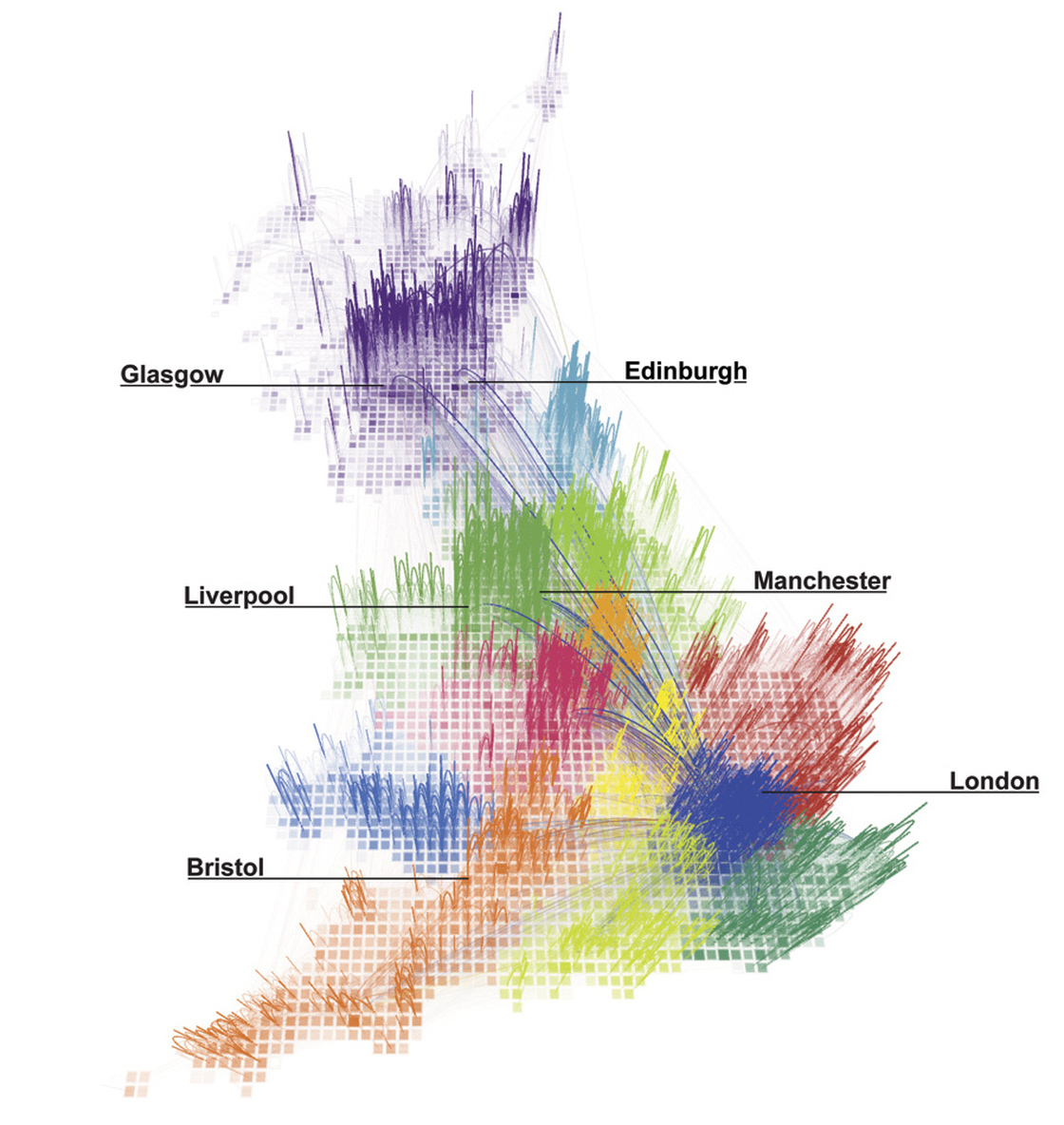
On the other hand, the political map of Great Britain, a much older country, tends to correlate somewhat better with the country's political map:

British Phone Map

The map actually looks somewhat similar to the Anglo-Saxon and Celtic kingdoms that existed before the Danish invasion in the 9th century CE:


I wonder if these patterns correlate with geographic features or just with traditional established economic centers.

But another, much stronger, point that immediately jumps to one's attention is that thinking of communities in terms of little bounded areas with well-established lines is silly. At best, the lines are very fuzzy. But it's also the case that the communication between people, especially in our times, is so fluid, dynamic and far-ranging that thinking of nations and communities in terms of boundaries seems unjustified.

Much better to think of them in terms of connections that unite people rather than borders that divide them:

Long Distance Map

Sunday, April 21, 2013

Meta-meta-ethics


(NOTE: for those who don't wish to read my summary of moral intuitionism, skip till after the second set of asterisks.)

I wish to propose a meta-meta-ethical view that will give reason for existence of meta-ethical theories.

What does that mean? Well, ethics asks evaluative questions. Such as: "What actions or circumstances are good or bad?" and "What actions or circumstances are right or wrong?"

Meta-ethics asks questions about the nature of evaluative truths. What is good and bad? What is their nature? What do we mean when we say those words (or should mean if we are to make any sense)? How do we know what actions are good or bad? How can we find out?

A meta-meta-ethical analysis asks what the role of making meta-ethical theories is. And how we know that those are true.

One simple answer is: by using reason. We can just see if a meta-ethical theory makes any sense internally. (Just like we would with, say, a geometric theorem.)

For instance, Kant says that a categorical imperative is a kind of imperative that would be binding on you if you knew it to be binding on everyone. Which you can verify by imagining a world in which such an imperative is not binding on anyone. Is this view coherent? Does it make sense? One can ask questions like: Well, yes, it makes sense that were absolute binding rules to exist, they would take form of categorical imperatives. But who says they exist? Also: how are we to judge whether a world in which everyone is free to lie or murder is a good world? Should we use our emotions? Why is that a good method for evaluating whether a world is good or bad?

In other words, we can test the internal coherence of a specific meta-ethical theory.

But people oftentimes don't do just that. They do that and they also test the conclusions of the theory. For instance: is torturing puppies for fun moral? Some might argue that it passes every one of Kant's moral maxims. Is lying to a Nazi asking you where the Jews are hiding immoral? Some argue that according to Kant's maxims it is immoral, and one shouldn't lie even in such a situation.

When people hear such conclusions, they infer that there is something wrong with Kant's meta-ethical theory. Or at least that it is incomplete. Because it leads to absurd conclusions.

But why should that be a test of a meta-ethical theory?

* * *

It seems that people already know what the correct moral answers are — at least in some cases. Even without having a coherent meta-ethical theory on their hands. How do they know? And if they do, what's the use of having meta-ethical theories?

Well, this is where the theory of moral intuitionism comes in. I've discussed it before, and I was introduced to it through writings of a moral philosopher Michael Huemer (whose book, Moral Intuitionism, I am currently reading and recommend to everyone interested in the subject), but, briefly, the idea is that there are moral truths about the world and our actions which we perceive intuitively.

What are these truths metaphysically? I haven't read that far in Huemer's book yet, but from his essays, it seems that he believes that the answer doesn't make sense. It assumes that moral truths must be defined in terms of some other set of truths, like natural truths. But, first, this would defy Humean is–ought gap, and, second, there is no reason why we cannot think of moral truths to be a separate set of truths, besides the natural ones.*

(I expressed my frustration and skepticism with this analysis before and offered an alternative explanation as to the metaphysics of moral truths. But I will leave that issue alone for now. And I am not completely sure I was right.)

How do we know about moral truths? Well, we perceive them. Intuitively. We have a perceptual modality called moral intuition, and through it we perceive certain actions as "choice-worthy" or not. And the idea called phenomenal conservatism says that unless we have a good reason to do otherwise, we should take our perceptions seriously. Because: well, they are there. We know about them. That is some sort of knowledge. Unless you have another sort of knowledge (usually from other perceptions) that denies this knowledge, it seems unreasonable not take the latter seriously.

* * *

So, how can moral intuitionism be a meta-meta-ethical theory? Doesn't it sound like a meta-ethical theory in itself?

Well, to answer this question, we have to humble ourselves a little regarding our physical and mathematical theories. We perceive physical and mathematical "truths" to be exactly such: true (we hope). Of course, with physics, we often re-evaluate our models later. And then again. With math we don't re-evaluate them, but we just make new ones if we need to. (So, in physics, "F=ma" is corrected by Einstein. In Math, Eucledean geometry exists in parallel with Riemannian geometry.)

But perhaps another equally correct way of thinking about both physical and mathematical models is not in terms of their absolute truth (or a degree of approximation thereof), but in terms of their usefulness. It is useful to imagine the world being countable in discrete numbers. It is useful to imagine shapes of all objects as being drawn on a sheet of paper. It is useful to think of the world as full of moving particles.

Until it's not useful anymore. And then, on that level, we apply a different model. What do I mean by "useful"? Useful in what sense? Only in the sense of explanatory power. I can explain how heat flows from one room to another if I model it in terms of many particles' kinetic energy. Such a model is more useful than one having some mysterious substance phlogiston flowing from one place to another, because the first model fits and predicts more observable phenomena.

The same goes for physical concepts like field, mass, energy, force, spin, voltage, and so on. They are just lego pieces that we invented; a perceptual glue to hold our observations together and make them fit into one shape. It's not really clear to me, for example, whether field really exists out there, as a property of space, or whether it's just something we made up to explain charged particles' behavior when they are a certain distance from other charged particles.

Why do we need the models? Because we can't observe all aspects of nature directly. So, we must deduce existence of something from those observations that we can make directly. And those deductions must be judged in terms of their usefulness in terms of their predictive and explanatory power.


What does this have to do with ethics? Well: I know it's wrong to kill humans out of pure convenience (or to prevent inconvenience). I know it's wrong to kill newborn babies. I know it's not wrong to kill one's cancer tumor (lo aleinu) or remove a mole. All these things I know from intuition.

I don't know whether it's wrong to kill fetuses. That's a gray area for my intuition.

For that reason, I need to construct a meta-ethical theory that will somehow incorporate my intuitive knowledge about ethics of "everyday" killing and will give me an answer about the morality of abortion. The data for this theory (that will either verify or break it) will be the moral facts I already know intuitively.

For instance, if we say that it's wrong to kill someone because you're extinguishing consciousness, then it seems OK to kill a fetus before his nervous system is developed enough to be conscious. Well... is it moral to put someone under anesthesia? Is it moral to kill someone, once he is under anesthesia? The answers to these questions seem intuitively obvious, and these answers break the "extinguishing consciousness" theory.

Note that "extinguishing consciousness" theory is not itself internally complete. It doesn't explain why extinguishing consciousness would be wrong. It only attempts to systematize our existing beliefs in some cohesive whole and make predictions about moral truths not immediately accessible to our intuition. Unfortunately, as I said, it is not a good meta-ethical theory, because it is broken by the data: our intuitive knowledge.

This way, moral intuitionism serves not only as a meta-ethical theory (it explains about the nature of moral truths and how we are to know them), but also as a meta-meta-ethical theory: it explains how meta-ethical theories can be useful even if we are not to think of them as "real truths" as opposed to mere models.

_____________
* Also, as an aside, if someone asks you: "What is water?", the most straightforward answer is: "What I perceive to be water: a clear, odorless, tasteless, drinkable liquid, with certain observable physical and chemical properties". Based on those characteristics, I know I am dealing with water.

If you answer: "Well, water is H2O", that invites the question: "What is hydrogen? What is oxygen? What are atoms?" You can explain in terms of electrons and protons, and so on... but eventually you will have to stop. You will have to say that there is a set of phenomena in the universe that behave a certain way, but why they behave that way we don't know for sure yet.

So, does this mean that you fundamentally don't know what water is? That seems strange. Also, imagine that — as unlikely as it sounds — it was proven that actually water is not H2O and H2O is not water. What would that mean? Would we continue calling the H2O water? Seemingly not. We would continue calling water the phenomenon of clear, odorless, tasteless, drinkable liquid that freezes at 0 degrees Celcius.

Basically, this analysis shows us that our perceptions are not chopped liver. Now apply the same analysis to "what is good" and "what is evil", and the answer "that which I perceive as something that ought not be done in principle" doesn't seem so silly anymore.

Wednesday, April 17, 2013

Intellectual property and scarcity, part 2


(If you're too bored to read the whole post, skip to the summary at the bottom.)

In the first part I have briefly outlined Stephan Kinsella's argument against intellectual property (IP) that is very popular in libertarian circles. To recap, Kinsella states that property rights exist to resolve conflicts over scarce resources. Because information is not scarce (my use of an idea does not conflict with/prevent your use of the same idea), property rights do not apply to information; in fact, they create a conflict rather than resolve one.

I said that I would outline possible objections to Kinsella's approach in the next post. It will probably take at least two posts. First, let's list the two possible metaphysical theories of information:

1. Information is a bunch of platonic objects
2. Information is patterns of matter isomorphic to other patterns of matter (I will explain below what this means)

A platonic object is a hypothetical ideal object ("ideal" as in "idea", not in "perfect") existing either in a parallel realm or as a part of our reality. Whenever we access some information through a piece of matter, we are actually observing that object, either in its "pure" form, or somehow distorted. So, if a few mushrooms are arranged in a circle, there is a platonic circle which somehow communicates with the matter of the mushroom resulting in their arrangement in an approximation of the said circle.

Likewise, the idea of Middle Earth is a platonic object (either created or discovered by J.R.R. Tolkien). Every time someone reads The Lord of the Rings, he accesses the Middle Earth platonic object. Likewise if he writes a novel set in the Middle Earth.

The assumption that information is non-scarce (that Kinsella and other libertarians make in their anti-IP analyses) alludes to the concept of platonic objects. Each such platonic object is non-scarce in the sense that both I and Tolkien can use Middle Earth to write a separate book (after Middle Earth has been created/discovered). Supporters of IP claim that Middle Earth can be owned by Tolkien estate. Critics of IP claim that Middle Earth cannot be owned by anyone, since nobody may exclude someone else from accessing Middle Earth, precisely because it is a non-scarce object, and one person's use of it does not conflict with another person's use. In other words, a rule that would allow such an exclusion would be both immoral and illegal in the sense that it would go against the moral/legal purpose of property rights: to prevent conflicts over scarce resources.

* * *
Here is the first part of my critique:

Kinsella's argument is based on the acceptance of the doctrine of platonic objects. But why should one do that? Why not assume the alternative hypothesis: that information is not platonic objects but merely patterns in matter not separable from matter itself? Or, if you wish, information is a series of patterns isomorphic to another series of patterns. "Isomorphic" here means "corresponding" in such a way that someone can use set of patterns A to recreate or analyze set of patterns B. For example, sequence of nucleotides on DNA is isomorphic to a sequence of amino-acids in a protein. Note that this doesn't have anything to do with human brain; cells use DNA code to create proteins all the time.

This argument is much more straightforward in that it does not require assumption of religious-like concepts like Platonic objects. If someone believes in platonic objects, let him bring forth evidence of their existence. (I will deal with a religious assumption that platonic objects exist in the next post.) Likewise, if he believes that we live in a Matrix, and all information we have is owned by some Matrix machine, let him also bring forth that evidence. Prima facie, it seems that information is nothing but patterns of matter that can either be recognized by our brains (by creating a set of isomorphic patterns in them) or not.

(The burden-of-proof argument is significant, by the way. If someone believes that platonic objects exist, he must formulate exactly what they are and how he knows about them. It may still turn out, from his evidence, that they cannot be property. For instance, if platonic objects exist in a non-material world, created by G-d, then who says they are our property? They are G-d's property. To be sure, so are all the objects in the material world, but G-d granted people rights of ownership because of the scarce/rivalrous nature of the objects. My point is: we can't willy-nilly state some theory without looking at its context.)

* * *

Significantly, this means that information is scarce. Only one person can read a given piece of information in a given book. Or, at least, it is as scarce as the carrier of the given instance of information. And someone certainly can own information -- by owning its carrier. If I bought a book from you, I now own the ideas in the book: the specific patterns of ink that create isomorphic patterns in my brain. You don't own them, because you don't own the book (since I bought it from you).

Can I use these patterns to create new patterns? (Either by copying the book or by using its fantasy-land setting to write my own book.) Why not? I am using my property the whole time. The book and information within it is my property. The new book that I am writing is also my property: I am using my paper and ink (presumably). I can sell it to anyone I want, since it's my property.

So, this analysis still argues against IP. And to me it seems like a much more straightforward approach that does not require the mental gymnastics of scarcity and justification for property rights. (Which I will deal with in the next post.) It's not clear to me why Kinsella, who is an atheist (and writing mostly for an atheist crowd) does not use it.
* * *
One can probably also criticize the platonic model as somewhat vague and incoherent. Imagine I re-write The Hobbit, replacing each instance of "Bilbo" with "Shmilbo". Is my Shmobbit the same ideal object as Tolkien's Hobbit? What if I write a novel (as has been done) from the point of view of Orcs: in which the latter and Sauron are actually misunderstood fighters for freedom against the oppression of the West? What if I write a novel whose fantasy-land setting has Misty Mountains, but nothing else from the Middle Earth? How about the Misty Mountains and a forest called Lothlórien? What if in my novel, the plot is very similar to Tolkien's (someone goes somewhere to destroy some object of power), but doesn't use the same details?

You can perform this kind of mental experiments to see that the concept of platonic objects is too vague to be used successfully as a set of rules for allocation of property. But this analysis also demonstrates that even if the universe of platonic objects existed, its anatomy would be so vague and alien to our mind that it would be difficult to determine who owns what and to what extent. It would be like owning land whose borders sometimes expand and sometimes contract.

In the next post I will try to analyze what would happen if we were to overcome the problems of figuring out what exactly platonic projects are and if we had some source (e.g., a religious revelation) that told us that all information is actually a bunch of platonic objects.

* * *

To summarize:

In the first version of critique of Kinsella's anti-IP argument, I am stating that a much easier argument would be to ask: what exactly are we owning? What is that object? Where is it?

If we discover that there is no such thing as platonic ideal objects (or their existence is subject to burden of proof), then we have to identify information with its material carriers. I cannot own contents of something without owning also its carrier. The contents of something are merely the properties of that thing.

The fact that my key fits my lock is my key's property. The unique pattern of the key's molecules is mine as long as I own the key, because it is the key. (Sure enough, another pattern on another key is that key and belong to whomever owns the key. Even if it is "the same" pattern, in the sense that it can fit the same lock or can be recognized as the same by a human brain.)

Some people may be against this attempt of "isolating" where and what objects are. But I disagree. Perhaps as a scientist, I find it important to understand the nature and ontology of some phenomenon before we deal with it.

The same goes, for example, for numbers, rights, values, tastes, truths, etc. We must identify what they are exactly before we are to deal with them.

Sunday, April 14, 2013

Intellectual property and scarcity, part 1


(who owns Middle Earth?)

I have recently thought about Stephan Kinsella's core argument against intellectual property (IP) and whether it has a hole in it. I think it might not, if certain assumptions are made, but I will try to discuss my approach to the issue. This will also be a useful review of why intellectual property makes no sense.

First, let me outline Kinsella's argument:
Nature, then, contains things that are economically scarce. My use of such a thing conflicts with (excludes) your use of it, and vice versa. The function of property rights is to prevent interpersonal conflict over scarce resources, by allocating exclusive ownership of resources to specified individuals (owners). 
(Against Intellectual Property, p. 20) 
You can read the quoted essay for more details of the argument. Here is my understanding of what Kinsella is saying:

1. Some resources in nature are scarce: they can only be used by one person at a time.

2. Sometimes two or more people will want to use the same resource and will not give way to each other. This is called "conflict over scarce resources". (The conflict can be actual, with two people arguing, or theoretical: for instance, if I see a resource and want to know whether I have a right to take it.)

3. Property rights exist (as an aspect of both law and morality) to resolve conflicts over scarce resources peacefully. NOTE: this means peacefully determining whom the resource should "belong" to. Enforcement of that decision can be violent or not.

The last point is important. Assume someone disagrees to honor a certain determination of property rights. It seems that the rights-holder has, well, a right to defend his property. With force if necessary. (Or threat of ostracism. Or personal authority.) Point is: it's moral and legal for the owner to exclude others from use of his property.

4. Resources that are not scarce don't fall under above justification for property rights. In other words: if my use of X does not conflict with your use of X, then it doesn't seem like there is any conflict. So, what exactly are property rights to X supposed to resolve? What is the justification for you to prevent me from accessing X if my doing so doesn't prevent you from accessing it?

Now, let's look at what information is. Information is a non-scarce resource. If you describe a new method for getting rid of garden gnomes or a new fantasy land, and I gain access to that information (e.g., by buying your book in a store), why should you prevent me from using that information whichever way I want with my property? (E.g., printing out instructions in my book and selling them or writing a new novel set in the same fantasy land setting.) It's not like I am preventing you from using the said information for your purposes.

One quick objection is that my activity can lure some of your potential customers away. But: therefore what? Do you own your customers? Do you own their money before they gave it to you? Certainly not. Is it a loss to the original author? Well, it is in the same sense that the fact that I cooked tonight and didn't go out was a loss to whatever restaurant I would eat out at. (And if I ate at a pizza place, that decision resulted in a loss to the deli next door.) It's a loss from the estimated potential future profits. But potential future profits were not in your possession — that's why they were "potential" and "future". So, I didn't steal anything that you actually owned.

What IP laws do, therefore, is not protect from theft of actual property. Quite the contrary: they themselves create theft (if we define "theft" more generally as "violation of property rights"; such as "borrowing without permission is theft"). If I am not allowed to use my pen, ink, and paper to write a novel in a fantasy world invented by you (or, for that matter, to distribute the book I bought from you), my property rights to my pen, ink, paper, printer, hard drive, etc., are being violated.


That is the general outline of the anti-IP argument prevalent in the libertarian circles. I will discuss my slight objection — and the potential answer to it — in the next post.

Friday, March 15, 2013

Deontological vs. consequentialist ethics

Deontological = rule-based. Consequentialist = consequence-oriented. Or, deontological = focused on the means, whatever the end; consequentialist = focused on the end, whatever the means.

An absurd example of deontological ethics is making it a rule never to lie and not lying to a Nazi asking you whether you're hiding any Jews. The result (people killed) is intuitively recognized as horrific, but you have adhered to the rule you committed yourself to. The point of this ad absurdum argument is that not caring about the consequences, as long as you adhere to the rules, is sometimes ridiculous. Or, in Latin, fiat justitia ruat caelum (“let the justice be done though heavens may fall").

One can also think, of course, of consequentialist ad absurdums. For instance, one achieves some worthy goal through lying or bullying others: you invest your client's money into something against his wishes, and that earns profit for him. Yes, you have achieved a positive result, but you have done so through an immoral act. Or, for instance, if you see some guy who owns some land that he doesn't use or uses badly. You confiscate the land from him, pay him very well for it, and put the land to a much better use, enriching the community. The guy was paid more than he would ever earn, and everyone benefited so much, but you have violated his property rights.

So, it would seem that it's important to take into account both consequentialist and deontological approaches.

One way to reconcile them is to treat deontological approach as producing long-term consequences with certain high but not 100% probability. Deontological rules can be framed in terms of slippery slopes. On the other hand, consequentialist approach worries about short-term consequences that have very high, near-100% probabilities (such as someone drowning). Usually it's more responsible to worry about long-term over short-term consequences, unless short-term consequences are totally terrible (and possibly unforeseen or an exception/emergency). So, this is the way to frame the balance between them in consequentialist terms (long-term vs. short-term consequences). Deontological framing would be to make a rule: e.g., "generally speaking, we don't lie, unless lying can save someone's life." Or: "generally speaking, we don't break into people's houses, unless we need to save someone's life from a fire." Etc.

Things get turned on their heads when allowance to break the long-term rules for short-term emergencies gets confused for not caring about the long-term rules. It's like a cousin who asked to sleep on the couch for the night and stayed for a month. I.e., the time frame of both the rule and the consequences gets confused. For instance, "we can confiscate someone's house to pay for someone else's cancer treatment". (Note, also, how the usual criticism of libertarian arguments involves life-boat situations.)

Sunday, March 3, 2013

Riddles in the dark


I stated earlier a position that mathematical concepts are just our way of making sense of our internal logical reality, not so much making sense of reality "out there". I repeated this view in a later post, stating:
Mathematical truths are merely descriptions of the internal laws governing our processing of the world outside. Specific laws and notations of mathematics are our ways of making sense of the external world. To say that there are 10 bottles in a pack merely means to say that we have grouped the matter in the pack into 10 objects (per our definition of "ten" and "objects") in our heads. There is nothing more to it. 
The reason why Math is useful is because our brain can model the reality pretty well (at least to a certain extent), having been created/evolved for that purpose, and the brains of people are quite similar in this capacity, such that these models can be shared and mutually recognized as either true or false (or, rather, good predictors of reality or bad ones). 
 As a matter of support for this view, consider that mathematicians and physicists choose different kinds of Mathematics to describe the world. Eucledean mathematics can allow you to build a pyramid, but not circumnavigate the world. And Newton had to invent of a whole new set of mathematical concepts in order to prove his theory of gravitation. Same for Einstein: he had to adopt a radically new set of mathematical models to describe his view of the physical reality. 
 So, while the physical reality is "external" and objective, our ways of understanding and modelling it are internal and subjective, pure products of our minds.
Let me illustrate this point of view with a few examples:

* * *

What is 400+200? Most of you will say: 600.

But imagine we are on a sphere that is 1000 miles in circumference. Each of us can be at most 500 miles away from each other (half the circumference). Imagine we are standing on the equator of the sphere, and you start walking away from me along the equator. You are 200 miles away. Then you walk 200 more miles. How far are you? 400 miles.

Now, pay attention: you walk 200 miles more. How far are you? You may be tempted to say: 600 miles, but remember that the sphere allows us to be at most 500 miles apart from each other, along the surface of the sphere. What happened is that you reached the opposite end of the sphere and then started circumnavigating it back towards me, along the other side. So, you're still 400 miles away.

On such a sphere, 400 mi +200 mi = 400 mi, when measuring distance between two objects.

The same is actually true for Einstein's Theory of Relativity. Once you start moving really fast, the speeds don't add up as they do in our everyday reality and they can never add up above the speed of light, c. So, what is 0.6 c + 0.5 c? It's some number smaller than c.

And according to Einstein's General Relativity, sometimes 3-dimensional space curves.

* * *

Another example would be of a wall clock. According to wall-clock arithmetic, 11 o'clock + 3 hours = 2 o'clock. 11 + 3 = 2. One way to state this is that the number line of the clock is curved onto itself, such that 12 = 0.

* * *

Imagine a string of numbers:

N = 1 – 1 + 1 – 1 + 1 – 1 + 1 – 1 + ... to infinity.

Can we figure out what N is equal to?

Well, we can write N as:

N = (1 – 1) + (1 – 1) + (1 – 1) + (1 – 1) + ... = 0 + 0 + 0 + 0 + ... = 0

But, another, equally valid way of writing this is:

N = 1 + (−1 + 1) + (−1 + 1) + (−1 + 1) + … = 1 + 0 + 0 + 0 + … = 1

So, N is equal to both 0 and 1.

But, we could also say that:
N = 1 − 1 + 1 − 1 + …, so:
1 − N = 1 − (1 − 1 + 1 − 1 + …) = 1 − 1 + 1 − 1 + … = N,
1 − N = N; thus N = 0.5

So, we can get three different answers for N just based on the simple concepts of addition of integers and infinity.

* * *
Then there are statements like: "This statement is not true". Is the statement in quotation marks true?

There is the well-known case of Xeno's paradoxes which was solved through invention of Calculus.

And so on...

* * *

All these examples show that specific systems of notation and logic get us only so far. A specific method of "keeping track" of our internal world's perceptions of the outside works for only certain kinds of perception; other methods may be devised for different kinds, and even within the methods we already know well, there may be limits of their applicability.

I think it may be true that the reality "outside" has certain logic to it, and we are mapping out different aspects of this "grand-logic" in our head using many different kinds of "mini-logic". This doesn't just apply to Math, but to any kind of logic, symbolic and formal or not.

The point is that we must be prepared for the idea that there are "creases" in the outside's grand-logic where our internal mini-logics flow into each other (or transition sharply). There may also be areas of the grand-logic where "here be dragons".

Morality and neuro-porn


(parallel circuits of prefrontal cortex and basal ganglia)

I am reading a neuro-porn article about morality. Neuro-porn is a sub-genre of popular science in which writers use imagery or description of brain scans to strengthen a point. In this article, the author is saying that moral judgments are an illusion because certain brain areas light up when a person is making a moral choice. In particular, many of the areas responsible for sub-conscious processing of emotions.

Well, brain areas light up when I am trying to catch a ball or learn how to shoot an arrow from a bow. Does this mean that space and time also do not exist? Furthermore, some of those areas will be responsible for subconscious processing of emotions, because emotions (salience) are crucial for people to learn. When I used to learn algebra, I actually felt the numbers through emotions: there were tricky variables, benevolent ones, etc. Math may or may not be a product of my mind (corresponding to objective reality or not), but I think it's silly to say that mathematical calculations are merely emotions.

Yes, it makes sense that our brain would express moral valuations through a feeling of disgust. But that doesn't necessarily mean that our moral judgments are simply products of feelings. That's just the "language" of the brain. Sometimes our brain uses one set of qualia to represent another set of information. Pain (or taste) feels as hot or sharp. It doesn't mean that temperature, pain, acute tactile pressure, and taste are the same thing.

Also, one should not discount the idea that subconscious processing of values could elicit subconscious emotional reactions. Another brain area that lights up consistently during moral choices is medial prefrontal cortex (mPFC). It is the area responsible for planning and execution of actions, but also for thinking about different outcomes and switching between strategies. It is one of the most advanced part of the human brain phylogenetically. Is mPFC being driven by the emotional centers? Does it drive them? Is there a more complicated picture? The causality is not clear, and I don't believe the state-of-the art fMRI can reveal it.

Making sense of moral truths, cont.


Because moral truths must be truths about reality (as I have argued in my previous post) if we are to reject the subjectivist moral position, we have to define very carefully what we mean by saying that moral truths are objective.

We could mean that the moral truths are universal statements of goals. Subjective evaluative statements are statements of compatibility with subjective goals. To say "it's too cold in this room" is to mean "I want to feel comfortable, and in order for that to happen, the temperature in the room must be higher". Obviously, this is a subjective evaluative statement, since what's cold for you might be too warm for me because of our unique biology or mental reactions.

Saying "taking I-95 N from Boston is wrong" implies that you want to go south (e.g., to New York).

So, maybe all people have a certain set of goals, and to achieve these goals, they must do certain things having property of "good" and cannot do certain things thus having property of "bad". That would be interesting, but I don't think we would find such a universal set of goals for all humankind. In fact, quite the opposite: most people want to continue surviving and incur pleasure while staying away from pain. But what are we to do if people's goals intersect: i.e., if causing pleasure to myself will cause pain to you?

* * *

What else we got? Well, we could define good as "beneficial". For instance, something good for a bacterium is to avoid destruction. For every living being there seems to be a set of goods and bads. So, just like we can recognize that certain things are good for us in the sense that they allow us to survive and enjoy ourselves, there are things that are good for others, both humans and other living beings.

One problem is with defining what exactly good is. Ayn Rand famously said that only living forms have a choice between staying living and being dead. Dead matter is already dead: it has no choice about it.

But surely one could argue that there is a difference between being a magnificent stalagmite and a bunch of crushed rock. So, we can define "good" and "bad" in terms of order vs. entropy. Order means good. Destruction of something means increasing its entropy. (Another objection to Rand is that humans can have other choices besides being alive or dead, such as leading more or less creative or rational lives, enjoying oneself more or less, etc. Those are real choices, and it's not clear one set of choices — e.g., how much fun to have in one's life — must be more important than another — how long to live.)

The problem is that the obvious fact of life is that in order for anything to survive it needs to feed on something else. We have to destroy plants and sometimes animals to survive; the animals do the same. Even the plants feed on the products of our sun's continued destruction.

So, is it good for a bear to eat me? It is good for the bear; it is bad for me. The same is true in reverse. So, again, how are we to decide between choices of good and bad? Should I steal someone's umbrella? It's bad to do that to someone else; but it's equally bad to let me walk under rain without an umbrella. Which bad should I avoid? Which good should I choose?

I do not claim that there are no answers to these question. I am trying to show that simply defining good and bad as harm and benefit does not suffice.

* * *

One can go the route of moral intuitionists and say that "good" and "bad" are simple properties of nature as "red", "green", "hot", "cold" or having a certain electrical charge or mass or occupying certain amount of space. And we know these things simply from perception and do not have to define them in terms of anything else.

Here is my problem with this view of moral truths: it seems an intellectually arbitrary dead-end. All the physical qualities I listed above have relation to other events in the universe, can be investigated further, can be detected and verified independently. The same goes for mathematical truths, whatever one makes of them.

But if I am saying that "harming children for the fun of is bad; end of story", it doesn't seem like I can investigate the nature of this quality any further or connect it to other phenomena. I either believe it to be true or not. Maybe I can compare it with other similar truths ("Is it acceptable to allow three children of someone else to die at the cost of saving one's own single child?"), but it seems that the results of the comparison are themselves singular intuitive truths which one cannot investigate much further.

Also, this approach smacks of arbitrary ascribing of one's internal states to the nature without any way to verify the truth and validity of it. Imagine that I said that on a rainy day, the nature is sad, on a windy day it's angry, on a sunny day, it's happy, and early in the morning it's calm.

When asked what I mean by these things: are those the emotions that I feel, I would say, no, they are the nature's qualities. I can feel such emotions myself, but in this case, I am describing the states of nature. Well, do I mean that the nature feels those emotions? No, that's silly. I am just describing the nature's properties or some truths about nature, and no further definition is necessary. How do I know that the nature has these states? Why, I observe it. I already know what angry, happy, sad, or calm are from introspection. I can also recognize these qualities in nature. There are those that can agree with me, and there are those that cannot sense those qualities in nature; maybe they are psychopaths of sorts.

I think most people would find these descriptions not only somewhat silly, strange, and arbitrary, but also not very useful.

* * *

So, how do I personally define objective valuations? First, I want to return to the idea that a valuation is an expression of correspondence to some goal. Something is good if it allows one to reach some goal.

The goal itself may or may not need justification; it may or may not need be a part of another goal. For instance, I eat because I don't want to be hungry and want to survive. I don't want to be hungry because I don't want to suffer. My goals of not suffering and continuing to survive cannot be explained; they are what defines me as who I am.

Perhaps the latter point needs some work. Maybe it is wrong to define something as an end in itself or an axiom without a good justification. (Such that denying it would force one to contradict oneself, such as saying "I don't exist".) I do not know yet if one can apply this method to goals to verify which of them are "basic" (or "final") goals.

Be it as it may, let me quote myself from an earlier post:
How can there be an absolute, "objective" purpose to the world out there? I walk in a forest and see a beehive. My purpose for it is to eat the honey to satisfy my hunger. The bees' purpose is to keep the honey to feed their larvae. Maybe somebody else's purpose is to take the honey and sell it on the market. How can there be an "ultimate" or absolute purpose, independent of any agents, built-in into the fabric of reality of the beehive? 
Clearly there cannot be, unless there is one agent who imbues all reality with a purpose: the one who created and continues to create the beehive, consciously, willfully, and with a certain goal in mind (so to speak). I.e., G-d, [the Creator of the World, imbuing it with a purpose].
That is my definition of objective morality. It is that which corresponds with the objective, teleological end of the world, its purpose. Those who don't believe in G-d might believe in something like Omega Point theory, which states that the universe has a teleological purpose defined in its laws to which it tends. In that case, following that purpose is good, while going against it is bad.

I am not making this definition because I am trying to fit morality into religion. Simply all the other definitions do not make any sense to me. (And subjectivist morality contradicts my perception of  intuitive, non-subjective truths being real.) I may change my mind, but this is where my view stands at the moment.

Finally, I do not mean to say that the only way to know G-d's purpose for the world is through a revelation. Another way is, potentially, through intuition, one's "moral compass". It may or may not be a good way to know G-d's purpose in certain things, just like our eyes may or may not be a good way to gain knowledge about space, time, colors, etc.

I think one's moral landscape must consist of a symbiosis between one's knowledge of G-d's revelation of His desires about the world and one's moral intuition.

Saturday, March 2, 2013

Thomas Nagel and coherence of moral truths


I have recently read a couple chapters from Thomas Nagel's recent book, Mind and Cosmos. In it, he argues that neo-Darwinian evolutionary theory of the origin of life as we know it must be incomplete or altogether erroneous, because it cannot account for many aspects of our everyday lives, specifically the parts of what's commonly known as mind–body problem. Nagel focuses on the problems with providing a Darwinian account of the origins (and justification of) consciousness, cognition (including knowledge of mathematical truths), and moral values.

I don't want to discuss here the main thesis of the book. I just want to focus on Nagel's definition of moral realism and objective moral truths, in which he follows the tradition of many other moral realists.

According to Nagel, moral realism asserts that moral truths are not merely subjective experiences of individuals contingent on their personal preferences. Moral truths are independently real — and accessible to most individuals through reason. Furthermore, moral truths do not need to be defined or proven in terms of other truths (subjective or objective). After all, we cannot hold that every belief must be defined and verified through an infinite chain of definitions and verifications. That would be impossible and incoherent. Some ground-truths must exist simply because they must exist; according to Nagel's description of moral realism, that applies to moral truths:
[Moral] realism is not a metaphysical theory of the ground of moral and evaluative truth. It is a metaphysical position only in the negative sense that it denies that all basic truth is either natural or mathematical. [...] Value realism does not maintain that value judgments are made true or false by anything else, natural or supernatural.
The part in bold is what I am having a problem comprehending. But first, let Nagel continue...

He explains that, of course, our evaluation of certain events as good or bad requires our knowledge of those events. The fact that running over a dog for the fun of it is evil requires knowledge that running over a dog will cause pain, suffering, and death of a living creature for the fun of it. But knowledge that causing pain, suffering, and death to another living creature is bad is self-evident according to Nagel. It does not require knowledge of anything else.

So far so good. But then he elaborates on the bit in bold above. David Gordon, in his review of Cosmos, explains:

But is not moral realism exposed to a decisive objection, famously pressed by John L. Mackie? In suggesting that values are "out there" in the world, rather than human preferences or sentiments, does not the moral realist postulate "ontologically queer" abstract objects, unlike anything else in the universe? 
Nagel convincingly shows that this objection rests on a misunderstanding. Moral realism does not hold that there is, in addition to ordinary objects, a special class of metaphysical objects called "values." Rather, its contention is that moral reasons do not require reduction to something else in order to count as legitimate. 
"The dispute between realism and subjectivism is not about the contents of the universe. It is a dispute about the order of normative explanation. Realists believe that moral and other evaluative judgments can often be explained by more general or basic evaluative truths, together with the facts that bring them into play.… But they do not believe that the evaluative element in such a judgment can be explained by anything else. That there is a reason to do what will avoid grievous harm to a sentient creature is, in a realist view, one of the kinds of things that can be true in itself, and not because something else is true." (p. 102)

I.e., the statement that causing suffering and pain for fun is evil is not a statement about a law of the universe; nor is it a statement about one's mind (since that would make it subjectivist). It is merely a truth, in and of itself.

(Michael Huemer makes a similar point, but I can't find the quote right now. Perhaps I confabulated it.)

I find this position incoherent. All truths must be either truths about our mind or about the reality outside our mind. Take mathematical truths, for instance. What are they? Several views can exist:
Subjectivist: Mathematical truths are merely descriptions of the internal laws governing our processing of the world outside. Specific laws and notations of mathematics are our ways of making sense of the external world. To say that there are 10 bottles in a pack merely means to say that we have grouped the matter in the pack into 10 objects (per our definition of "ten" and "objects") in our heads. There is nothing more to it. 
The reason why Math is useful is because our brain can model the reality pretty well (at least to a certain extent), having been created/evolved for that purpose, and the brains of people are quite similar in this capacity, such that these models can be shared and mutually recognized as either true or false (or, rather, good predictors of reality or bad ones). 
 As a matter of support for this view, consider that mathematicians and physicists choose different kinds of Mathematics to describe the world. Eucledean mathematics can allow you to build a pyramid, but not circumnavigate the world. And Newton had to invent of a whole new set of mathematical concepts in order to prove his theory of gravitation. Same for Einstein: he had to adopt a radically new set of mathematical models to describe his view of the physical reality. 
 So, while the physical reality is "external" and objective, our ways of understanding and modelling it are internal and subjective, pure products of our minds.
Realist: The above view is ridiculous. Yes, the specific ways in which we measure and analyze the world and perceive the logic of it are unique to our brains and products of them. But there must be some independent, external aspect of reality that these internal models are representing. That is why Fermat could predict certain property of numbers in his Last Theorem, and people could prove it after a few hundred years, in a book several hundred pages long, itself being a product of seven years' worth of research based on centuries of previous research.
That is why, just from knowledge of geometry and Calculus, I can figure out how tall the level of water (whose rate of flow I know) will be in a pool of known dimensions after a certain number of minutes. I can figure it out theoretically, without knowledge of empirical laws of physics, and then go back and observe my answer being correct in reality (as long as the measurements of the pool's dimension, the flow of water, and the time elapsed were approximately correct). How the heck can I predict something like that about the world outside of my head just through introspection about my own logic? There must be something more to it. 
Furthermore, mathematicians sometimes develop theorems that they think are purely abstract. Later it turns out that they can be useful in modelling the world. For instance, extremely abstract Riemannian geometry (developed in the 19th century) was found to be useful in the 20th century as a mathematical basis for Einstein's General Relativity Theory. 
This manner of consistency must result from something objective existing "out there", not just a subjective modelling of the world inside our heads, a merely useful way to keep track of all the geese in one's herd. Thus, mathematics must be a part of the physical world.  
(Incidentally, perhaps the reason why mathematicians can study this part "internally", without ever getting out and observing the world, is because their brains also operate according to the same laws of logic as the rest of the universe. Thus, lehavdil, "from my flesh, I envision G-d".) 
Mystic/Platonist: The realist is right that there is objective reality which mathematicians study. But he is not right that it is a part of the physical world. It is a part of some parallel world of forms, "on which" the matter of this world is built, in a manner of a matryoshka (Russian doll). There, the forms and numbers and other abstract truths exist in their pristine form. 
In our, material world, those "ideal objects" are forced onto the matter (or the other way around), such that we can still recognize them through reason and observation of the world, but we have to abstract them in order to mentally study their relationships in the world of forms. This is why we can make precise predictions about the extremely imprecise physical world. Our theories about it must be modified all the time, but not our theories about how to make mathematical sense of it. 
This is not because our subjective view of our internal world is so unshakably consistent and reliable (after all, psychological accounts of our internal world evolve constantly). Nor is it because our knowledge of the physical world is so precise (it is constantly corrected as well; in fact, some long-held descriptions of reality, such as Newton's Laws, are eventually proven to be incorrect or imprecise). It is because we can know the world of forms (by inference from the physical world or by internal knowledge through our souls) in a better fashion that we can know the world of the physical matter. There may be a kabbalistic reason for it (such as that the world of forms is one of the Worlds of Truth, while in the physical world, the truth is muddled up by the physical matter).

Whatever the correct view of the ontology of mathematical truths, as I said before, they must be truths about something. They must be a part of the reality: either a subjective part of our brains and minds (similar to tastes), an objective part of the physical reality (like laws of physics), or a part of some parallel non-physical world. To say that something is good, but mean neither that "goodness" is its realistic property nor that its my mind's reaction to it, is not demonstrably wrong or illogical; it's simply incoherent.

To be continued...

Thursday, February 28, 2013

Do ideal objects mean existence of soul?


I have recently heard a shiur by one rabbi which is a one of a five-part series called "Philosophical Evidence for Soul". This shiur was part 2 or 3, and the argument of the shiur can be briefly summarized as following:
We have access to knowledge of ideal objects. Those include numbers, imagined colors which we have never observed in real life, geometrical objects, and in general abstract ideas and logical concepts. 
All those things are not a part of the physical world, even though they can have a relationship with the physical world (e.g., objects can be counted using numbers). On the other hand, they do exist, and some of them (e.g., numbers, relationships between shapes) are necessarily true. So, if all there is to our mind is that it's a physical brain, then how can something physical know about something non-physical? Clearly, we need an organ that itself would be non-physical and allow us to know of non-physical (ideal) phenomena. Such as, for instance, soul.
I think this argument is flawed. Not that I disagree with the outcome, but I certainly disagree with the logic.

There are obvious immediate problems with this argument (why soul? why not another mysterious organ?), but I want to focus on the biggest problem with this argument: it misrepresents what ideal objects are.

I am going to spare you of a lengthy discussion of the history of this topic's philosophy and an outline of all the different views. I will just give you my own view, and you can judge yourself what you think of it. I will note that my description is limited to those things that we can observe with out own eyes and that everyone has knowledge of. I am not going to talk about angels, parallel worlds, souls, and other phenomena that I think exist but are not a part of our everyday experience. After all, the argument above states that we can deduce from our everyday experience that materialism is wrong.

The essence of my argument is that something physical can know about something non-physical. And there are things besides our brains that do so all the time. But, first things first:

It is true that physical objects are not the only phenomena out there. Or, rather, it is true that matter is not all there is to physical reality. There is also space. There is time. There are properties of matter, which consist of the ways that pieces of matter behave in space and time and the ways they are arranged. Let us call all those aspects of reality ideal phenomena. (I am just giving a definition.)

A few things immediately should be noted:

1. Ideal phenomena do not exist independently of matter. One can have mushrooms arranged in a circle, or chairs arranged in a circle, but there must be something arranged in a circle. (Now, I know that philosophers claim that there are circles existing as a part of our mind. And as ideal objects in Platonic sense. I am not talking about those right now. Actually, I will touch on the former soon. But, for now, I am just talking about physical phenomena as we think they exist objectively, by themselves, as a part of reality.)

2. Ideal phenomena are not the same thing as matter. As evidenced by the fact that I can arrange different pieces of matter in the same set of arrangement (e.g., I can arrange keys in a circle or mushrooms in a circle).

3. Ideal phenomena are not strictly nominalistic: they are not merely our own descriptions of the world out there. It is crucial to understand what exactly I mean:
  • I do not mean that circular and triangular arrangement are really "out there", the way we perceive them. I don't know what's really "out there", and I do not think it is a meaningful way to talk about the reality at all. I cannot know what's "out there" except through the way I perceive it in my mind. (Although I could compare my views of what's out there with others, including, potentially, aliens who may see reality completely differently from us. But then I would just know one or more ways of perceiving the reality, not the reality "itself".)
  • I do mean that there is something out there, independent of my mind, which I perceive in my mind as a "triangular arrangement" or "color of blue" or "a particular sequence of nucleotides of DNA". That something is distinct from my perception of it. And that something is distinct from the matter that I perceive it consists of.

    The proof that I have is that objects interact with each other independently of my mind, and can even use what we call information: DNA is the best example. Millions of cells in our body use the information of their DNA interactively and have done so before we came to exist. They used patterns of matter of their DNA molecules as a crucial aspect of their survival. They have evolved and continue to do so (micro, macro, whatever) using DNA.

    So, it's silly to say that properties of objects are only in our mind. Our perceptions of them are only in our mind. But whatever caused those perceptions is real, and it is really separate from whatever causes our perception of its matter.

So, what about our mind? What about ideal objects that the rabbi claims we perceive: the numbers, the imaginary colors, the geometrical objects? Well, in my opinion those are nominalistic. They are models of reality that exist in the patterns of our brain matter's arrangement and patterns of its behavior in space in time: what we can collectively call "mind".

To explain:

First, let us acknowledge again that information can exist outside of our consciousness. Computers store, use, and share information. So do living cells (including the non-neural ones).

Information is a representation of some ideal phenomena using another set of ideal phenomena. So, for instance, a specific kind of amino-acids that make up a protein is the protein's property, one ideal phenomenon that is associated with the protein's matter due to its matter's peculiar arrangement.

That property is represented in a sequence of nucleotides on a DNA (or RNA) molecule: a completely different set of matter arranged in a completely different way, but such that the arrangement can be used by the cell's machinery to build the protein. That specific arrangement of pieces of matter on a DNA molecule is information about the protein.

This example allows us to understand what mind is and how physical matter of the brain can "know" about the non-physical ideal phenomena of the world. It can do so by arranging itself in such a way as to represent those phenomena (the same way that nucleotides of the DNA are arranged to represent the sequence of amino-acids of a protein). That arrangement is itself an ideal phenomenon, an information.

That arrangement can be further used to do other things. Unlike DNA (to our knowledge), the brain is capable of making new information (new arrangements of matter) based on the patterns of old information which it used to represent the world's ideal phenomena. It does so to model the world and predict it.

That's what the brain does when it imagines a color that would be between two shades which it observed. It has three types of information stored in it:

a) color A: the representation of the ideal phenomenon that the brain perceived from the world outside
b) color B: ditto
c) color C: a modeled representation of what a color between A and B would look like if it were to exist

It is true that color C was never perceived from the "outside". But we should not say that it existed "somewhere" in some ideal realm. It was invented by the brain.


The same is true for numbers. Numbers are models that brains use to make sense of reality. To say that there are three apples on the table is not a statement about objective reality. It is a statement about our internal model of the objective reality. We perceived a bunch of matter out there and grouped it into separate apples. And we made sense of it by assigning the concept of "three" to the peculiar way in which we grouped the apples.

This is why children need to be taught math, even basic counting. Because it is not something that they perceive as a part of the world naturally, from birth. It is a way that they can model the world in their brains, and this particular way is useful for making all kinds of predictions about the world.

So, the "logical truths" and numbers and geometric objects all come from "within", not from without: neither from the physical world nor from some ideal, spiritual Platonic parallel universe. The reason we can share that information freely with each other (and why Mathematicians get paid salaries) is because our brains are similar enough that, with enough basic training, arranging and modelling our perceptions of the world into numbers or abstract geometric shapes comes easy to us. (Some of it. Some people have very difficult time understanding higher-level mathematical concepts. Which is why most people don't use algebra, calculus, differential equations, or multi-dimensional topology in their everyday lives. Only certain professionals do.) The fact that our brain is so flexible in its modeling of reality and imagining different concepts (some having nothing to do with reality) is probably to blame.

Also, although it is quite mysterious that mathematics is so useful for predicting the reality,
we must realize that:

1) mathematics really merely organizes our internal representations of the reality (i.e., 2+2 always equals 4, because our brains are consistent in how they use the concepts of "2", "4" and "+" and how they apply those to understanding of reality),

2) the specific form of mathematics we have chosen is one that predicts reality well. We may have chosen other systems.

A better question is: how come our mind can predict reality so well, using the systems of abstraction that it creates? But that's another issue. (Isaac Newton would say that the answer is that the world was created by a rational G-d who imparted some of that rationality onto us, creating us in His image. But some people today would say that the brains simply evolved to do so in their environment.)


This is not to say that souls don't exist. I believe that souls exist, but that they belong to a third class of phenomena (besides the matter and the ideal phenomena): the spiritual "objects" (again, it's just a working definition). And that is another story.

And this is not to say that our knowledge about the brain and the physical/ideal objects explains consciousness. I don't think it does (yet). And that (which is part 1 of the rabbi's series) is a valid critique of materialism. But that is also another story.

Tuesday, February 19, 2013

Divine Command and Euthyphro dilemma


Background

What makes something moral? What is the nature of morality?

There are many answers given by philosophers. They range from answers by moral realists (different variations of "morality is out there") to moral subjectivists (different versions of "morality is each person's personal taste"). There are a few other brands and some groups in between (e.g., cultural relativists who assert that the morals are societies' norms, and in that sense they are objective and "out there", but, they can differ from society to society and in that sense they are subjective), but those are the major divisions of views.

Divine Command and Euthyphro dilemma

Then there is a view that morality is equivalent to Divine Command (DC). That morality = Will of G-d. It can be classified as either objective or subjective (I prefer the former logically). There are a number of "external" objections to the DC, such as "how do we know that G-d exists" which I will not address here (see this, for instance).

I have read about an "internal" objection called Euthyphro dilemma, named after a character in Plato's play, which can be summed up as:
Is what is morally good commanded by G-d because it is morally good, or is it morally good because it is commanded by G-d?
Possible answers

Well, let's look at the options:

1. That which is morally good is commanded by G-d because it is morally good.

This is a problematic answer for a number of reasons:

a) It doesn't really give an answer about the nature of morality. G-d wants that which is morally good because it is good, but why is it good and what makes it moral? We are back to square one. If this were the essence of DC, then DC could not be a valid moral theory; it would be just a confirmation that G-d cares about morality.

b) This answer contradicts the very definition of morality. DC cannot logically tell us we should do something that we know is moral because it is commanded by G-d. Morality by definition is "that which ought to be done". So "because it is commanded by G-d" is superfluous as the impetus for doing morality. If we already know what is moral, we don't need to be told that we need to do it because X . We already know we need to do it.

(I.e., this argument is the flip-side of the previous one.)

c) This definition implies that there is something binding on G-d, which is problematic for a number of theological reasons (which I won't discuss in detail here) such as: primacy of G-d, omnipresence of G-d (not just physical, but logical), and omnipotence of G-d (ditto). I.e., G-d must precede all concepts, cannot be dependent on any concepts, and must be "found" in all concepts (the last point is controversial according to some schools of thought, but suffice it to say that I wouldn't eat their shechita).

So, what's the other option?

2. It is morally good because it is commanded by G-d

Let us define very clearly what might be meant by this statement. One possibility is that to find out what is good, one needs to ask G-d (or see what G-d told others, if it's applicable to one too).

I don't think this definition is logically problematic, but it is empirically problematic. I.e., if we look at Jewish tradition, we find that there are indications that humans (and Jews in particular) should know already what is moral, even without having been told by G-d. For instance, there is a statement by one of the meforshim that someone who has to pay his wife a kesuba doesn't only need to depend on what it says in Torah. He must know by himself that he has to pay the kesuba because he made a promise.

There is a statement that even if mishpotim were not given, one would be able to learn them oneself.

There is a sense, from learning various Jewish texts, that rabbis already have a sense of justice and morality independently of Torah. In fact, oftentimes, Torah is tested against those concepts: one asks, how can Torah prescribe X, or how can G-d do Y, and then people answer, revealing that in fact X and Y do not contradict our concepts of justice and morality. Why don't we merely say: "Don't asks stupid questions. Whatever G-d decided must be just by definition." (Similarly to someone who might say: "He who made oil burn will also make vinegar burn". I.e., don't ask how G-d can violate laws of nature: He created them!) It is assumed not only that Torah and Hashem must behave according to the concepts of morality (which is another issue, to be discussed below), but also that those concepts are known to us already.

Finally, it seems that Torah does not have a very detailed discussion of morality like it does, say, of laws of tefillin. Certainly there are moral statements in Torah and certain prescriptions pertaining to morality (such as laws of visiting the sick, loshon ho'rah, business dealings, etc.), but the general discussion of morality seems to be lacking. (Maybe I am wrong.)


(There are concerns brought by philosophers that usually rely on intuitionist moral conservatism: i.e., taking our moral intuitions seriously. The concern is usually voiced as: "If G-d told you to torture someone, would you do it? Would that make it moral?"

I don't think this is a valid argument because it presupposes the truth of moral intuitionism. The argument assumes that we know what is moral from our intuitions, and then finds a possible contradiction between that morality and DC-produced morality. But that basically amounts to saying: "I think DC is wrong because I think we know what is moral intuitively." I would classify this as an external critique of DC, not an internal one, and I am not completely sure that the intuitionist approach could defeat DC on these grounds.

In fact, it could probably be defeated on its own grounds: if we have two intuitions, one telling us directly that X is wrong and another telling us that we know that G-d told us X is right, we should probably trust the second intuition and assume the first one erroneous. If the first intuition is strong, we can double-check the second one multiple times to make sure that that is indeed what G-d said and there is no room for mistake, but once we are assured of that, we should probably go ahead and rely on the intuition telling us that X is right.

This is no different in principle from observing by eyes that a lake is shallow, but some independent measurement telling us that the lake is indeed very deep. If that happens, we should probably double-check the measurement, but, as my boss says, the data are what they are.

Which is not to say that intuitionism is useless. Keep reading.)


The Verdict

What does this mean? Well, I think it means that while we might identify the commandments that G-d gave us directly as moral imperatives, we must have an independent way of identifying the "regular" (mishpotim-like) moral truths.

So, actually I think one might say that intuition is actually a good source of morality. I have been exploring this idea recently and have found myself growing more fond of it. (I have discussed it here and here.)

But does this mean that DC has failed? I think that there can be an intermediate solution: We can identify morality as G-d's will, but say that it is not discoverable (only) directly as G-d's will. To quote myself:
We might say that our intuitive feeling of goodness is one of the good's principia cognoscendi (its giluim): the qualities by which it can be recognized (the other being the fact that G-d told us that he wants it to be done). On the other hand, the fact that good is G-d's purpose for the reality is good's principium essendi (its atzmus): the description of what it is
One can still identify good or bad through his intuition, not only through Halacha; I am just explaining what it is that he is identifying. (Likewise a physicist might explain that when I feel cold, I am sensing indirectly the average kinetic energy of molecules around me.)
This also solves the problem of whether G-d can order us to do something which we will intuitively feel as wrong. One might say that no. My wife recently gave me the following argument of why Halacha cannot contradict morality:


Both Halacha and morality are prescriptive systems (they tell us what we ought to do). Both come from G-d (because everything comes from G-d). Presumably, G-d cannot at the same time want us to do X (according to Halacha) and not want us to do X (according to morality). Therefore, Halacha can never violate morality.

(Importantly, I don't think one could argue that everything comes from G-d, but not everything is allowed by Halacha or morality. Our animalistic urges, although they come from G-d, are not binding on us. But morality is, by definition. So is Halacha.)

So, what happens if G-d tells one to sacrifice our child? Well, that's like asking: if Earth's magnetic North and South shift places, where will the needle of a compass point? Well, obviously to the new location of the North, the former South pole. Now replace the compass with intuition and North with good, and you get the analogue.

This is assuming that one's intuition picks up good automatically (sort of like compass points to North automatically). It could be that G-d set up our intuitions to work a certain way (or even that they developed biologically in a certain way — although that would amount to the same) which is more rigid. After all, our sensory perception is rather rigid: this is why we get optical illusions. But we have a way of dealing with illusions, as mentioned above: just compare them to observations from other, more reliable, sources.

So, it is possible that we might feel intuitively wrong to do X but at the same time know objectively that G-d commanded X. Some sources say that this is how Abraham felt at the time he was commanded to kill Yitzchok. He felt intuitively that this was wrong, but he also knew intuitively that G-d told him to do so. So, he figured that the second intuition makes more sense to follow.

(In our times, the situation regarding child sacrifice is actually reversed. If you have a strong intuitive feeling that G-d is telling you to kill your children, check yourself in to a mental health facility. This is because we know that G-d doesn't want us to kill children and will never command us to do so. Therefore, whatever you feel like "G-d's will" is probably just an illusion or psychosis. Assuming one has not lost all his logical capacity, he can figure this out on his own by reminding himself that he is not a prophet.

On the other hand, this problem may be philosophically unsolvable. If I accidentally take a strong hallucinogenic drug and think my wife is a bear attacking me, I will have to defend myself. How am I to know better? (Remember that illusions don't just come as perceptions; they come with intuitive feeling of reality to them.) It seems there is nothing to be done in this case except to lock me up (hopefully temporarily, until the drug wears off). But it also seems I cannot be blamed for my actions.)


In any event, I think the above answers the Euthyphro dilemma to some extent.

Friday, February 15, 2013

Are moral truths objective?


In the previous post, I have assumed myself and relied on a proof by the philosopher Dr. Michael Huemer that moral truths are objective, rather than subjective. For instance, I believe that Hitler was objectively evil and that murder is objectively wrong, not that they are so only in the eye of a particular beholder. As I wrote:
Hitler was evil in and of himself, independent of anybody perceiving him as such and not in definition of the targets of his evil acts. I.e., that Hitler killed a lot of Jews was certainly bad for them, but we also think that the fact that he caused all that harm was an evil event in itself, not just from his victims' point of view (and not just because we fear that he or someone else might do the same to us, chv"sh).
Otherwise, it would be nonsensical to argue that murder is wrong: after all, if it's only wrong subjectively, from the point of view of the victim, then the victim is no longer there! So, once the victim is dead, the murder is no longer wrong, as there is nobody anymore to whom it could be wrong. But a murder is by definition murder only after the victim has been killed.
The best one could say then is that it's wrong because it caused suffering to the victim's family, but that is not what we mean when we say that the act of murder is wrong independently of whatever side effects it caused. I.e., yes, murder is wrong because it causes suffering to the living, but first and foremost it is wrong because it eliminates life — even of a completely useless person who has no relatives or friends. Likewise, we must distinguish between wrongness of murder and that of threat of murder.
There are, of course, those who disagree that Hitler was objectively evil. In my opinion, they are objectively wrong, just like those who think that moon is made of cheese, but our disagreement is not subjective. My disagreement with my wife over whether fish tastes good is, on the other hand, subjective. Neither of us thinks that it is an independent property of fish to taste good or not; we think that tasting good/bad is a unique reaction that fish produces in our brains/minds.

Dr. Huemer attempts to prove objectivity of moral truths in his essay Moral Objectivism. I urge you to read it carefully to judge for yourself whether he is successful. But I also wanted to quote a summary of his argument from another paper on moral objectivism:
[Claim:] Moral values are objective. That is, they really exist, and are independent of observers.
I have discussed this issue at length elsewhere and do not wish to repeat myself (at least not very much), so I will just review briefly two general reasons for this opinion. First, and most importantly, I think it is essential to our common sense conception of morality. When we contemplate or discuss moral issues, we normally experience ourselves as exploring a subject, debating matters of substance, and trying to make the correct judgements about them. Nor do we think that our obligations (etc.) depend on our or anyone's beliefs about them. We do not, for example, think that one way to solve all the world's problems would be for everybody to get together and agree not to consider anything bad anymore. We don't think, for instance, that one way to eliminate all oppression would be for a sufficient number of people to say, "There's no oppression." 
Therefore, we think that the evil (and of course the same would be true of good) exists independently of what observers say or think. And I think that one always ought to assume that things are the way they appear, until they can be proven otherwise. [Emphasis added — AC.]
Second, moral objectivism (like objectivism in general) seems to be entailed by the law of excluded middle and the correspondence theory of truth, along with a couple of what seem equally obvious observations about morality:
(1) There are moral propositions. 
(2) So they are each either true or false. (by law of excluded middle) 
(3) And it's not that they're all false. Surely it is true, rather than false, that Josef Stalin's activities were bad. (Although some communists would disagree, we needn't take their view seriously, and moreover, even they would admit some moral judgement, such as, "Stalin was good.")
(4) So some moral judgements correspond to reality. (from 2,3, and the correspondence theory of truth)
(5) So moral values are part of reality. (which is objectivism)
I don't know if a typical subjectivist would try denying (3), but if so, then to resolve the dispute, what we have to do is weigh the plausibility of the most plausible moral judgement there is (since he claims it is false) against the plausibility of whatever argument he produces (assuming he has one). For instance, suppose that the most plausible moral judgement you can think of is "It is wrong to torture people just for the fun of it;" and suppose that the subjectivist claims that this is not true; and suppose he claims it on the basis that the existence of moral values is incompatible with logical positivism. Then what we have to ask is: Which do we find more plausible, that it is wrong to torture people just for the fun of it, or that logical positivism is true?
This is just an example of the sort of difficulty the subjectivist or skeptic will get into, which convinces me that no argument against objectivism could possibly discharge its burden.
In other words, what Dr. Huemer is saying is called phenomenological conservatism (in this context: phenomenological = pertaining to our observations; conservatism = taking stuff seriously). Which means: if you see that an apple is round, unless there is a good reason for you to think otherwise, you can assume it's round. If you think there are ten bottles left in a pack after you took out two of then, you should treat that thought as a fact, unless someone demonstrates to you that your math or knowledge of facts (e.g., someone taking a bottle without you knowing) are wrong.

The same goes for moral knowledge: if we know that Hitler was objectively evil (because we perceive him to be evil), then unless some other observations tell us otherwise, we should assume he was objectively evil: that he had a property of evil to him (or his actions). In Moral Objectivism, Dr. Huemer refutes a number of subjectivist arguments against objectivism: for instance, that our feeling that Hitler was evil is just an emotion. He says:

Call the first the appeal to introspection. The making of a normative judgement is experienced as just that — making a judgement: i.e., as a matter of good phenomenology, when one considers a moral issue, it seems clear, one is engaged in that mental process known as judgement; one is not primarily engaged in imagination or memory or perception or feeling (though those may accompany the process of judgement, of course). And I think that everybody can see this if they think about it — that is why moral judgements are, after all, called "judgements". 
If someone reports that when he introspects he does not ever detect a process of judgement going on where morals or practical matters (meaning matters of what to do) are concerned, then in the first place, I won't believe it, and in the second place, if I did then I would conclude that the unfortunate fellow is simply unable to grasp moral concepts and is therefore unable to think about them — I would conclude that he is moved by emotions and instincts rather than reason and morality. Moral concepts and arguments are as a rule highly abstract, and the existence of such people as cannot understand them is certainly not inconceivable. Animals are most likely all in that position.

In other words, upon introspection, moral judgments don't "feel" like emotions, projection, social norms that you liked, etc. They feel like judgments: perceptions about reality no different in principle from judgments like "there are ten bottles in the pack" or "apple is round". And, unless there is a good reason to disbelieve this introspection, then we should continue believing it.

You may ask: if moral truths are truly objective, then how do we come to know them and how to we verify that our knowledge is correct (after all, people disagree on morality — even  objective morality — all the time). And isn't there a pernicious is-ought problem that prevents us from deriving any ought statements from is observations of the world?

Dr. Huemer's answer is that we come to know the moral truths intuitively. In a sense, moral knowledge is the sixth sense. Dr. Huemer defends this view in this and some other essays, as well as one of his books, Ethical Intuitionism.

The famous libertarian-anarchist economist and legal philosopher David Friedman also touched on this subject:
Let me suggest an analogy that I find informative. Think of moral intuitions as playing the same role in our knowledge of normative propositions that sense data play in our knowledge of positive propositions. 
The way we choose scientific theories is precisely by taking our sense data as input and trying to make sense of what they tell us. And it would seem very odd to argue that "it is not clear why we need theories at all: we can just consult our sense data" for understanding the world. For one thing, having formed theories, we sometimes use them to conclude that we ought not to believe particular sense data. [...] 
For me, at least, the crucial step to making this account plausible was realizing how shaky the basis is on which we accept our senses' account of the physical world (to the extent that we do). While the grounds for belief in physical objective reality—more precisely, in an objective reality reasonably close to what our senses report--are not as strong as they might at first seem, they are, in my view strong enough. The grounds for belief in a normative objective reality are not, in my view, enormously weaker. [...] 
If you take the sixth sense analogy seriously, the next step is to ask why you believe the other five senses. The answer is not "because I understand how they work." To begin with, you probably don't, and even if you do, Aristotle certainly didn't—and none of us are willing to argue that he ought to have denied the evidence of the senses. 
You believe your five senses because you have imposed on them all the consistency tests you can think of, and they have mostly passed. You see something, your eyes tell you an object is there, you reach out and sure enough you can touch it. The thing is a bell. Last time you tried hitting a bell your ears told you there was a sound; you try it again and it still works. 
Occasionally there is an apparent contradiction—you can't touch a holographic image, and when you hit a holographic image of a bell it doesn't make a noise. But as you get farther and farther into the structure of the physical world revealed by your senses more and more of those contradictions turn out to make sense after all. 
A second set of tests occurs to you. Your senses tell you that other people are very much like you. If so, they should perceive the same physical universe. You ask them, and sure enough they almost always do—again with very rare exceptions such as color blindness, exceptions that turn out, on further examination, to make sense. 
Note, however, that what you are finding to be consistent is observation of very primitive facts—there is a table there, there is not a lion sitting on the table. About the patterns implied by those facts—for example, whether capitalism or socialism results in higher standards of living, or whether the earth goes around the sun or the sun around the earth, or whether paying enough money to the Church of Scientology will turn you into a superman—there is lots of disagreement. 
You conclude that your senses give you a reasonably accurate picture of the base facts of physical reality, consistent with that of almost everyone else, but that reasoning up from there is sufficiently hard, and/or depends sufficiently on the particular subset of facts observed, so that people disagree a good deal—and your confidence about your beliefs on that level should be appropriately weaker. You accordingly conclude that the physical universe is really out there, and the parts you have observed really have about the characteristics you observe. If someone tells you that there is a lion on the table you conclude he is a lunatic. If he is very convincing, you ask a few other people first and then conclude he is a lunatic. 
Now apply the same approach to moral reality. Replace sense perceptions with moral judgements—not grand theories such as "you should never violate rights" but "perceptions" such as "in the following well described situation, person X acted wrongly." Checking with other people you find, pace the ethical relativists, a very high degree of agreement. The disagreement either involves the sort of situation that, on consideration, you find morally difficult or (far more often) disagreement about the assumed facts, not the judgements. 
Some people will find this claim implausible. I offer as one of my reasons for it the following observation: 
I have been arguing politics for a long time. In arguing with people on the left, I find it is very hard to come to an agreement on the assumed facts surrounding the situations we are judging. My imaginary capitalist has capital because he worked hard clearing part of the boundless forest while his employee-to-be was being lazy and living on what he could gather—so it is entirely just that the capitalist gets part of the output of his land and his employee's labor. But the leftist doesn't like that hypothetical. His imaginary capitalist inherited his capital from a father who stole it. I don't like that hypothetical. I conclude that our moral intuitions are similar enough so that the same assumed facts push both of us in the same direction—and since we want to go in opposite directions we want so assume different facts. 
My (very tentative) conclusion is that the normative universe, like the physical universe, exists. Certain ought statements are true, certain ought statements are false. Torturing small children for the fun of it really is wicked. I cannot go behind that and explain "ought" as derived from "is"—or "is" from "ought." Both are undefined terms, which I am confident that normal human beings understand. I can observe "normative facts" and try to form theories about them, just as I can observe physical facts and try to form theories about them. But I should not be surprised if other people form other theories in both cases.