From Boston Legal, a conversation between Allan Shore’s secretary, Catherine Piper (above), and the firm’s client, Bernard Ferrion, who has recently commited two murders (one against his mother, another — against his only friend, an elderly neighbor):
— All I’m saying is: if you killed two people and if you’re as alone as you say, there couldn’t be a better time for you to turn to Jesus Christ, your Savior. — Under normal circumstances I’d agree. — But?.. — I’m Jewish. — Bernie, there has never-ever been a Jewish serial killer. — Son of Sam? David Berkowitz? — He was adopted. Genetically, he’s one of ours. — Well, what are you saying? — I am saying that if you’re out there murdering people, on some level, you must want to be Christian. Would you let me take you to church?
(Update: Catherine Piper ends up killing Bernie with a skillet, when she realizes he is too evil, and stores his body in a freezer in her basement.)
Once, when Beatles were recording a new song of theirs, “While My Guitar Gently Weeps”, they were disturbed by a profusely hung-over youngster Eric Clapton, who, having lost control of his actions, grabbed George Martin’s guitar and played a solo on it. George declared that he wasn’t about to spend his own money on recording the song over again, and Beatles were forced to leave the recording as it was, with Clapton’s solo in the middle of it.
Paul McCartney then asked Clapton: when had the youngster gotten so drunk?
— Yesterday! — answered Eric Clapton.
“Yesterday…” — thought McCartney. — “Why, that’s not a bad title for a new song!”
A classic work by Ludwig von Mises — for anyone who wants to understand what is going on on the market and general principles of economics. Liberate yourself from liberal (no pun intended) propaganda of socialist and Keynesian economics.
There is nothing mysterious about what Mises writes; you won’t have to take a leap of faith, abandon your ethical principles, learn higher Math, commit treason to your government, or worship foreign gods. It is all just common sense.
It is customary to (try to) forgive people who wronged you and ask others for forgiveness before Yom Kippur. Our actions “below” draw similar actions from “above”. But what does this mean — what is the point of forgiveness, whether between one human and another or between a human and G-d?
We forgive others because we realize that essentially we are one. One soul. One essence. And one cannot hate himself. (This, by the way, is the point of “loving your fellow as yourself”.)
The same is with G-d — we ask for His forgiveness, expect it and are granted it, because on Yom Kippur we reach the level where our essence is one with the Essence of G-d. There cannot be any separation, and, therefore, cannot be any grudges.
So, sins and offenses are not really “forgiven” — they simply loose their relevance, disintegrating in the unity of the offender and the offended, the soul and G-d.
The Great Depression was supposed to end in 1936, say two UCLA economists. By regulating the market, creating government-sponsored monopolies that reduced competition, and artificially inflating wages (and, therefore, prices), Roosevelt put a noose around economy’s neck and prolonged the depression, making it Great.
Is there anything we can learn from this? This morning, people on NPR wondered: why didn’t the bailout package work? Maybe not enough time has passed? Maybe it wasn’t enough? Maybe new government regulation policies are necessary — the ones that haven’t been invented yet?... This reminds me of bloodletting practice used before in medicine. Doctors and scientists (if they could be called so) misunderstood how the body works and thought that if you just release blood, it will release the disease with it. What it did, of course, was making a patient weaker and prolonging the disease. What would the doctor say if asked why the patient hasn’t recovered? Maybe not enough time has passed… maybe it wasn’t enough… maybe new ways of bloodletting need to be implemented.
“History teaches man that man learns nothing from history.” We already have a history of one Great Depression created by regulationist practices of the Big Government that kept pulling the hand-break higher and higher and couldn’t quite figure out why the car wasn’t going faster. The problem? They confused the hand-break with gearshift stick and didn’t realize that the car was automatic. Just let go of the big controlling lever, press the gas and let the car go into the next gear by itself.
“President Roosevelt believed that excessive competition was responsible for the Depression by reducing prices and wages, and by extension reducing employment and demand for goods and services,” said Cole, [a UCLA professor] of economics. “So he came up with a recovery package that would be unimaginable today, allowing businesses in every industry to collude without the threat of antitrust prosecution and workers to demand salaries about 25 percent above where they ought to have been, given market forces. The economy was poised for a beautiful recovery, but that recovery was stalled by these misguided policies.” [...]
In the three years following the implementation of Roosevelt's policies, wages in 11 key industries averaged 25 percent higher than they otherwise would have done, the economists calculate. But unemployment was also 25 percent higher than it should have been, given gains in productivity.
Meanwhile, prices across 19 industries averaged 23 percent above where they should have been, given the state of the economy. With goods and services that much harder for consumers to afford, demand stalled and the gross national product floundered at 27 percent below where it otherwise might have been.
“High wages and high prices in an economic slump run contrary to everything we know about market forces in economic downturns,” Ohanian said. “As we’ve seen in the past several years, salaries and prices fall when unemployment is high. By artificially inflating both, theNew Deal policies short-circuited the market's self-correcting forces.”[Emphasis mine throughout the quotes — A.]
The policies were contained in the National Industrial Recovery Act (NIRA), which exempted industries from antitrust prosecution if they agreed to enter into collective bargaining agreements that significantly raised wages. Because protection from antitrust prosecution all but ensured higher prices for goods and services, a wide range of industries took the bait, Cole and Ohanian found. By 1934 more than 500 industries, which accounted for nearly 80 percent of private, non-agricultural employment, had entered into the collective bargaining agreements called for under NIRA.
Cole and Ohanian calculate that NIRA and its aftermath account for 60 percent of the weak recovery. Without the policies, they contend that the Depression would have ended in 1936 instead of the year when they believe the slump actually ended: 1943. [...]
“The fact that the Depression dragged on for years convinced generations of economists and policy-makers that capitalism could not be trusted to recover from depressions and that significant government intervention was required to achieve good outcomes,” Cole said. “Ironically, our work shows that the recovery would have been very rapid had the government not intervened.”
What does this mean for us (in case you haven’t guessed yet)?
“Why the Great Depression lasted so long has always been a great mystery, and because we never really knew the reason, we have always worried whether we would have another 10- to 15-year economic slump,” said Ohanian, vice chair of UCLA’s Department of Economics. “We found that a relapse isn’t likely unless lawmakers gum up a recovery with ill-conceived stimulus policies.”
Oops… (By the way, the above article was written in 2004.) What is amazing is that nothing changed in seventy years: the government still thinks that it can make everything better by imposing new regulations on the market, and people think that giving out free soup is a solution to everything.
An excellent article by Rabbi Tzvi Freeman, which I always recommend to beginners in Judaism (and theology in general) asking a question: “What do you mean, we cannot know anything about G-d? Isn’t it practically the same as not believing in G-d?”
After reading this article, think about this: on Wednesday night and on Thursday, if you are Jewish you connect not to a “Fingertip”, but to the Beyond. On Rosh HaShana, you declared G-d the King — you do this by saying: “I will be one of your nation. I will connect my will to your will.” Rosh HaShana is not the day of Creation of the world; it is the day of creation of Human. Because the world was created for the purpose of Human forging a relationship with G-d — which is stronger, when it is done through the physical matter of the world (by definition, this world hides G-d; therefore, when you make the world a dwelling place for G-d’s Will, you reveal His Unity and Absolute Truth to the extent, which is impossible in the upper worlds).
On Yom Kippur, you are saying: We will not let the world be a barrier between me and G-d. The world is the interface; it doesn’t exist for itself. The descent I made into this seemingly G-dless world is to meet not the Manifestation of G-d, but the Essence of G-d itself. The descent of my birth was for the ascent achieved during my life. The descent of every sin I did throughout this year was for the ascent of teshuva that has an ability of turning a sin into a mitzvah: when I cry out from the distance from G-d (caused by my sin and by this world), the cry brings me closer to G-d than I was beforeI fell. (No, you cannot sin for the purpose of later teshuva — it doesn’t work that way.)
On Yom Kippur your sins loose their significance and existence, because you are achieving a unity of the Essence of the world, Essence of your soul and Essence of the Infinite G-d. Let it happen speedily, in our days, that we witness the coming of Mashiach and this unity becomes b’giluy — in a revealed way; both physically and spiritually.
See also this post on Simple Jew’s blog — what is taking shoes off on Yom Kippur all about? Where is the balance between being completely immersed into the world and being an ascetic removed from it?
Continuing the topic of similarity of iPhones and socialism: under socialism, things are given to you “for free”. Of course, you find out later that “for free” means you pay several times the item’s cost for its wrapping — but hey, fair is fair; at least you got the item itself for free.
Alex Exler writes (in Russian) about conditions of getting an iPhone for free in Moscow: you sign up for MTC (Russian cell phone company) plan and get a free iPhone. Of course, you have to pay immediately 30,000 rubles and then use the company’s service for 15 months (5000 rubles a month) — but that’s part of getting a free iPhone. So, you pay $1200 right away for a free iPhone and then pay them $2000 more for 15 months’ worth of using it — not bad…
Vote yes on Question 1. Bail me out — with my own money! Vote to reduce the Big, costly, ineffective, unmanageable, unaccountable, irresponsible, sticking-its-nose-in-your-private-life, controlling government. Pay for protection of your rights and freedoms — nothing else. Delegate to the government your right to protect yourself; don’t delegate your personal choices. Something that can be done privately is done better privately. Including charity and support of social causes. Stop paying salary to bureaucrats to take your money and throw it away.
If you’re confused by conflicting information and different opinions, educate yourself. Rely on facts and logic, not authorities.
A story about how Obama helped a stranger 20 years ago by paying for her extra baggage in an airport. Which is why we should elect him as a President, so that he can “encourage” us to help strangers in all other areas of life — whether we want to or not, and whether we approve of who is being helped and for what reason or not. And whether those that are being supposedly helped are really being helped.
Well, in any event, the man is now cleared in my eyes. He may have associated with terrorists, assassins and people like Tony Rezko; he may have had a racist for a mentor; he may have committed a felony by violating Logan Act; he may be really bad for the country’s economy and international relations — but all of this is nothing, because he helped a stranger 20 years ago.
And if you read the article, the note at the end is simply charming: if this story turns out to be a lie, like numerous stories about Palin and McCain, well, in this case nobody will be hurt. How cute! Maybe this is the way some journalists think nowadays: “First, do no harm” — as long as I haven’t actually hurt anyone, a little bit of lying is not unethical. Of course, not all journalists have such admirable self-restraint, so we should applaud those that limit their lying only to cases where nobody is hurt. At least, directly.
One of my colleagues said the same thing. Highly intelligent guy, by the way (no joking).
I have another idea: instead of giving easy mortgages to people with bad credit history — and when they can’t pay, bailing them out, as suggested — just give them taxpayers’ money to begin with, directly. Save a lot of hustle. Better yet: not the money of all tax payers, but just the rich people’s taxes. Actually, why stop at mortgages? Give the poor people credit cards, and send the bills to the rich folks. And anytime one of the poor people makes a mistake which costs him money, a rich person will pay for it. Yeah… Take from the rich and give to the poor… Hmm… Why did nobody ever think of that, huh?
And… and… why stop at money? Let’s equalize people’s opportunities and luxuries in all areas: let’s take over-privileged pretty people who got “pretty” genes from their parents (and thus are able to have sex a lot) and force them to have sex with under-privileged ugly people who didn’t get such good genes from their parents, affecting their opportunity to get ahead in life laid. (Analogy suggested by arbat.)
Liberals should make the guy in pink sunglasses one of their spokespersons. A scientific Marxist, no less.
I also liked how the brown-haired girl explained that the life in the Soviet Union was overall much better than in capitalist countries. That’s why so many poor people immigrated into the Soviet Union from capitalist countries, not vice versa. Yes, there were some people who decided to leave the Soviet Union and China and head for US, UK, Germany, Israel — but they were clearly masochists. Or very stupid and uneducated — whoever heard, for example, of Russian or Chinese scientists, writers, artists, programmers, or business people immigrating to capitalist countries?
By the way: Stalin’s murder of ~50 million people was apparently during the war on industrialization. Funny, I thought Stalin did all the purges trying to convert Russia’s economy from agrarian to industrialized as quickly as possible. It must have been the other way around!
Another woman: “I’ve been to Cuba several times, and I see… you know, there are not luxuries, but people have food! They have education!” Holly shit! Why didn’t I know about this? I am moving to Cuba right away. I mean, here I am, sitting in the US, with all my luxuries but no food or education. Especially since, as it turns out, people in Cuba “are free to speak out” about how conditions are so good. Everyone has food, clothes, place to live, a chair to sit on. I bet, they are also free to criticize capitalism.
This article in the Economist seems to agree with both the contents and the imagery of the earlier post — regulationist vortex of business nationalization is wrecking the economy. The best thing to do is allow the laws of finance restore the market.
A longer-term worry is the inevitable urge to regulate modern finance into submission. Though understandable, that desire is wrong and dangerous — and the colossal success of commerce in the emerging world [...]. Finance is the brain of the economy. For all its excesses, it allocates resources to where they are productive better than any central planner ever could.
Regulation is necessary, and much must now be done to improve the laws of finance. But it must be the right regulation: an end to America’s fragmented system of oversight; more transparency; capital requirements that lean against booms and flex with busts; supervision of giants, like AIG, that are too big and too interconnected to fail; accounting that values risks better and that everyone accepts; clearing houses and exchanges to make derivatives safer and less opaque.
All that would count as progress. But naive faith in regulators’ powers creates ruinous false security. Financiers know more than regulators and their voices carry more weight in a boom. Banks can exploit the regulations’ inevitable blind spots: assets hidden off their balance sheets, or insurance (such as that provided by AIG) which enables them to profit by sliding out of the capital requirements the regulators set. It is no accident that both schemes were at the heart of the crisis.
A later article, however, seems to argue otherwise and supports the bailout.
Intervention may help taxpayers, because they are also employees and consumers.
Thanks for deciding for me what’s going to help me. This one goes even further. Arguing that credit unavailability is bad (compare with this opinion, stating that the economy is not yet ready for loose credit — it needs to wind down and stabilize before credit becomes more available), the article proposes not just national, but international socialism:
Governments need not just to communicate, but also to co-ordinate.
Why don’t we cut through the b.s. and call it the Third (Fourth?) International already? “Regulationists of the world unite!”
Creating huge propaganda machine for your cause: check. Using lies through this machine whenever and wherever possible: check. Enlisting children and youth for your cause: check.
...is coming, says Michael Malone. Painfully, but surely.
From where I sit, the United States government has embarked on two pieces of social engineering in the last few years. One was to make oil [as expensive] as possible to drive people to greater use of alternative energy sources — because anything less would be irresponsible and destructive to the environment. The other was to enshrine home ownership (i.e., easy-to-obtain mortgages) as a new American right — because anything less would be unequal and racist.
None of us voted on these decisions — indeed, neither was even spoken about directly, much less debated. But nevertheless, both became national policy… and both have sparked national, now international, crises. Then, once they became crises, both were blamed on ‘greedy capitalism’, instead of what they really were: legislative interference into market forces. […]
To my mind, what makes this economic crisis different from ones in even the recent past is that it has exposed the fact that there are, apparently, no real leaders left in Washington — that the intellectual capital in the National Capitol has fallen to a new low — if that’s possible. Most of all, it shows that we can no longer look to D.C. for leadership into the rest of the 21st century.
Marxists and statists of all stripes are, as one might expect, rubbing their hands in glee and declaring this the final death crisis of Capitalism. But I think just the opposite is occurring. What we are in fact seeing are the final death throes of governmental social engineering. As I noted two weeks ago, we are in a kind of Mentos-in-coke world right now — where, thanks to tech, the sheer speed of transactions and the enormous breadth of response, almost any outside influence can quickly turn the whole economy (or culture) into an explosive brew.
As it happens, out here in Silicon Valley, we have been conducting our own social engineering experiments. Three, in fact, have been at least as sweeping as Freddie Mac’s changing of mortgage eligibility rules. One of them has been to wire the entire world in a huge, high-speed global information grid (the Internet). Another has been to restructure the entire entertainment industry and its pricing model (the iPod). And the third has been to empower the citizenry to form groups based upon common interests rather than the limitations of physical proximity (Web 2.0 — social networks). […]
(Read the rest here.) The prognosis sounds good, although I am not sure that I am as optimistic. But what do I know?…
This reminds me of listening to Ukrainian Rada (parliament) on the radio with my grandfather, back in mid-90’s. At some point, you realize that these people are driving circus clowns out of business…
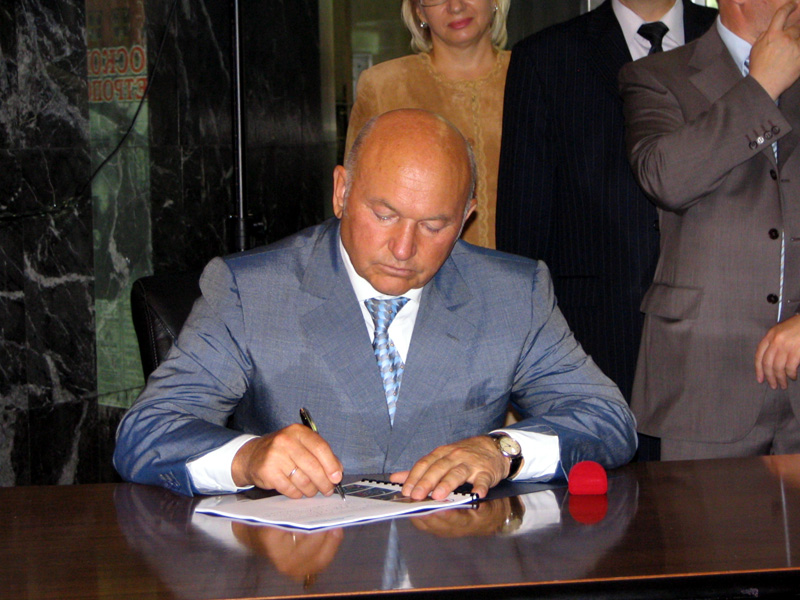
I just noticed: the way Russian, American and English capitals’ mayors look seems to be representative of each country’s culture — or, at least, the popular image of that culture.
Moscow mayor Luzhkov:
(Silk suit in bad taste — the guy looks like a pimp… Red ball… What is he signing? It looks like a brochure with pictures — a set-up photo? Pompous, fake, full of himself…)
New York (yes, it’s the cultural and economic capital) mayor, Michael Bloomberg:
(Microphone, conservative look, talking to some journalist liar. Probably about some Great Cause, in which he without a doubt believes himself.)
— So, what, everyone is an idiot? All the politicians, all the economists in the Washington think this is the right thing to do, and they’re all idiots? How can all of them be idiots? — What about the Soviet Union? Were all the politicians, economists, etc. idiots? — In the Soviet Union — yes. Here it’s different. — It’s not different for those that want to turn the US into a Socialist state. … — You didn’t like everything going on in the Soviet Union, did you? The corruption, the black market, the country turned into a prison, nobody caring about anything… — Yeah, but that was politics. — The politics is the result of the economic system. Whenever socialist goals are set, the society starts to change — go down the drain. In order to “regulate” that, the government has to implement all the “wonderful” political tools of Socialist era. Politics is always closely tied to the economy and vice versa.
Right now, I was listening to Joe Salerno. He said the exact same thing: that even the economists like Bernanke, who seemed to understand what was going on, right now are being sucked into the idiocy. The explanation is simple: once you get involved with the government, you start thinking in terms of political self-preservation and get sucked-in into the centralized vortex of regulationism. The closer you get to the vortex, the more you’re influenced by it, the sooner you loose the independence of thinking.
Very interesting conversation. He also discussed Keynesianism (“It’s dead from the neck up”) — a great enabler of the state power, the credit crisis, and the hysterics. Bottom line: allow the economy to restore itself. In the time of recession, the credit cannot be loosely available — and it became loose to begin with because of the Fed.






![[info]](http://p-stat.livejournal.com/img/userinfo.gif)