Tuesday, October 30, 2012

Too much information


I was just reading a quite well-written book about baby brain development: Brain Rules for Baby by John Medina. I like the book for the most part, but this little bit annoyed me:

In the chapter where he talks about relationship between the parents, the author discusses how having frequent fights between the parents is bad for the baby's brain development. In passing, he mentions that epinephrine and cortisol are secreted as a part of the 'fight-or-flight' reflex.

And that's it. He sort of just mentions them and then says that if the brain is 'cooked' in the appropriate set of hormones, it grows up healthy, but if not, then it grows up not as well developed.

I really hate when people do that: mention some facts of physiology or anatomy without explaining their relevance. It smacks of a cheap parlor trick. It's almost as if they were doing that to impress the audience with their knowledge of biology or somehow use the biological 'illustration' to give greater credence to their (often non-biological) argument.

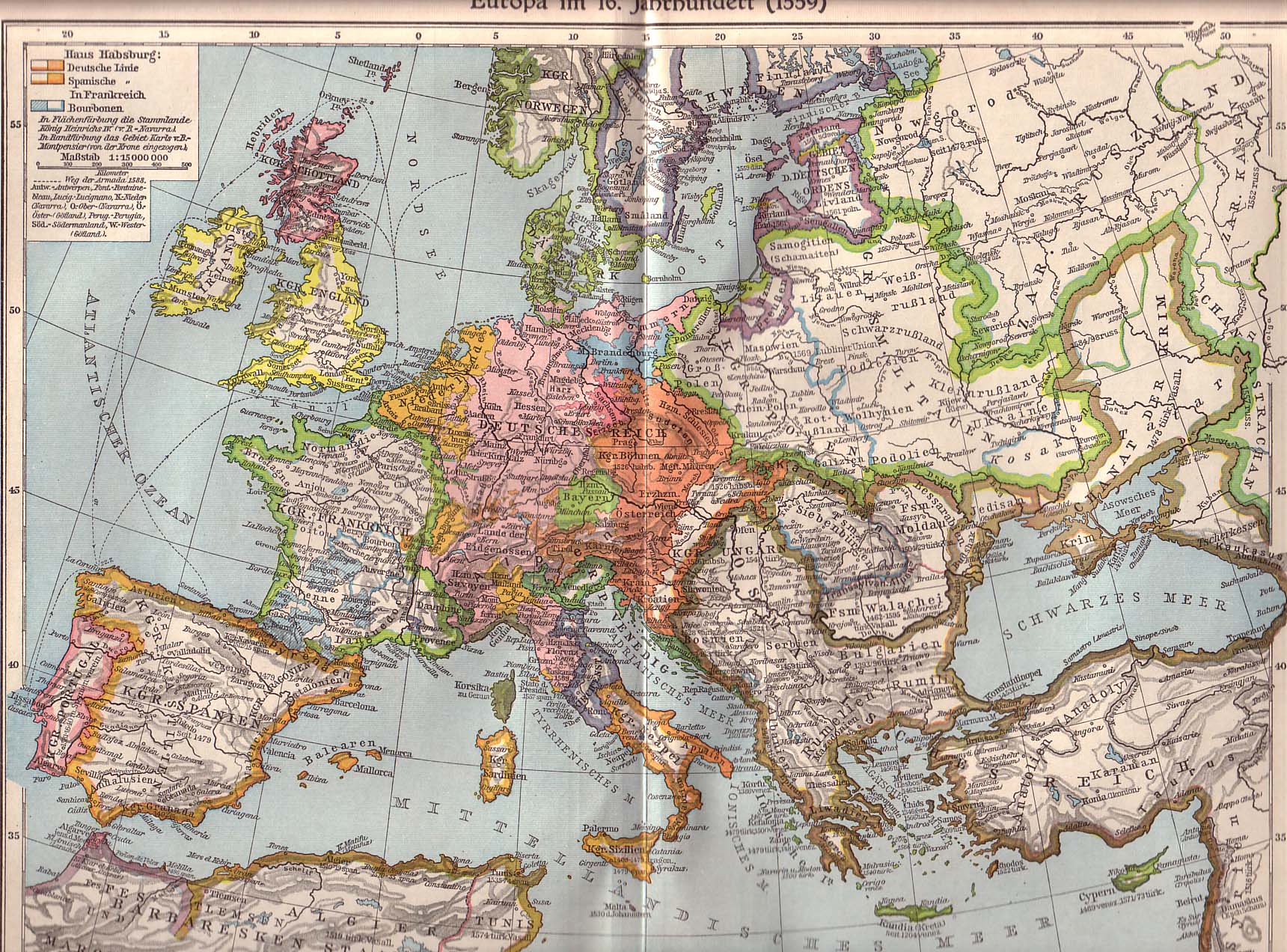
I once saw a textbook of Psychology that had a picture of the map of Vienna at the beginning of the chapter on sexual behavior. The caption under the picture said something like the following: 'Many psychology textbooks have pictures of reproductive organs in the chapters on sexual behavior. The authors of this textbook are not sure what the relevance of those pictures is. That is why we included the map of Vienna — while equally irrelevant, it may be more entertaining.' When I read this caption, I thought it made an excellent point.

I have recently given a talk on the role of DNA methylation in late brain development. I had a slide in which I showed a figure from a study that showed that blocking DNA methylation affected long-term potentiation; I also wrote on the slide that 'a number of genes were upregulated'. My advisor asked me if I was planning to discuss or list those genes. I answered 'no'; I didn't think it was relevant, and the authors of that study had only provided a table of genes without discussing them much themselves. My advisor said: 'In that case, don't mention them at all.'

Again, I thought this was an excellent advice. If you're not going to explain how something fits into the puzzle, don't have it lying around, just for decoration. People have limited attention, and, more importantly, everything thing you say must make a point.

So... how could the author have made a better point with the mentioning of cortisol, etc.? Well, as it turns out, the function of cortisol is to draw glucose from most cells of the body towards muscle cells. Basically, when you see a lion and need to run away from it, your body needs quickly to raise energy 'currency' to supply your muscle cells. Release of cortisol does exactly that. And it makes sense to do that in a short term. As Robert Sapolski (an expert on the biology of stress) once put, 'Run away from the lion first; ovulate later.'

Imagine, however, if this process goes on for days or weeks or months! Your cells being constantly depleted of their energy resources. That will create energy crisis in most tissues of your body (except the muscles) and the long-term effects will be disastrous: the lining of your stomach will develop ulcers, your reproductive system will lose ability to perform well, and your brain cells will suffer damage (first, ability to make plastic changes in connectivity is diminished; next, dendritic complexity is reduced; finally, even cell loss -- the irreversible change -- can take place).

Now, if you think about the developing baby brain undergoing energy crisis, it makes sense that exposure to stress can be detrimental to brain development.

I am sure a writer as talented as John Medina could put the above into fewer words. Then, his mentioning of cortisol and epinephrine would be relevant to the discussion of the baby brain.

Thursday, October 25, 2012

False sense of safety

*


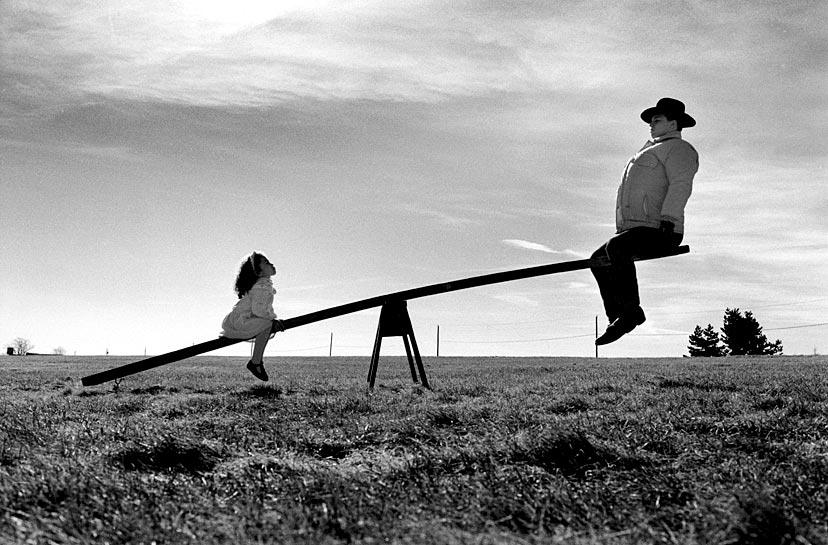
The worst invention in the Western Civilization's recent history was a result of Americans' attempt to reduce fatalities from road accidents. They introduced the inflatable airbag into the cars. Now the passengers drive, having a sense of safety.

If I were trying to reduce the accidents, I would put a sharp knife in the middle of the steering wheel. And that would reduce the accidents, because, by G-d, people would be driving carefully now.

-- Hugh Hendry, British hedge funds manager (and a famous critic of the government's attempts to manage the economy)


The point of the above quote is that by creating agencies that manage our safety for us, without our choice, the government makes us less safe. First, the agencies like FDA are extremely inefficient and in general bad at what they're trying to do, as a result of being monopolies. But more severely, they prevent us from caring for our own lives and safety.

As a result, you have attempts at logical arguments that state that without FDA, unsafe drugs and food would fill the markets, because the people wouldn't have anyone watching out for them (while the businesses would of course care more about selling the drugs and not about the safety of their customers). The people who make them cannot imagine that someone might want to care for his own safety, relying (if necessary) on private inspection agencies whose reputation he would keep an eye on.


And I think, in the end, that is the worst result of socialism: it changes the culture. It creates a nation of slaves, of people who are similar to a 30-year-old who lives with his parents and is unable to make a decision himself about his life. (As I have written before, studies show that children who were given some small allowances and allowed to manage their purchases themselves grew up to be more responsible adults.)

This is the worst result of American and European governments' policies. We see this culture of dependent junkies in Greece today. When their government attempts to cut down on spending, they come out to streets and protest, since they are not getting the free pie.

The same thing happened in the Roman Empire: in an attempt to please the public and win popularity, the government created welfare programs, feeding and entertaining the masses for free (the source of the 'bread and circuses' expression). Unfortunately, this could not be sustained forever. In an attempt to pay for the ever-increasing demands of the public, Roman government debased the currency, creating massive economic crisis that spanned the centuries and was one of the reasons for the downfall of the Empire.

In my opinion, unless drastic change of course is undertaken (by the people themselves -- for the government will never change itself for the better), both American and European societies are headed the same way. They will destroy themselves from the inside, degenerating socially, economically, and culturally.

___________________________
* source of image

The axis of weevils


It seems that the axis of evil now includes:

Iran
Syria
(Not North Korea)
Venezuela
Some random African countries
Finland
Norway
France
Ireland
Switzerland (they get the money of those who didn't want to pay taxes to US gov't)
New Zealand (now that Peter Jackson is filming another movie, they need no aid)

But, on a serious note, one good thing about the picture above is that the French do not get my tax dollars.

Wednesday, October 24, 2012

Shooting oneself in one's foot

"Our target is communism"
— Motto written on one Soviet nuclear missile facility

Saw this picture on the Facebook:


It's nice to know Obama Administration cares about the common folk and not those 'rich bastards'.

This reminds me of FDR's efforts to keep food prices high (presumably to stimulate the economy by stimulating the food industry) by paying farmers to slaughter livestock while people were starving.

So, I know: how about we confiscate all gasoline imported to the USA and burn half of it?.. That should make the economy better, eh?

I thought we were fighting a war on (the concept of) terror? Yet, our government is doing a good job of aiding our presumed enemies... maybe it can declare itself an enemy of the state and sequester itself into Guantanamo Bay?.. (I won't make suggestive jokes about drones, so as not to excite too much the CIA agents reading this blog.)

Monday, October 22, 2012

Gifts from jellyfish and pond scum

Dr. Michael Häusser of University College London speaks about new tools neuroscientists use to study neural circuits:

Friday, October 19, 2012

What makes us overeat?


I'd like to advertise my father-in-law's blog which discusses the above question. He is a professional psychologist helping people overcome eating problems and is in the process of writing a book about emotional eating disorders (when people over-eat to overcome an emotional struggle).

The blog is interesting not only to those who may have such a problem, but also to those who are interested in the question of motivation, willpower, and self-control. At the center of his ideas is the hypothesis about emotional eating and loss of self-control. One school of thought looks at self-control as a 'mental muscle' which gets tired after too much exercise (hence the slips in self-control). He looks at a loss of self-control differently: in his opinion, it is not a loss at all, but rather an attempt for someone to regain control over his life (or at least demonstrate to himself that he is control) when he feels that he is losing it.

So, for instance, if your boss makes you do a project you hate, your wife makes you wash the dishes when you want to watch a game on TV, and your kids force you to take them to a park, you may have an urge to demonstrate to yourself that you're in control of your life by doing something forbidden -- something you know you're not supposed to do. Emotional overeating is one such behavior.

If you're interested, read When Willpower is Not Enough.

More on the topic of self-control, as it pertains to my thoughts on economics and politics:
Time Preference and the Wealth (or Poverty) of Nations

Thursday, October 18, 2012

Do libertarians lack the concept of tzibbur?


A friend of mine has recently asserted, in his critique of libertarians, that they lack the concept of tzibbur: a community. As a result, he said, they think about everything in terms of individual rights and responsibilities, but they don't conceive of the 'community' owning things or having rights and the individuals owing to the community.

I disagree with my friend. First of all, without the concept of a tzibbur, libertarians would not have rights. Yes, rights are centered on the individual, but the purpose of the rights is for the individual to live in a community, at peace with others.

But I agree with my friend that there is a concept that libertarian lack. And that is (for better or for worse) the concept of slavery. Here is my response to my friend:
I think you're wrong that libertarianism doesn't acknowledge the existence of tzibbur: both as a psychological need (or reality) and as a metaphysical concept of co-existence of individuals. There is a lot of evidence that it does. For instance, see this article: http://mises.org/daily/4931 
But I would say that libertarianism doesn't acknowledge that tzibbur can hold individuals as slaves. (And that is because, according to libertarianism, slavery is praxeologically impossible. It is impossible for me to be mafkir of my will. I can never let go of it in order to transfer it. One can certainly 'let go' of his will by committing a suicide, chv"sh, but in that case the transfer is impossible; the same goes for lobotomy -- in other words, as long as a will is really a will, it belongs to only one person, and nobody else can own it or take possession of it.) 
So, while I can belong to a tzibbur, I must be free to choose a different tzibbur. For instance, if I don't like A's minyan, I can join B's minyan. Just because I am a Jew, or a social being, and, as a result, I have to be a part of the tzibbur, I still should be able to choose the particular tzibbur that I am going to be a part of. 
Even if, as you say, a person finds himself automatically belonging to a tzibbur, as you describe it ('a person never thinks of himself only as an individual -- he always thinks of himself as both an individual and a part of a tzibbur'), it doesn't mean he must remain beholden to the particular tzibbur into which he was born. (Such a situation would be absurd for many Lubavitchers, ba'alei teshuva, de novo Chassidim, etc.)

And you implicitly agreed with the above when you said: 'America is a great country, where you can live in a state that suits your desires. If you want to work hard and live well as a result, you can move to Texas. If you want to be a couch potato, you move to California.' (Not that I agree with this logic completely.) 
But what libertarians are saying is that the same principle must be applied to all aspects of life, including protection and legal services, and cannot be tied to geography. I should be able to choose which socio-political tzibbur I belong to without having to move. (As I do with a shull or, lehavdil, a phone company.) 
One may say that it's utopian, since we need protection, and there is a free-rider problem, etc., etc. So, your objections are economic, not principled, and that's a separate discussion (whether private legal authorities and defense agencies would do as good a job as the government, and whether public good can be externalized).

Saturday, October 6, 2012

Scalia's mistake

3rd-rate minds are only happy when they are thinking with the majority. 2nd-rate minds are only happy when they are thinking with the minority. 1st-rate minds are only happy when they are thinking.
-- A.A. Miln (the author of Winnie the Pooh)

An exchange on Facebook:

UCS shared a link.

Scalia appeals to duel federalism in support of his case that some of the more controversial issues currently argued over at the Federal level are easy to deal with from a Supreme Court perspective. He argues they are matters to be dealt with by the individual states.

Comments:

AC:

Scalia lives in this funny universe, where:

1) rights are created by the governments, no received naturally, at birth;
2) constitution must be defended, except when it comes to Justice Scalia's pet topics, inspired by his Catholic background (marijuana, gay rights, abortion, etc.); in those cases it's ok to use the same methods that his friends Ginzburg and Breyer use to defend their pet projects.

U:

A, are you familiar with duel federalism?


AC:

I am familiar with the concept. Doesn't mean I like it (although it's obviously better than centralized power that Vladimir Put... I mean, Barack Obama would have). Doesn't mean I don't think that Scalia is a hypocrite.

The constitution has recognized people's natural rights. Just because the drafters and their contemporaries were hypocrites doesn't mean we have to follow their lead.

Look up Lysander Spooner's argument that slavery was unconstitutional (even before the 13th Amendment). E.g.: http://medicolegal.tripod.com/spooneruos.htm

U:

It is a matter of who you want to 'define' your rights. In order to 'protect' your rights, they must be defined. We reject the incorporation doctrine, not because we think States should violate the rights of individuals, but because we don't trust a centralized power to be able to define our rights.

It is a curious position to distrust the federal government, but then want to use it to protect rights.

Also, do you agree that people disagree on what constitutes a right?

Why shouldn't this be left to local governing bodies?

Leaving it to local governments doesn't mean you condone any abuse of rights that may occur on the local level, it just means you don't trust a centralized power to be the arbiter of your rights.

A:

Who should define what the word 'ostrich' means? Why shouldn't this left to the governing bodies? A better question is: why should it?

To leave anything to any kind of government, an institution founded on the concept of violence (of either majority at the hands of minority or vice versa), means to invite violence.

Why would you want something as precious as understanding and definition of our natural rights (the concept that binds us into a society) be left to a monopoly organization, however local? Obviously, it should be left to the people themselves -- and competing (on a free market) private legal authorities who codify the 'will of the people'.

U:

If you are an anarchist it is even more of a curious position to want a central government to be the arbiter of your rights.

A:

Obviously, I don't want the central gov't to be the arbiter.

My point was not that in an argument of how often to rape people -- once a week or once a month -- the first argument is right. My point was that rape is wrong.

The whole premise that natural rights need to be 'defined' by some governing body is wrong from the start. Natural rights need to be discovered and recognized. This is what Scalia is missing.

The question of which social mechanism is best for efficient and precise rights discovery (central gov't vs. local gov'ts vs. private 'authorities') is secondary (and, to some extent, not so much a legal or a political question, but an economic one).

So, when Texas says that sodomy should be illegal, Scalia finds nothing wrong with it. For Scalia, this is how Texas has 'defined' the right of having sex: 'as long as it's between a man and a woman'. But I say: in their (presumed) attempt at rights discovery, Texas made a mistake. Of course, I agree with Scalia that when the central gov't tells Texas that, the situation becomes even more dangerous in the long run.

Anyway, in my personal life, my rights are violated much more by the state I live in than by the federal gov't.

Friday, October 5, 2012

Democracy and the illusion of public ownership


Today, in a shower, I put a finger on what I subconsciously understood to be wrong with democracy. And so I hurry to share it with my (potential) faithful audience.

What's wrong with democracy is that it is an actualization of the legal fiction of public ownership. Let me explain what I mean.

Imagine that 500 people presumably own some public property: let's say, a central square. That's our premise.

Now, by 'ownership' I mean 'legitimate control'. When I own something I can control it (and we agree that I am doing so legitimately): I can decide what its fate is: I can use it, leave it alone, allow others to use, or forbid others from using it (even if I am not using it at the moment myself). A funny counter-example is a story of Ludwig Wittgenstein who once told him that he would give me some trees growing nearby as a present, as long as the student agrees never to use or alter them in any way or prevent the previous owners from using them in whatever way they wish. The point was to illustrate what ownership is: it's legitimate ability to exercise control over something and prevent others from doing so. If you don't have that, then your "owning" of something is merely academic.

Next comes democracy.

People elect a mayor of the village who will decide what happens to the public square. 251 people vote for Bob, while 249 vote for Bill. Bob becomes the mayor and decides to plant a tree in the public square, against the wishes of 400 people. But, they can't do anything about it, because Bob was elected through a democratic process. 'Next time we will be wiser', say the 400 people (or, at least those that voted for Bob) and walk home.

Let's see what happened here. There were two acts of aggression:

1. When 251 people imposed Bob as the village mayor on the 249. The argument that had it been the reverse (with Bill becoming the mayor), it would be worse, may be true, but it doesn't refute that electing Bob was an act of violence.

2. When Bob decided to plant a tree against the people's wishes.

So, first we had an act of oppression of the minority at the hands of a majority (249 vs. 251), which in itself created the oppression of majority at the hands of a minority (the villagers vs. Bob). But since the first act is meaningless in and of itself (if by the village's constitution, Bob couldn't do anything, then his election would not be a meaningful act of any sort), the essence of representative democracy, as we have discovered, is the same old oppression of majorities at the hands of minorities, which we had back when we had monarchy.

The difference is that the majority of the people get to decide who the jerk on the throne is going to be*. The difference between monarchy and representative democracy is, therefore, what I call 'economic'. It's not a principled difference, it's a difference of the expected practical outcome. Sometimes the 'economic' expectation works out, sometimes it doesn't. (Certainly, publicly elected officials have done more damage than the kings, but perhaps that's because they had better technology and more people at their hands.)

The same goes for constitutional democracy: the basis for preferring it (an expectation that it would somehow curb the abuses of the elected 'jerk') is economic. Sometimes it proves to be true; sometimes it doesn't. Certainly American constitutional democracy has proven to be a failure to a large extent. Today, most people don't even understand what constitutionality means.

So what then? Direct democracy? Well, first of all, as all of you thought the moment you read these words, it's economically unfeasible for a large number of reasons. Second, it creates the same oppression of the minority at the hands of the majority (although, true, it doesn't create the second step of the new oppression of a new majority at the hands of elected minority).

So, at least under absolute monarchy, there are no illusions: the king owns the land, and he decides what happens on his property. End of story.

Of course, economically, it's better if there are many small private owners (each deciding what's going on on his property, and private competing judicial 'authorities' arbitrating arising disputes), but that's another discussion.


But this is what I thought about in the shower: what's particularly funny about the above situation with the villagers and the central square is that the whole time they are being oppressed (by either majorities or minorities) the people live under an illusion that they somehow own the public property. In reality, however, the elected official owns it, at least to the extent that the tolerance of the people will allow him (directly or through some constitutional mechanism).

Imagine the following scenario: a family of five decide to buy a dinner. They vote for milchiks vs. fleishigs, and four out five decide to get a pizza. The fifth person has to go along, and when they are eating the pie, he complains about the taste. One of the four looks at him and says: "Well, don't complain now -- you bought it!"
__________
* A more sophisticated reader may point to the idea of government with consent. So, the difference between a democracy and a monarchy is that in the first case, people in charge govern with the consent of the majority. But that again is fallacious: how do you know that every decision is made with the public's consent? We don't make an argument that the king rules with the consent of the governed: we check it, through elections (and the elections show that it's difficult to predict, without actual verification through voting, whom the majority supports). But if we are going to verify through voting that the president and Congress have the consent of the majority for every law they pass, then we might as well have a direct democracy!

Otherwise, we are back to the situation where every time the government passes a law, it goes against public wishes (or at least without any evidence of public agreement) regarding what should be done with the public's presumed property.

Wednesday, October 3, 2012

Willows of the brook


And you shall take on the first day the fruit of a beautiful tree, branches of palm trees, boughs of leafy trees, and willows of the brook, and you shall rejoice before the L-rd your G-d for seven days.
Vayikra, 23:40

Over the Yom Tov I read a beautiful sicho, in which the Rebbe's view of other Jews shines through.

The Rebbe notes that al pi Halacha, three out of the four species that we take on Sukkos need to correspond to their description from Torah: the fruit needs to specifically esrog and the palm branches have to be from a palm (and the fruit has to be beautiful in appearance), and the 'boughs' have to be 'leafy' (they need to have at least three leaves growing from the stem).

But the branch of the willow does not have to come literally from a 'willow of a brook'. I.e., the willow tree from which we cut the branch does not have to grow by a waterway. Why is that?

It is well known that the four species represent four kinds of Jews: those that perform mitzvos, those that learn Torah, those that do both, and those that do neither; these four categories correspond to the species that have good taste, good smell, both, and neither. The willow branch belongs to the latter category.

The willow thus represents the Jew who neither learns nor performs mitzvos. And that is why the willow does not need to grow specifically by the river.

The other three species are characterized by their mitzvos and their Torah. For both mitzvos and Torah to be 'valid', they need to be connected to a tradition: we cannot perform a mitzva willy-nilly; we must have received a tradition from our ancestors as to how to perform it. The same goes for Torah learning, especially learning Halachos. While to a certain extent innovation in Torah learning is allowed and even encouraged (especially interpretation of what Chumash teaches us in avoida), even that must happen within the context of an already-existing mesoira.

That is why the species that represent the Jews whose 'claim to fame' is observance of mitzvos and learning of Torah must themselves be validated by a tradition: they must correspond to their description in Torah. (Also, for instance, our Rebbeim note that we need to have a tradition for a specific sub-species of esrog, just like we need a tradition for a species of a bird to be kosher. That is why the Lubavitchers only get Calabria esrogim from Italy or Kfar Chabad.)

But what about the fourth Jew? What's good about him? Certainly not his 'external' aspects -- he has nothing to be proud of in his service of Hashem. But we still love him, because Hashem loves him. Because he is a Jew. He has in him Essence of Hashem. And that comes to the fore when the external aspects are diminished.

That is why the willow branches do not have to be specifically from the willows that grow by the river. As long as we know that they originate from brook willows, that in their essence they belong to the species, no matter where they are right now, they can still be part of the avoida of Sukkos.

Lacanian psychoanalysis of Chabad and Modern Orthodox Judaism


(Slavoj Žižek, post-modernist troublemaker)

I am going to try to analyze Chabad and Modern Orthodoxy using the psychoanalytic approach of Lacanian triad: 'the imaginary, the symbolic, and the real' (I'll explain below).

I want to do this because I have for a long time thought about the dichotomy of the 'real' and the 'imaginary' in the MO world. In addition, recently, I have read Iraq: the Borrowed Kettle by Slavoj Žižek (pronounced as 'Slah-voy Zhih-zhek'), a Marxist philosopher-psychoanalyst. I obviously disagree with many of Žižek's ideas and conclusions about capitalism and the Western world, but I find his analytic methodology entertaining. (So, keep this in mind as you read the bits of this post about the Iraqi war. What matters is not the contents, but the analysis.)

In Iraq, Žižek analyzed the motivations for the 2003 invasion of Iraq using Lacanian psychoanalytic triad:

1. The imaginary: the purpose of the war was to spread the ideals and the benefits of the Western democracy. This was the official propaganda line fed to the masses in order to garner their support.

2. The symbolic: the purpose of the war was to spread American political hegemony. This level is called symbolic because the invasion of Iraq really served a 'symbolic' purpose in the international diplomatic stance of the USA: it strengthened its roles as the international policeman and 'paved the way' for the possibility and acceptability of now starting the war on the 'imaginary' grounds, without support of the UN, and in a form of preemptive strikes.

3. The real reason for the invasion, according to Žižek, was economic control over Iraqi oil and, more generally, strengthening of US dollar against the euro. (Perhaps one can tie in the Keynesian motive for mythical 'stimulus' of the economy through defense spending.) This is classical of Žižekian analysis of political events: he envisions a nation-state, a government, or a culture (e.g., the USA) as an individual, and applies to it Freudian and Lacanian psychoanalysis, showing that (in his opinion) the sub-conscious drive is the real one.

Now, let me say at once that I do not necessarily agree with the above analysis of Iraqi war. Or, rather, I neither agree nor disagree. It is certainly the case that the invasion has failed on all three accounts: it did not help with spreading of democracy, either in the region or in the world; it has ruined US political image and led to diplomatic and military backlash, and it had an adverse effect on US economy on multiple levels, including, in the long-term, the current Great Recession. Of course, that doesn't mean that Zizek is wrong in his analysis of motivations.

As Kelsey Wood notes in Žižek: A Reader's Guide:
Žižek is careful to point out that in this Lacanian triad of imaginary-symbolic-real, each of these three levels has some degree of autonomy, and none of the is simply a mere semblance (Iraq, p.4). For example, ideological fantasy produces effects in people's behavior, and has an impact on people's lives. This indicates how fantasy is constitutive of symbolic reality. But again, with regard to the triad of imaginary-symbolic-real, 'it is not that one is the "truth" of the others; the "truth" is, rather, the very shift of perspective between them' (Iraq, p.6).
Again, I do not care whether or not Zizek's analysis is true. I care about using this method to analyse both MO and Chabad branches of 'frum' Judaism.

Let me start with Chabad, using davening as an example (I am crediting my wife for giving me this idea):

1. The imaginary: on this level, we look at davening through 'general' Orthodox Judaism. I.e., all the halachos of davening, the nusach, what davening consists of (the parts of davening), the zmanim, etc. Also, the purpose of davening as interpreted by Alter Rebbe: connection to Hashem.

The 'imaginary' level can also be termed 'ideal' or 'formal'. In a chess game, the 'imaginary' dimension of a chess piece is the rules by which it moves. A synonymous expression for 'imaginary' is 'make-belief', and that applies to the religious application of the Lacanian triad: the 'imaginary' aspect is not something that is not real (G-d forbid), but it is something one must believe in, or at least it's not something accessible to one's immediate experience; it is both a foundation and a goal, both of which must exist on the level of emunah-like commitment (you can read here more about the distinction between emunah and da'as).

2. The symbolic: when looked at through Chabad Chassidus, davening is not simply carrying out of the halachic obligation, but a path of self-development, literally an avoida ('service'). Again, I am using the 'symbolic' as merely Lacanian jargon. In an abstract sense, the act of prayer itself (i.e., what is literally a supplication) is a 'symbol' (an excuse, if you wish) for improving oneself and establishing a relationship with Hashem.

For that purpose, one must daven at length, with great concentration (oftentimes outside of the minyan), and, most significantly, one must learn Chassidus before davening, so that one can be hisboinen (contemplative, meditative) of the learned concepts (comprising either haskallah, the intellectual concepts, or avoida, the concepts of self-service, of Chassidus, or both). This has effect on the interpretation of Halacha (the first level), since, to fulfill the 'symbolic' aspect of davening, we must be lax with the zmanim, allow eating before davening, etc.

3. The real. In reality, you can find Shachris minyanim in 770 going on until almost after shkiah. Not because some chassidim use this much time to learn Chassidus, but because davening late has become a 'reality' of Chabad culture, independently of its 'imaginary' and 'symbolic' counterparts. The same goes for eating before davening (sometimes eating a quite substantial meal), etc.

Don't get me wrong: I am not saying that this is what happens to most Lubavitchers. (In fact, I don't really know what the numbers are.) I am just saying that this phenomenon (almost unique to Chabad) exists, and that's what its nature is.

Of course, it is also true that davening has become a completely different experience ('reality') in Chabad circles, both for the newcomers and the 'balabatim'. Many people would describe davening at Chabad as a richer, deeper, more vibrant experience, albeit annoying to the Jews belonging to other branches of Orthodox Judaism, whose 'imaginary' and 'symbolic' (and, as a result, 'real') expectations of davening are somewhat different.

The same analysis can be applied to many other aspects of modern Chabad 'culture', both in terms of shlichus and the 'Crown Heights' velt. I think it can also be used in a positive sense. For example: a person is stopped on the street and asked to shake lulav and esrog:

1. The imaginary: the person does the mitzva of lulav and esrog, the formal obligation he has to G-d. G-d's Will is carried out in this world.

2. The symbolic: the act of doing the mitzva connects to the essence of his neshama, revealing it (potentially). The act of doing the mitzva is important not because of its dry obligatory context, but because of what it accomplishes: the unification of G-d with this world through the act of mitzva and the subsequent creation of dira b'tachtoinim (the dwelling place of G-d in the lower worlds). I.e., the mitzva is not just a dry fulfillment of a contract, but a vehicle (a 'symbol') for the essential purpose of creation and revelation.

3. The real: it is possible that the person will become interested in Yiddishkeit and inquire about it (and, perhaps, about Chabad specifically) and this simple encounter will bring him 'back' (or, at least, closer) to frumkeit. In this, the circle of the purpose of mivtzoim is closed.


Now, let's use the same analysis in application to Modern Orthodoxy:

1. The imaginary: MO views itself as Orthodox Judaism. In fact, it does not view itself as a 'b'dieved Judaism', i.e., Judaism of a compromise. According to the MO philosophy, its path of Yiddishkeit is preferred. Torah is given to be lived, in this world. (Note that this is not the same as the Chabad concept of engaging 'der velt' in order to make dira b'tachtonim. For Chabad, 'der velt' is the goal. For MO, it's simply the status quo. When a Lubavitcher gets a job, he is being an idealist, at least as far as Chabad Chassidus is concerned. When a MO Jew gets a job, he is being a realist.)

Likewise, Torah is given to real human beings, with real desires and everyday circumstances; it was not given to the angels.

2. The symbolic: In order to accomplish the goal making Torah accessible to the modern mentality of the 'real, everyday' Jew living in the Western world in modern times, one must unite Torah with 'modernity'. Because this contemporary Jew is the one commanded with both performance of the mitzvos and learning of Torah, we must be able to interpret the meaning of the former and the content of the latter from today's, modern, perspective.

From here comes the MO view of Judaism. Mitzvos are patterns of behavior that bind us together in a Jewish community. Torah is G-d's revelation of His message of how to live a fulfilling and successful life in everyday world. The 'realism' of the mitzvos and of Torah is pushed to the shadows. It doesn't matter whether the world was created in Six Days, 5773 years ago. What matters is the message of the story to us, today. It doesn't matter whether I accomplish 'objectively' anything when I shake lulav and esrog. What matters is that that I feel and 'experience' something when I do it, that I focus on the symbolism of the act, in its historical and (constantly reinterpreted) everyday context.

3. The real: Having their significance reduced to merely symbolic context, mitzvos and Torah stop being religious phenomena and start being social ones. They are no longer an aspect of the Jew's (or the community's) relationship with G-d; they are an aspect of the Jew's relationship with other Jews and a way for him to see his own culture and self-identity on the national and international scale.

When a Chabad rabbi speaks before Musaf, he talks about avoidas Hashem and da'as Hashem. He uses some aspect of the parsha or the Yom Tov as an illustration of what our relationship with G-d must be, or how we can understand G-dliness -- G-d's revelation of Himself in the worlds, the purpose and design of His creation, etc.

When a MO rabbi speaks before Musaf, he talks about Israeli politics, using a symbolic interpretation of an aspect of the parsha (reduced almost to an anecdote). Or, perhaps, he talks about how we must approach our everyday work environment or a project: the parsha can teach us about successful interpersonal relationships or work ethic and give us peace of mind.

The interpretation of the mitzvos also suffers from the symbolic approach. Because hair covering is looked at from the symbolic point of view, not either strictly legal (as a Litvish Jew might look at it) or 'realistic' -- i.e., having a real, objective purpose outside of one's perception (a Chabad Jew's perspective), it is only important insofar as it binds a Jewish woman to a particular community of hair-covering women, or if it adds anything to her personal experience. Otherwise, it is discarded.

The same goes for many other mitzvos. The tendency of make Torah 'livable', armed with always-ready ability to assign a symbolic interpretation to a mitzva, allows one to be as meichel as one possibly can (or as Rav Moishe allows), and then perhaps some more.

In reality, therefore, MO Judaism is 'Orthodox' in name only. In practice, both its theoretical view of Judaism and its practical observance is almost closer to Conservative Judaism, from which, after all, it has evolved (as one MO rabbi said, a bit tongue-in-cheek, 'if the Hareidim build mechitza up to the ceiling, and the Conservative don't have a mechitza at all, the Modern Orthodox mechitza will be exactly half-way').


I don't know what my conclusion might be. Writing of this post was mostly self-therapeutic in nature and perhaps may be of some help to those whose encounters with MO Judaism (or Chabad, for that matter) were frustrating.

Next project: psychoanalysis of the 'yechi' culture. Just kidding!..

Saturday, September 22, 2012

Absolute vs. "discovered" morality


On a mises.org forum, one author wrote the following:
The intimation of [an article by David Gordon] is that the facts of moral realism are embedded into the very structure of the Universe at a level transcending humanity itself. But there is no reason to believe this is actually the case. What we observe is that the conditions for moral facts reside entirely within the human social order. That is, morality is not a question that has anything to do with the Absolute or the Universe as it would appear to an omniscient being. 
Rather, moral facts are facts merely about the human social order, about human nature. They are facts about human brains, human bodies and terrestrial biology and our terrestrial environment and the particular facts of our situation in this corner of the cosmos. Is it immoral for Martians to kill Martian children? I have no idea. But I know that it is immoral for humans to kill human children. That's because I know the facts about human beings relevant to human morality but I don't know the facts about Martians relevant to Martian morality.
In other words, morality is not absolute. It's something that can be discovered by observing human society. Later, the author explained that we can observe how human societies function (and human nature in general) and derive from those observation the rules of ethics -- rules of how to achieve satisfaction for a human being.

So, for instance, "human beings like company of others; human beings do not like to keep company with people who annoy them; if human beings want satisfaction in their lives, they should not be annoying to other human beings" (obviously, among other things). In this sense, being an annoying person in unethical, but being a nice person is ethical.

In all my conversations with atheists, this was basically their description for "G-dless" basis for morality.

My response:
As I see it, morality needs to be on the one hand applicable to the individual (you can't make a moral prescriptive statement that addresses the needs or goals of a society, since it is the individuals who make choices) and on the other hand universal (we can't say that a serial killer acts morally, since his actions bring him the greatest satisfaction). What's left then? It seems to me that what's left is precisely the Absolute Moral Truth -- applicable to individuals but regardless of their individual preferences. If adultery is wrong it's wrong for everyone and always.

(Of course, there can be built-in conditions. Lying is wrong, but lying to save someone's life is right, since saving life takes moral priority.)

It also seems to me that libertarian morality is based on the assumption that nothing changes between two people existing in a state of nature and them existing in a society. To see whether something is wrong or not, we have to ask: would it be OK for me to do that to you on a deserted island? For instance, would it be ok for me to steal from you, when there is no society around us? If not, then why is it ok for me to steal from you when there is a society, with the society's help?

But if there is no Absolute Moral Truth, then, indeed, why is it wrong for me to rob you when we are alone on a deserted island if I calculate that it is a greater benefit for me to do that than co-exist with you peacefully? Also, if my actions even in a society are secretive enough, I can get away with doing them without changing the society itself. So, one can say: "people's happiness will be the greatest if they live in a society where children are not killed". But what does this have to do with me personally making a decision whether or not to kill a child secretly? Presumably my actions do not affect the society I live in. Also, while a law against child killing (that benefits the society) could exist on a societal level (applicable to all citizens, enforced by all law agencies of the society), it would still not be a moral law, since it would say nothing as to why I need to keep it at all times and in all circumstances.


I have once heard a joke: If you're stranded on a deserted island with limited food and water in a company of either an atheist or a statist, you should kill them immediately, for your life is in danger. Neither of them can conceive of what is moral or right outside of the society. If they are sufficiently liberated from the traditions of their upbringing, they will reason the justification for killing you very easily.
Obviously, one can define "morality" as "a set of rules to achieve satisfaction". (You can define morality as whatever you want -- for instance, "eating meat from time to time"; in that case, a vegetarian is acting immorally.) Therefore, if you are like most people in that you like company of others and it is true that (most of the) people around you don't like jerks, it is immoral to act like a jerk.

But what happens if you don't care about the company of others, but it gives you satisfaction to cause misery to others? Then it suddenly turns out that acting like a jerk is not immoral for you. As I said, you can define morality whichever way you want, but I just don't think that this fits most people's innate understanding of morality.

Wednesday, September 12, 2012

Keynesians are honest in their confusion

Facepalm...


I can see why Bernanke and the rest of Keynesians are genuinely confused. They just don't get the point... which is: you shouldn't be able to print it easily, and it should have intrinsic value. That's real money.

Of course, that's just words. I might as well say: "cars should not have safety belts, and motorcycles should have only three wheels".

So, to see what gold standard is all about, read this. If you don't feel like reading a lot of background and introductory theoretical info, you can skip to this: The "Proper" Supply of Money.
Now we may ask: what is the supply of money in society and how is that supply used? In particular, we may raise the perennial question, how much money "do we need"? Must the money supply be regulated by some sort of "criterion," or can it be left alone to the free market?

Thursday, September 6, 2012

Chai Ellul


There is a Chassidic saying that 18th of Ellul, "Chay Ellul", the birthday of the founder of Chabad movement, Alter Rebbe, brings chayus, life, into the month of Ellul.

What does this mean? It means that teachings of Chabad allow one to have his Ellul with chayus, with life and energy. Ellul stands for "ani l'doidi v'doidi li" -- "I am to my beloved, and my beloved is to me", which corresponds to our relationship with G-d. This relationship, expressed in Judaism, must be done with chayus, with life and energy.

A person must realize that Torah and mitzvos are not a "lifestyle". They are a living, breathing relationship with the Creator of the world. Every time a person does a mitzva, every time he learns Torah, he must not do it as a habit, as a rote, as a part of his "lifestyle" or "identity", but as an aspect of an ongoing relationship with the Eibeshter.

And the same way, every aspect of his life, from his work and his hobbies to his family to, obviously, his davening and learning and mitzvos, one must strive to connect to G-d. When something happens to a person, or when a person does something during his day, no matter how mundane, he must ask: "How is this a part of my relationship with Hashem?" And if he doesn't know the answer, he must search for it.

There is a story told about Mitteler Rebbe, Alter Rebbe's son. One year, Alter Rebbe was away for the reading of the Torah portion where all the curses that would befall the Jews if they did not keep Torah were listed. When he heard the curses being read out loud, he fainted and fell so ill that it wasn't clear if he would be able to fast on Yom Kippur.

People eventually asked: "What happened? You hear your father read the same Torah portion every year." He answered: "When my father reads this, I only hear blessings."

What's the point of this story? One of the major ideas expressed through the teachings of Alter Rebbe is that G-d is benevolent towards us. There are many mystical and philosophical ways of understanding it, and one must learn them all, but the bottom line that one must keep in mind every day is that anything that happens to one is a direct gift from G-d, whether or not it is a revealed blessing or a blessing in disguise.

May we be worthy of reaching very soon the time when our relationship with Hashem is revealed in this world on all levels.

Friday, August 31, 2012

Doing their job...

I have written about this before, so I know I am repeating myself, but just as an illustration to the pictures below...

Oftentimes, I hear "they are just doing their job" about the actions of police officers (or TSA officials in the airports). In what way is that an excuse? A hired killer is also "just doing his job". If the policeman's job is to follow his superiors' orders to rob and murder people blindly, without a thought, then he is not a human being; he is just a mindless beast, and defending against his actions using whatever force necessary is completely legitimate.

The whole astonishing innovation of Nuremberg Trials was that people following their democratically elected government's orders can be criminals, and "I was just following orders" does not absolve one of responsibility.

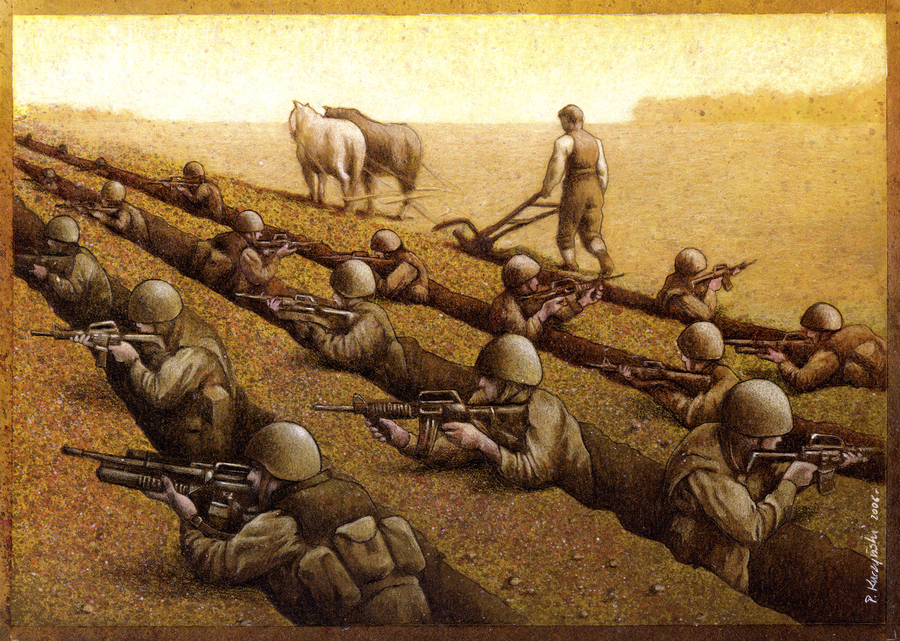
People in both these picture were "just doing their job". Notice both the main figures and their colleagues, who are looking on. All are criminals.


Police officers who did not rescue a drowning man in this video were also just doing the job and just following instructions:


And looking at the following picture, I am reminded of an opinion of one of acharoinim that "the worst government is better than anarchy". I guess he lived before the 20th century. Even the worst "private" thugs and criminals don't commit the atrocities that government thugs are capable of:

The inglorious side of war


This one is also an illustration of the relationship between the civilians of the world and their governments:

Cartoon: military occupation (large) by pkuczy tagged occupation


More from the artist (links taken from the above source):


http://pawelkuczynski.com
http://acidcow.com/pics/17777-sa...
http://www.boredpanda.com/satiri...

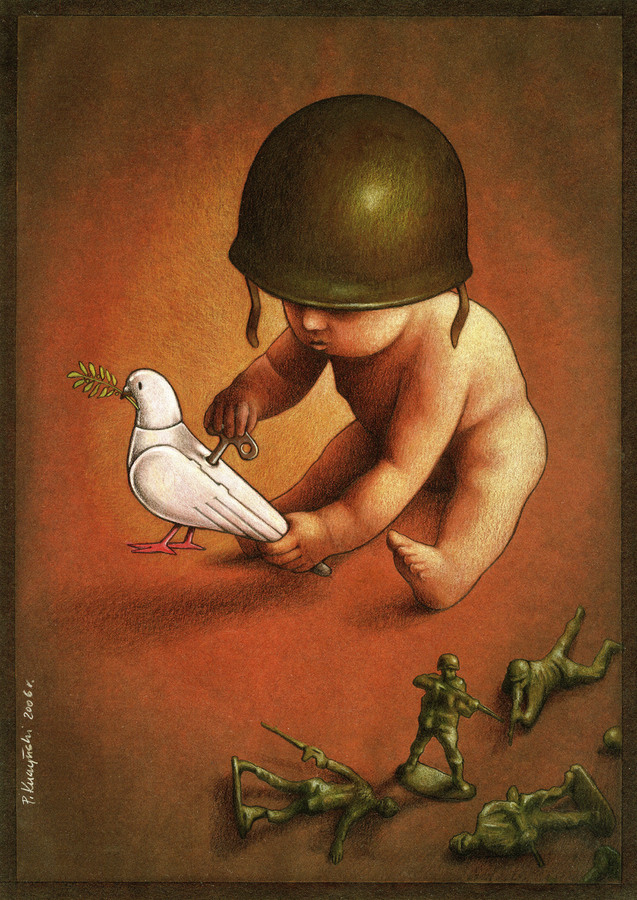
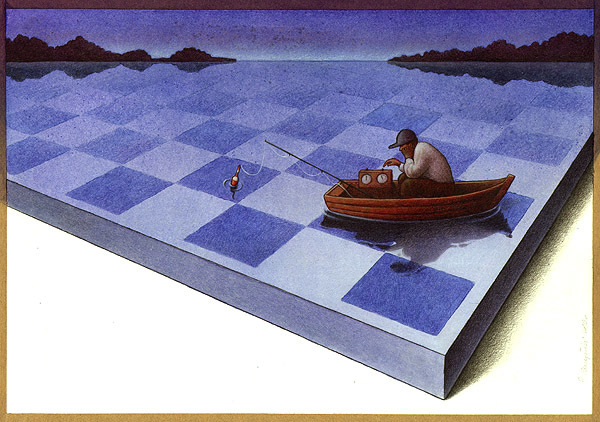
I didn't like all of his works due to their obviously socialist leanings (it seems today, just like 100 years ago, you are either in favor of the corrupt establishment or against everyone equally), but I also liked these:

Cartoon: peace (large) by pkuczy tagged peace

Cartoon: Chess (large) by pkuczy tagged chess
(in Russian, and possibly in Polish, the word for the rook chess piece is ladya which was the name for Russian medieval warships, similar to Viking ships)

Wednesday, August 29, 2012

Without the government, who would regulate traffic?

I heard once from someone working for Goldman Sacks (or JP Morgan, or one of those other lowlife beehives) that "deregulating economy would be like turning off all traffic lights".

Also i hear from people that "without the government, there would be a balagan".

Well, what really happens when you get rid of traffic regulations? Massive accidents, right?


More on the topic of privatization of roads and highways from Walter Block:

Friday, August 17, 2012

Conservatism and mistrust of spontaneous order


A brilliant quote from Friedrich Hayek's essay "Why I Am Not a Conservative" (note that in Hayek's lexicon, "liberal" means what we today mean by "libertarian"):
In looking forward, [conservatives] lack the faith in the spontaneous forces of adjustment which makes the liberal accept changes without apprehension, even though he does not know how the necessary adaptations will be brought about.

It is, indeed, part of the liberal attitude to assume that, especially in the economic field, the self-regulating forces of the market will somehow bring about the required adjustments to new conditions, although no one can foretell how they will do this in a particular instance. There is perhaps no single factor contributing so much to people's frequent reluctance to let the market work as their inability to conceive how some necessary balance, between demand and supply, between exports and imports, or the like, will be brought about without deliberate control. The conservative feels safe and content only if he is assured that some higher wisdom watches and supervises change, only if he knows that some authority is charged with keeping the change "orderly."

This fear of trusting uncontrolled social forces is closely related to two other characteristics of conservatism: its fondness for authority and its lack of understanding of economic forces. Since it distrusts both abstract theories and general principles, it neither understands those spontaneous forces on which a policy of freedom relies nor possesses a basis for formulating principles of policy.

Order appears to the conservative as the result of the continuous attention of authority, which, for this purpose, must be allowed to do what is required by the particular circumstances and not be tied to rigid rule. A commitment to principles presupposes an understanding of the general forces by which the efforts of society are co-ordinated, but it is such a theory of society and especially of the economic mechanism that conservatism conspicuously lacks.
Many people are reluctant to trust the "market forces" probably because they envision them to be some chaotic combination of random vectors, like all the wind currents that propel a falling snowflake. But in reality, "market" is not just some chaotic forces; it's literally millions of individuals making decisions based on their needs and desires. Many of them do so as a part of their profession, in which they have been proven to be successful (by making profit both for themselves and their clients; and while I don't think that profit or money in general are "be-all and end-all", certainly, profit is a good evidence that an entrepreneur is successful at predicting public's desires).

On the other hand, government's regulations are a product of only a handful individuals (whose main skill is oftentimes simply oratory), themselves isolated from profit and loss or competition, making decisions (backed up by a threat of violence) on behalf of millions of people.

So, the market may "not be perfect" (whatever that accusation means), but it's definitely better than the government.

Another wonderful quote:
Let me return, however, to the main point, which is the characteristic complacency of the conservative toward the action of established authority and his prime concern that this authority be not weakened, rather than that its power be kept within bounds. This is difficult to reconcile with the preservation of liberty. 
In general, it can probably be said that the conservative does not object to coercion or arbitrary power so long as it is used for what he regards as the right purposes. He believes that if government is in the hands of decent men, it ought not to be too much restricted by rigid rules. Since he is essentially opportunist and lacks principles, his main hope must be that the wise and the good will rule – not merely by example, as we all must wish, but by authority given to them and enforced by them. Like the socialist, he is less concerned with the problem of how the powers of government should be limited than with that of who wields them; and, like the socialist, he regards himself as entitled to force the value he holds on other people.

When I say that the conservative lacks principles, I do not mean to suggest that he lacks moral conviction. The typical conservative is indeed usually a man of very strong moral convictions. What I mean is that he has no political principles which enable him to work with people whose moral values differ from his own for a political order in which both can obey their convictions. It is the recognition of such principles that permits the coexistence of different sets of values that makes it possible to build a peaceful society with a minimum of force. The acceptance of such principles means that we agree to tolerate much that we dislike. There are many values of the conservative which appeal to me more than those of the socialists; yet for a liberal the importance he personally attaches to specific goals is no sufficient justification for forcing others to serve them.

Friday, August 10, 2012

Begging consent


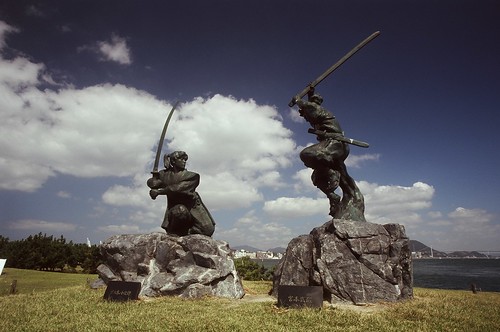
(sculpture depicting the famous duel between samurai Miyamoto Musashi and Sasaki Kojirō)

"My sword is longer than yours; hence, you have to obey my will"
— what most arguments in favor of the government's legitimacy amount to

Oftentimes, one hears the "consent" argument as a justification for the necessity and moral imperative of keeping the government's laws.

For instance: "You live in America (Canada, New York, Hicksville, etc.); therefore, you have to obey the laws. If you don't like the laws here, go live somewhere else." (A tangential note: the "laws" in this case means "whatever the government said", not "what people's custom is". The distinction is important, as will be seen below.)

Or: "People must obey the ruler's laws, because by living on his land, they showed that they accepted his authority over them." (This argument is used by some halachic authorities regarding dina d'malchusa dina.)

It seems to me that this argument has a gaping hole in its logic. The argument assumes (and in no way attempts to prove) that the government a priori has legitimacy — hence, one must either obey its laws or go live somewhere else, since the government has authority either to enforce the laws or expel the law-breakers. But this argument cannot be used to prove that the government's laws are legitimate, since that would be a classical case of begging the question!

Why do people fall for this argument? Because they mistake positive law for natural law. They assume that "whatever the government said" is equivalent to "how most people behave". In many cases, as I previously explained at length, it is true: the positive law (although illegitimate to begin with) eventually creates patterns of behavior. For instance, if someone wants to drive on the left side of the street, he should go live somewhere else, since most people drive on the right side of the street in this country. Out of respect for the majority of the people (whose custom "was there first"), one must obey the local natural laws (whether or not they arose spontaneously or resulted from oppressive positive law).

But this in no way means that, for instance, tinting your car windows more than 35% (which is illegal in some states) is being disrespectful to local people, just because some local bureaucrat decided to forbid it.

Hence, if I claim that some bully (whether he is an elected politician or a local mafia boss) is illegitimate and, therefore, his laws are illegitimate, telling me that "I live on his turf, therefore, I have to listen to him" is illogical. I live on what he claims to be his turf (with support of some people), but that in no way makes his claim legitimate, unless the "turf" actually is his property which he can prove to have homesteaded.

Which brings me back to dina d'malchusa dina: the above analysis shows that the "tacit consent" argument and "king the landowner" argument are in fact one and the same. Without the second, the first one falls through. But, it seems to me, that if the consent argument is presented as some sort of chiddush, or at least as a shitta standing aside from the "king the landowner" argument, then the consent argument is simply fallacious.

Tuesday, July 31, 2012

Go Seigen vs. Kitani Minoru


It is better to compete on board, peacefully, then in real life, lethally:

Friday, July 13, 2012

Obama the Honest


Well, at least he stopped pretending...

Statists (both Conservative and Leftist) fallaciously believe that the role of the US President is to "govern". To "get things done". They are wrong, because no president can do that. All that a president can do is "do no harm". He can use the power of veto to reduce the Congress's encroachments on Americans' liberties. The best presidents in the US history have done exactly that.

But Obama has even retreated from (pretending to occupy) those lines. Now he has admitted that he got the job description wrong. The purpose of the president is not to get "things done". It's to bullshit the American public into a sense of national unity:
"When I think about what we've done well and what we haven't done well," the president told CBS television in an interview, "the mistake of my first term — couple of years  — was thinking that this job was just about getting the policy right.

"And that's important. But the nature of this office is also to tell a story to the American people that gives them a sense of unity and purpose and optimism, especially during tough times ..."

So, keeping in mind that the government that governs least governs best (simply because everything that the government does will be harmful a priori), if all that Obama does in his second term is "tell a story to the American people that gives them a sense of unity and purpose and optimism" (I guess someone watched The King's Speech), he will join the ranks of the best American presidents.

Unfortunately, I don't think that's all that he will do...

(By the way, if you were wondering why I haven't been posting for a while, it's because, b"H, I had a baby girl born on Shabbos, Gimmel Tammuz. Now that the baby is toilet trained, walking, and talking, I have more free time on my hands and will try to start posting again...)

Wednesday, June 20, 2012

Pray for the welfare of electricity monopolies


The government in the US grants monopolies to electric companies. Thankfully, it's not one company per country, but oftentimes, it is one company per state, or per region, or at least per city.

Recently, the electric monopoly of Boston area, NStar, has received a good share of criticism. Most of it has to do with outages resulting from old or badly maintained equipment, personal errors, long response times to electric line damages (thousands of families were without electricity for weeks as a result of a "hurricane" last year — part of the time, during freezing weather), drastically rising costs of service and operation, and environmental mishaps. Basically, every problem that can happen to an electric company has happened to NStar.

I am sure the same is the case with almost every monopoly out there. I remember, when I was living in the South, the same things were said about the local energy company, Entergy.

Some of these things may not be the companies' fault. For instance, rising service costs have to do with rising gas prices, which the companies are hardly responsible for. On the other hand, we simply do not know what the "right" price for electricity in a given region should be, because there is no competition, and a company can charge higher than it would had the energy business existed in a free-market condition. The same goes for response times, equipment maintenance, etc.: all these problems which are blamed by NPR hosts on "greed" have to do with the government creating a monopoly. And also, probably, with greed. And mismanagement. But greed and mismanagement are allowed to flourish and give fruit when there is no competition. Free markets punish for them. Customers punish for them.


All this is beside the point, however. We do all use electricity. Every day, people use it. Hospitals use it. Police and firefighters use it. Businesses use it. Synagogues use it. We use it during the week, on Shabbos (passively) and on Yom Tov. Electricity has greatly transformed our existence, has benefited us immensely. It has allowed us to live more comfortable, more fulfilled, more meaningful, and longer lives. It has allowed us to be (with all other things being equal) better human beings and better Jews. Just today, without electricity I may have suffered great health problems (G-d forbid) as a result of the heat wave.

Therefore, I wish to propose the following two statements:

1. Pray for the welfare of local electricity monopolies. For without them, we would all sit in the dark. We would be cold in the winter and hot in the summer.
2. Even a worst electricity monopoly is better than lack of electricity monopolies, when a man has to sit in the dark and live in the Middle Ages.


Clearly, the two statements are ridiculous. Right?

Without NStar, there would be a different company. If it's a bad electric company, it must fail and be replaced by a better one. Better yet: why not allow electric companies to compete and see which one does a better job or gets a greater share of the market? In fact, let two or more companies co-exist and cater to different customers' preferences. I am currently trying to decide whether to stay with my current Internet service provider (which charges cheaper rates and gives better speed of connection, but whose service outages are more frequent) or switch to a different one. The same kind of choice should exist for electric companies.

And the second statement is silly too. It seems to imply that there are only two choices: NStar or sitting in the dark. But that is clearly not true. There is a middle ground.

(Also, it's not really true that without electricity we would be cold in the winter or hot in the summer. People would come up with some of the obvious alternatives.)


So, why, when the same two statements are said regarding the government (first one is modeled on a Mishna, second — on a rishon's comment to the Mishna), we just gulp them up? I am not saying that we should just discard something that Chazal say, G-d forbid, but perhaps when the statement is strange, we can use a little common sense and logic to try to figure out its meaning and applicability, as opposed to doing Bible-thumping.

Perhaps what Mishna said was that we should value electricity... I mean, law and order — not the actual organization of the government, but the service that it provides. Just like we should value medicine. Without it, people would surely die in many cases. Does this mean there has to be a monopoly on medical decisions in a given geographic area (and, for that matter, as wide an area as possible)?

Perhaps in Mishna's times and the place where it was written, there was no societal concept of anarcho-capitalism (many independent and passively competing sources of law and order coexisting within the same territory). We know that such a thing has existed in the past, but it doesn't mean this concept was available to the specific society of Mishna's times and place (or those of the rishon commenting on the Mishna, even though he was a relative contemporary to medieval Ireland and Iceland).

Political concepts are not much different from technology or medicine or economics. All of them are just ideas about how to do things. Their accumulation and development require research, passage of information down the generations, ability to improvise and experiment, and flexibility to accept change. We shouldn't blame Chazal for working within the political realities of their times any more than we should blame them for working within technological, economic, or medical realities of their times.

But then again: we should be cautious to accept blindly the statements that are so strongly intertwined with the state of the contemporary knowledge as binding to our times, and, worse yet, as some sort of eternal instruction of how to view certain phenomena. That may refer to bleeding or leeching; that may also refer to cornering the markets or the government.

Tuesday, June 12, 2012

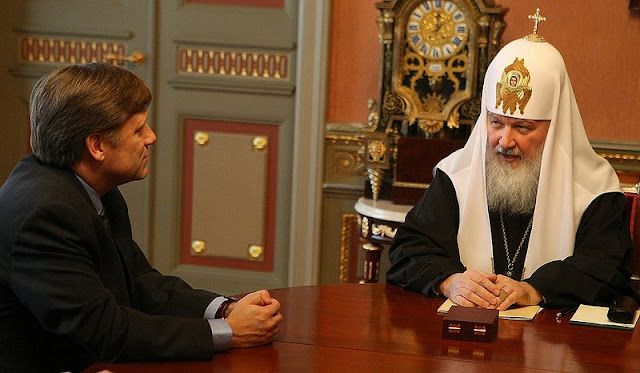
US and Russia

Фото пресс-службы посольства США

The meeting of two crooks.

The only question is: what's in the box?

Tuesday, June 5, 2012

Polish duel

I've posted this before. The action in this scene happens during one of the wars between Poland and Sweden. Polish king's marshal is trying to get one of the Polish nobles to fight for Poland. The noble refuses. The marshal has his house surrounded by the king's soldiers. He calls him out to a duel, promising that if the noble wins the duel, the soldiers will let him go (he makes the soldiers swear).

This is the duel itself:


At the end of the duel, the marshal slightly taps the noble on his head to knock him out. The noble survives and ends up fighting for Poland against the Swedes.

By the way, I recommend to anyone interested in Polish literature and history (military or not) book by the famous historical fiction writer Henryk Sienkiewicz (pronounced as "Senkevich"). The above action is taken from a movie based on the book Deluge.


(Also, interestingly, the author used to be very popular among early Zionists. He was also very popular in Russia as many other Polish authors. In fact, my favorite writer today remains Polish, and one of my favorite writers of the childhood was Polish.)

Monday, June 4, 2012

Social contract, majority rule, and chazakah


I have just seen the following justification for the concept of the government in a book on Jewish ethics. I am paraphrasing (since I don't have the book in front of me), but the idea is common enough. It went something like this:
All civilized societies recognize the need for law and order. The individuals living in the societies recognize that they need to give up some of their freedoms and rights in exchange for protection of others -- in particular, freedom from danger and right to safety of one's person and possessions. 
To achieve this goal, the societies form governments which represent the people of the individual societies. Since no government can enjoy a unanimous support, the majority rule is evoked: the fact that majority of people support a particular government creates a custom of acceptance of this government's rule. Just like any custom supported by the majority, this custom is binding on the minority.

Let's break it up in parts and see if they make sense:
All civilized societies recognize the need for law and order.
So far, so good. Agreed.
The individuals living in the societies recognize that they need to give up some of their freedoms and rights in exchange for protection of others -- in particular, freedom from danger and right to safety of one's person and possessions.
And we started off so nicely... The purpose of the law is to protect one's rights, correct. But it does not follow that to have law you need to give up some of your other rights (for instance, a right to pick your own rights protector out of the list).

For instance, you can have a society built like any anarchic societies throughout history: for instance, medieval Ireland or Iceland. You choose your own law-enforcement (or rights-protection) agency, become its voluntary client, and enjoy the protection of your rights. As long as the majority of people agrees in the society that such a state of affairs is good and that peaceful arbitration between private "government" agencies is preferable to violent wars between them, such a society will have law and order without a need to give up one's rights.
Since no government can enjoy a unanimous support, the majority rule is evoked: the fact that majority of people support a particular government creates a custom of acceptance of this government's rule. Just like any custom supported by the majority, this custom is binding on the minority.
Note that here there are two arguments for the defense of a government monopoly:

1. We need a monopoly, because otherwise we wouldn't have law and order. (Disproved above.)

2. Because most people choose a particular government, this choice creates a custom. This custom, just like all other customs, is binding on the citizens of the community.

I want to address the latter argument. It is an argument similar to one present in the discussions of some poskim (both Rishoinim and Achroinim) in justificaiton of dina demalchusa dina. Some of the modern commentaries invoke this precise argument, attributing it to the Razal.

Let's try to rephrase the argument giving an example:
In most cities, people enjoy being able to travel to other cities quickly by buses. For that reason they sometimes endure sitting in an uncomfortable seat for a few hours. In a particular community, the majority prefers to travel by Greyhound. The minority prefers Bolt Bus which has more comfortable seats but more expensive tickets.

Because everyone recognizes the need to have buses, the majority may compel the minority to choose Greyhound. First, because you can't have two bus lines operating within the same city (the buses will be unable to negotiate the right of way on the road and run into each other, causing casualties). Second, because by choosing Greyhound, the majority created a custom, and just like any other custom, this one is binding on the whole of the community.
 The absurdity of both arguments is self-evident.

But what about the Razal? I think what they are saying (and I base this on the article about dina demalchusa dina in Encyclopedia Talmudis) is the following:

When people interact, they do so within certain customs. Customs are implicit understandings between people that need not be negotiated explicitly. That is why the majority's custom may be binding upon a minority (as long as the minority interacts with the majority in the area that the custom applies to). For instance, if in some locale, upon hiring a worker to paint your house, it is customary to pay him for a half-an-hour lunch break, then the workers have a right to demand the break. If you did not pay them for the break time, you stole from them (or committed a form of stealing, called neshek, "withholding a debt").

Customs may arise spontaneously. Customs may also be set up by the authorities. For instance, in the US people drive on the right side of the road. In the UK -- on the left. It could be that these customs arose spontaneously. It might also be that they were set up top-down, by some authority. It doesn't matter. As long as the majority abide by this custom, it becomes binding on the minorities and individuals (as long as they share the same commonly used road with the majority).

Because the laws of the government practically speaking create such customs (whether government coercion is ideal or moral doesn't matter; the fact is that it creates patterns of human behavior), dina demalchusa dina -- the law of the land is binding.

Note, first of all, that this refers only to the laws which create patterns of behavior. Not arbitrary positive regulations or restriction (such as "it's illegal to sell used mattresses in Massachusetts"). Second, the chazakah (custom) mentioned here is not regarding the acceptance of the government, but regarding  the acceptance (or tolerance, or obedience under threat of punishment) of its laws as customs. Hence the popular translation of dina demalchusa dina: "the law of the land is the law". The law of the land: meaning, its people's customs.

Sunday, June 3, 2012

Dina demalchusa and halachic responsa


Interesting article on Daf Yomi web-site that shows that even if one simply goes through existing teshuvos, not everything is so simple with dina demalchusa dina.

What's important in these two examples is not so much the final psak but that the issue is being discussed at all. The poskim don't just accept DDD hands down, but discuss its applicability. In the second example, economic basis of a specific law and its effect on the community is discussed.
Since the early periods of our exile many Jewish communities have been subject to cruel governments that have treated them and their property arbitrarily and taxed them unfairly. The question arose as to when a Jew would be forbidden to take money from such a government whose funds are deemed to be stolen. In a certain Hungarian community a fire consumed some buildings owned by a wealthy Jew. The local regime exploited the situation, forbade him to rebuild and confiscated his land for public use. He demanded compensation. 
The government taxed the Jews to finance the compensation, claiming they would benefit from the public facilities though only a few Jews lived in the area. The government paid the landlord but the Jews in turn demanded their money from the wealthy Jew. Our sugya explains that if tax-collectors give a person something in return for what they took, he must return it to its owners. So, in this case, the government took the land and paid the owner funds collected from Jews. They, in turn, wanted to be compensated. However, the Erech Shay (162:61) decided that he is not obligated to do so as it is not certain the money he received was the very same coins collected from the Jews.
Note the specific reason he did not obligate the land owner to return the money. What interfered here was a detail, but not the spirit of the concept that taxation of the community was immoral.

Second example, with some introduction:
First of all, we must emphasize that illogical laws that a king arbitrarily imposes are excluded from the category of dina demalchusa dina, as mentioned in our sugya. Concerning ordinary laws imposed by a king, the Rishonim have a few opinions as to which must be obeyed (see Rema, Choshen Mishpat 369:8): 
1.We must only obey laws pertaining to taxes,
2. We must only obey laws intended for the king's benefit, and
3. We must obey all the laws, both those for the king's benefit and those for the public benefit.
Rabbi Moshe Feinstein, zt"l, (Igros Moshe, Choshen Mishpat 2:62) sums up the parameters of this Halachah and says that we must obey laws intended to maintain public order and prevent anarchy [and by "anarchy", Rav Moishe erroneously means chaos and lawlessness — CA]. As mentioned above, those who live under a government must accept its laws. Still, some laws are not included in dina demalchusa dina, such as inheritance laws, which cannot be defined as intended to prevent general civic disorder. Many people divide their assets as they see fit. Further, there are not many inheritance disputes over a given period arousing worry for civic order. Those laws do not necessarily stem from any wish to maintain the regime or protect the country. 
When the law for the protection of tenants was brought to the attention of poskim, they decided it was created only for the benefit of the public and not for the government. Hence, the obligation to obey it depends on the above difference of opinions as to whether we must obey laws intended for the king's benefit or those for the public benefit. As the Halachah has not been clearly decided, many opinions continue to be expressed (Imrei Yosher II:152:2, by Rabbi Mayer Arik, zt"l; Chavatzeles Hasharon, Choshen Moshe 8, and in its 2nd edition, 86; Dovev Meisharim, 76; Minchas Yitzchak, II, 86; Tzitz Eliezer, 10:52; etc.). 
The author of the responsa Chavatzeles Hasharon questions the fairness of the basis of the law. In his opinion, when the law was passed, it aided tenants in rented homes. Later, rental conditions worsened as prospective landlords were worried that the law would curb their rights. As a result, there is some doubt as to defining the law as benefiting the public. He further claims that the law's basic principle was dictated by communists or socialists who sought to re-distribute property equally among all people, thereby sometimes seizing properties from their owners, a viewpoint not condoned by the Torah.
The last paragraph is rather amazing, in my opinion. And once you open the door to permissibility to question the government's law as far as its effect on the community... well, the sky is the limit. And by "sky" I mean laissez-faire. Of course, most poskim probably wouldn't agree with this, but they would simply be injecting their socio-economic views into their halachic opinions. (I am not saying that that would invalidate the specific opinion. I am saying that they would not be definitive as to the principle of DDD.)

The above are just two examples of how the way things stand with DDD is not poshut at all.

Also, I believe the above introduction to the concept is rather simplistic. One has to look into the halachic basis for DDD and the scope of its applicability. Unfortunately, most people treat these two topics as separate: they discuss the spread of the opinions of why dina demalchusa is binding and then move on to discuss which kinds of laws are binding. From such a discussion, it seems that the two topics are separate. But in fact, it's quite the opposite: one must be able to see the existing shittos that link the basis for DDD and it scope.

I will cover that in the future posts...

More pie for me

Normally, I am not a big fan of these Facebook memes, but I thought this one was very good. It is a very good description of what Keynesian economics boils down to: