Sunday, May 22, 2011

US Navy: a public good?

USS Constitution Ship in a Bottle 11 model ship

In the previous post, I asked the following question: was US Navy a public good that it was necessary for the US government to provide? After all, it was created to protect American public from the raids by Barbary pirates that hurt US trade that everyone presumably benefited from. And American post-revolutionary merchants were presumably too poor to hire protection themselves.

Three answers to this argument.

1. First answer (source):
Nobody "forced" Americans to begin to build a navy in the 1790s. Government officials and seafaring merchants decided to do so and to deploy this force against (among others) the pirates to whom the government had been paying protection money. They might instead have continued to pay off the Barbary raiders. Or they might have rested content to let the merchants of other nations, perhaps Great Britain, which already had a large navy, handle the shipping of American goods in the Mediterranean. The fact that U.S. leaders resorted to force does not demonstrate that they chose the best option. This option did, however, socialize the costs of engaging in the Mediterranean trade, spreading it across all American taxpayers largely for the sake of the traders who had an immediate interest in the matter.
        This historical affair might well serve as a lesson applicable to one foreign-policy episode after another in the following sense: the national government's power, created at the national citizenry's expense, was employed to resolve by armed force what amounted to a special-interest economic problem. Stephens's examples of U.S. participation in World War I and the so-called Tanker War conform to the same template. Here is what governments do best: concentrate the benefits and disperse the costs, or, with similar effect, privatize the gains and socialize the losses. National leaders, all too often beholden to one special interest or another, speak as if "we" Americans all have the same interest in knocking down some group of foreigners, but such is rarely the case.
So, there you go. The simple point is: there is no way to tell, at this point, that this was the best thing to do for the "American public". (Whether it was a moral thing to do or not is a separate point.) In order to build a navy, US government taxed other businesses and private citizens. Who can say that North Atlantic trade was more crucial and irreplaceable for the "American public" than the services which did not happen (or happened in lower quantities and qualities) as a result of taxation?

2. It is still not clear to me that it was the case that building ships for defense of merchant fleet was economically impossible until I see specific figures of how much it would cost to build and man a frigate vs. building and manning another merchant ship and that the merchants indeed did not have money to spend on this. I sent a letter to a historian asking about this, and he just reiterated that it would be too expensive without providing actual figures and sources. Then he criticized Fox News. I remain unconvinced.

The reason why American merchants did not raise a private navy could be political: they knew that if they waited and lobbied long enough, American government would take care of the problem (at the taxpayers' expense): either by paying off the pirates or by raising a navy.

3. In response to the question "Why did in nine years of piracy and after eleven trade ships captured by the pirates, did the merchants not raise money for protection?", one can also ask the opposite question: "Why, after nine years of piracy and eleven captured ships, did the American merchants continue sending their ships to the Mediterranean?" Apparently, it was worth it to them, either in actuality or in potential. It's not like the merchants could not go into some other business. So, basically, to make their business more profitable and safer, they convinced US government that their business is a "public good" and therefore, American citizens should be taxed to improve it.

Just like American banks and US auto industry convinced American government that, somehow, American cars are a public good that needs to be protected. Because, G-d forbid we say that, for whatever reason, US auto industry provides inferior product to the American consumer and this product must be handled by Japanese auto industry. No! Americans must drive only American cars. And sell their molasses and raw materials to Great Britain only through American merchants.

I mean, as long as we declare outsourcing evil and protecting "domestic industries" good, maybe the first step should be financing American-born customer service representatives. Everyone knows that when you speak to those Indian representatives, they don't understand what you're saying, and you don't understand what they are saying.

4. Perhaps by allowing British merchants handle the commerce, American merchants could have looked into new venues of profit, thus expanding the trade or economy in general in new areas. This is the classic anti-Luddite argument: yes, machines (computers, Chinese, Indians, robots) take our jobs. But the new capital results in industry expansion and creation of new kinds of jobs. Same way: yes, Walmart drives mom-and-pop stores out of business. But, you could also say that it forces them to start thinking about what kind of unique service they can provide for the customers that Walmart cannot. In the end, the customer benefits.


Friday, May 20, 2011

A pirate’s life for me


(the original founder of the Pirate Bay, working on the side as an unlicensed speech therapist for George VI)

“I understand everything. Except that wig.” (Azoy)

What should we think of privateering? Larry Sechrest provides a perspective.
The claim that all legitimate defense functions can and must be privately supplied flies in the face of certain economic doctrines that are almost universally accepted. Almost all economists declare that there are some goods or services that will be provided in suboptimal quantities — or not provided at all — by private, profit-seeking firms. These "public goods" allegedly bring benefits to all in the society, whether or not any given individual bears his or her fair share of their cost. This "free riding" by some persons diminishes the profit incentive motivating private suppliers. Therefore, to make sure that such highly valued goods are provided, the government serves as the principal, or often the only, supplier and taxes all the citizens in order to finance the production and distribution of the good. [...] 
The purpose of this paper is to challenge just that sort of statement. The attack on national defense as a public good that must be provided by the state will be two-pronged. One part, the briefer of the two, will raise theoretical questions about public goods in general and national defense in particular. The second part will be devoted to a detailed survey of privateering, a form of naval warfare conducted by privately owned ships which lasted from the 12th century to the 19th century.  What privateers were, how they operated, the legal customs that grew up around them, how effective they were, how profitable they were, and why they disappeared will all be addressed. The common employment of privateers during wartime will be offered as empirical evidence that defense need not be monopolized by the state.
Don’t be lazy. Read the paper. I am still looking up information on Barbary campaign, but here is one bit I saw:

The Barbary campaign was simply a way for the merchant class to get its defense costs subsidized by American tax payers. It was the beginning of the long tradition of the American military advancing the interests of American businesses around the world. 
If America had been a free society, American vessels would have paid to fly the flag of a foreign power that either a.) had relations with the Barbary States or b.) would provide protection from them. In the 12th Century the English navy did exactly that. It paid Genoa to allow its ships to sail under the protection of Genoa's flag, the St George's Cross, which eventually became the flag of England as well. 
In the absence of State subsidized navies, private merchant defense navies would be created which merchants would hire.
I am still verifying the claim that American merchants tried to raise/borrow money to build a private defense fleet and were not able to do so. 

Wednesday, May 18, 2011

Moscow, 1931


A post from Tyoma Lebedev's blog, showing 1931 photographs of Moscow colored by hand. (Warning: don't click on his blog to see other posts. A lot of past-nisht stuff.) Source of the pictures is here.

Did you know that once upon a time, Kremlin was white?

Tuesday, May 17, 2011

Bounty hunters

Dog The Bounty Hunter - Oakley Thump

Coming home from work, I was listening to a surprising interview on NPR. The show was about bounty hunters. This was not the surprising bit, however. Nor was what was said about the bounty hunters surprising to me personally. What I was surprised by was that they aired that on NPR.

The host of Freakonomics Radio explained that more than 25% of felony defendants don't show up on the court date. Which results in a loss of time/money for the police, lawyers, prosecutors and judges. (Well, the civil servants don't really lose money, unfortunately, but the "society" that pays them to show up for nothing loses money.)

The second statistics is that police has 50% success rate at catching the people who jump bail.

The third statistics is that private bounty hunters have 97% success rate.

The NPR guy asked the Freakonomics Radio guy: What's the difference? Is it that the bounty hunters are scary, muscular, tattooed, rude, long-haired men with dogs that make more impression on the criminals than the muscular, non-tattooed, rude, short-haired policemen without dogs? The FR host answered: first of all, most bounty hunters do not look that way at all. It's a stereotype created by the movies and television shows. They have to deal with police; they have to deal with judges, lawyers, families of the criminals, etc., and thus have to look presentable.

Second of all, what makes them different form the police is incentive. If a police officer does not catch a fugitive, nothing will happen to his job, as long as he does most of his duties passingly well (which is not much in most places) and is not too brutal. On the other hand, if he catches a fugitive, he gets no raise to his salary. After all, he is doing his job.

A bounty hunter who catches a fugitive gets 10% of the bail. If he doesn't catch him, he gets paid nothing. This also makes sure that the bounty hunters have more incentive to go after the more dangerous criminals (who have, presumably, more bail posted for them) and that different bounty hunters specialize in criminals of different caliber (just like car salesmen specialize in different cars: old used Fords vs. brand new BMWs).

I would also add that another reason is competition. Bounty hunters compete with each other, and good bounty hunters drive the bad ones out of the market. Now, even if you gave police officers incentive (e.g., if the officer catches the criminal, he gets 10% of the bounty) and even if you allowed them to compete (i.e., any officer could catch any given criminal), you would still have the people in charge of catching criminals limited to the pool of officers. Some of them may be good — but you just don't know how good until you allow them to compete with the rest of the market.

Another benefit is specialization. Cops are busy... well, they are mostly busy giving speeding tickets, looking for people driving cars with outdated inspection stickers, and playing solitaire on their laptops (as one of my colleagues observed one doing another day), and eating doughnuts, and tasering Black ladies, but presumably they are also involved in solving and preventing crimes. So, they may not have as much time to look for fugitives as the bounty hunters — the professionals who stick to one specific job in order to do it well.

The bottom line is: a job for whose performance by so-called "civil servants" you pay money out of your taxes is done better by private individuals. This, as I said, is not so surprising to me. What's surprising is that they aired it on NPR.

Now, think about all the other jobs that are paid for out of your taxes. Mail. Fire protection. Building roads. Directing traffic. Teaching. Dispersing your taxes to charity and welfare. Defending you, inside and outside the country? Running the government? Well, let's not touch the last two for now. But for all the rest — leaving aside the argument whether you should be forced to pay for those services (if you're not immediately receiving benefit from them), ask yourself this: even if we say you should be forced to pay for them, wouldn't your money work better if it paid private individuals and companies competing for it, in a free-market fashion?

In other words, ask yourselves this question. Let's say rich people should be forced to pay for the poor people's medical bills, housing, medical and education bills, etc. People should be forced to give charity. But a) why should the government be in charge of dispersing that charity?, and b) wouldn't the charity work better if taken care of by private, competing organizations, who would have real financial incentive to do their jobs well and who would compete with each other?

I.e., a person would have to pay certain amount of his money to charity, just like today. But instead of paying it to taxes, he would pay private charity organizations — and it would be his choice which organization to pay. And the organizations would compete with each other for the type of services they provide, as well as for the effectiveness and quality of the service. And the "tax payers" would vote with their money.

There would not have to be one single type of food stamps of public education program as today — whichever one the majority in the government voted for. They could be as many varieties as the market would sustain (just like today there is a number of companies providing cell phone service). I.e., if I think that kids in public schools should pray in the morning and say a stupid formula in allegiance to a piece of cloth and you don't, we don't have to try to win the majority in the government. We can donate money to different charities that fund different kinds of schools (or directly to the schools themselves), and both of our views will exist in the society  represented by privately provided services — as long as there is enough demand for providing that kind of service. Just like today, I don't have to convince you that AT&T is better than Cingular — we can agree to disagree and sign up for different versions of the cell phone service.

I've posted this 1999 video before, but I'd like to do it again:


And I ask the same question: who do you think will spend your money better — this guy, or a local pencil pusher, whose strong skills are in... umm... what is it that the politicians are skilled at again? Oh, right. "Policy". "Influencing education more than one classroom at a time". Right...

Monday, May 16, 2011

Ministry of Truth


Bill Clinton complains: too many people online say all kinds of provocative things which are clearly false. Yeah, sure, most official News agencies long ago report the "truth, down to its innermost depths", but online people still use their heads — to lie, of course.

Therefore, he proposes: let's create a Ministry of Mag... I mean, of Truth. That would report things "as they are". Only facts. Apparently, it will be sort of the same thing as BBC or NPR.

From Wikipedia article about the Soviet newspaper Pravda:
As the names of the main Communist newspaper and the main Soviet newspaper, Pravda and Izvestia, meant "the truth" and "the news" respectively, a popular Russian saying was "v Pravde net izvestiy, v Izvestiyakh net pravdy" (in the Truth there is no news, and in the News there is no truth).
[source: arbat]

Sunday, May 15, 2011

the myth of "natural" monopoly

Read the article from Mises.org.

of nodes and parallel universes


[a re-post]

Both thoughts I am going to present are just imaginations, fantasies. They have nothing to do with anything I have learned anywhere (although they were inspired by some Chassidus and somewhat by Alan Lightman's Einstein's Dreams). Nor do I necessarily think that's how things are.

* * *
Imagine the five-dimensional space of the Universe as a system of nodes. A system of connected worlds that looks like a subway, through which your personal universe is going through. Most of the time it's a straight line, as far as you're concerned. But sometimes the train comes to a fork. At this junction, you have an ability to make a decision; you have freedom of will. Whatever decision you make will decide what the universe be like. If you decide to put the pencil on the desk, it will be the universe with the pencil lying on the desk. If you throw it into the trash bin, it will be a completely different universe.

And then the train keeps rolling.

By making decisions, you create the worlds; or, rather, you bring out of oblivion of potential one particular world that does exist in reality. Of all the different nodes connected to your current node, one particular node lights up; the rest stay gray. So far so good.

Now, imagine that G-d knows all the possible paths, all the possible nodes, all existing in potential, in parallel, in the gray dreamy sea of possibility.

Imagine that the network of the nodes is constructed in such a way that a certain number of key nodes necessarily exist; you must pass through them, whatever your journey to that station was.

Now comes the tricky bit. Imagine that for G-d, it does not make a difference which of they gray nodes became silvery lit up, and which remained gray. To Him, the sea of nodes never changes and stays the same. To you, the universe in which you live is the reality, and what could've been is a dream. But to Him all the possible universes are an ever-existing reality. And He knows them all equally.

And no decision of yours ever makes a change in that Knowledge.

[chess.png]

* * *

This part is not related to the first part, above.

Imagine the same kind of network, except each node is not dependent on decisions you made, but is in fact a different reality. In this reality, the used car you're planning to take a look at turns out to be nice, and cheap, and in good condition, and just for you. And in this reality, this car turns out to be a piece of junk, and you've just wasted your time and money on the subway.

Now, imagine that based on the decisions you make in your life, G-d pushes you into one reality or the other. It's not always visible; it's not always evident, and it's not always linear. But sometimes it is. And because of that little piece of loshon horah that you decided to say you were directed into the universe where that first date went horribly, and both of you decided to walk away. While in the parallel universe, the parallel you (who kept his mouth shut) has a relatively good time, goes on with the shidduch, marries and lives happily ever after.

Or not.

Imagine your life, yourself as a little car, being bounced from one silver dot on the map to another. The different universes, different parallel worlds that you visit. Sometimes due to your decisions, sometimes not. With endless sea of gray dotes stretching out to eternity all around you.

Thursday, May 12, 2011

Radio soup

I have a problem. I bought a used car, which doesn’t have an auxiliary cable output to plug in into my smartphone. It does have a tape player (into which I can put the tape gizmo that connect to my smartphone), just like my old deathtrap of a car had, but that’s where the problem lies: the tape player makes loud knocking sound.

The solution to the problem is to buy an FM transmitter, which will connect to my smartphone either through Bluetooth or a cable and at the same time will transmit to one of the FM channels, allowing me to listen to my smartphone through the radio.

Until I bought it, however, I have to listen to the radio, since I generally don’t like driving in a car in silence.

Here is another problem: we are in the middle of Sfiras Ha’Omer. Which means I can’t listen to music. Which creates the same problem as the years ago, before I started listening to Chassidus on mp3 player: I have to listen to a talk radio station, not music one. Which back in the day left me only with NPR (in New Orleans, we used to call it National Palestinian Radio), before I discovered Rush Limbaugh station. Sfiras Ha’Omer few years ago coincided with the Lebanese war. I was so disgusted with the liberal media’s coverage of it that I decided I’d rather listen to all the mechanical problems that my engine had than to that drivel.

Well, today I gave NPR another try. And then Rush Limbaugh station (which I am not sure was airing the Rush at the moment). And then NPR again...

NPR: a new movie with Will Ferrel. “Those were the times when my mom could leave me alone in the car when she’d go grocery shopping. And I would listen to those songs.” “Can you sing one right now?..”

Rush: Democrats suck... (Another problem, which is a general problem with Conservative radio hosts: they tend to sound not like normal polite human beings, but like captains of cargo tankers.)

NPR: Some Black farmer talking about how Mississippi river is killing his corn. Freedom riders in the South.

Rush: Democrats are crooks.

NPR: Now that Osama is dead, maybe we can pull out of Afghanistan?

Rush: The Democratic Congress person is wrong. There are not ten million “undocumented people” in this country. First of all, there are one hundred million...

NPR: Syria presents a problem. On the one hand, its leader is killing its citizens. (Thought: so does the American government, with the war on drugs. And government-run roads. And the socialist tunnels whose ceiling falls down on the cars. But whatever...) On the other, Syria — especially being so close to Israel — presents a stabilizing force in the region. (Here comes the star of the program...) Therefore, although the government is dictatorial, repressive and murderous, without it, there would be chaos. Trumpets. (And people would eat each other alive. We know.)

Rush: ...Second of all, they are not “undocumented workers”. They are illegal aliens. They are invaders of this country!

Doctor Who: We are not fighting an alien invasion. We are leading a revolution.


(starting 0:09)

The last two bits (the one from NPR and the one from Rush) hit it home: these are statist fish swimming in a statist soup. They can’t even imagine that there is anything else possible...

Is there a libertarian radio station? Maybe I’ll just go to BestBuy and buy this.

(I could also use my headphones, but that would require not leaving them at home in front of the computer...)

Friday, April 29, 2011

Sunday, April 17, 2011

Up and down

http://wejew.com/files/77f43c6c0a93.jpg

When Jews were crossing the sea, two events happened. One: the Heavens descended down to the Earth. Two: the Earth was elevated up to the Heavens.

Alter Rebbe explains in a ma'amor that sea represents G-d's Speech, which is the sphera of Malchus of Atzilus. All three concepts — sea, speech and Malchus — have in common that they exist both to unite and to separate. (Interestingly, this is also the idea seen in the mitzva of Havdala.)

In order to express his thoughts to others, a person must speak. But at the same time, speech separates the one who receives the person's ideas from the person's mind. Once spoken, thoughts do not exist anymore in the same state as they did in the mind. They are made accessible, crystallized — and also limited.

Similarly, the sphera of Malchus of Atzilus exists to create the lower worlds, to direct to them the light of its own world — but at the same time, Malchus separates the three created worlds from Atzilus.

In this way, it is also similar to the sea. Malchus is called "the great sea", because, just like "all rivers fall into the sea", the six emotional spheros (Ze'er Anpin) collect their lights into Malchus. And just like the sea separates the marine creatures from the earth creatures, since the former cannot breath above the water and the latter cannot breath below it, Malchus of Atzilus makes sure that the phenomena of Atzilus cannot exist in the created worlds (they would "suffocate" from such limited Light) and that, conversely, the created beings cannot ascend into Atzilus (since they can only receive the Light in a limited form through the vessels of their worlds and would "dissolve" in Atzilus).


This, then, was what happened during the Kriyas Yam Suf, the splitting of the Sea of Reeds: the Great Sea, Malchus of Atzilus, split. Two views (that of the Zohar and that of Arizal) exist regarding what happened:
  1. The limitation of Malchus of Atzilus was stopped so that the Lights of Atzilus could descend and unite with the physical universe below and Jews inhabiting it.
  2. When Malchus "split", the Jews were elevated into Atzilus.

One of the views places emphasis on the fact that the Jews were able to continue walking on dry land towards their destination. If there was a sea on their way — then the sea split, but that's not the main point. The other view's emphasis is on the fact that Jews were plunged into the middle of the sea. The dry-land aspect of the journey was only a means for the Jews to survive their journey into the realm normally uninhabitable.

Alter Rebbe explains in his ma'amor that both these points of view are correct: the Heavens split and the Supernal Lights were able to reach the physical Universe and the Jews, and, at the same time, Jews themselves were elevated to the level of the Supernal Lights.

Kriyas Yam Suf was an event that prepared the Jews for the receiving of Torah. The two spiritual aspects of the Splitting corresponded to two aspects of Mattan Torah: the fact that it was received (by Jews) and the fact that it was given (by G-d). On the one hand, Jews are never lofty enough to receive the Wisdom and Will of HaKodosh Boruchu Himself. On the other, G-d is too lofty and elevated above the physical aspects of the world for His Will to be associated with them. Both these limitations (so to speak) were broken at the Kriyas Yam Suf.

This explains what Torah and mitzvos accomplish. On the one hand, they elevate the person who performs them to the state of holiness ("asher kideshanu bemitzvoisav..."). On the other, they introduce G-dliness into the physical aspects of the world and the levels of our souls associated with them, creating a dwelling in the lower worlds for G-d.

On the more abstract level, the two aspects correspond to yichuda ila'ah and yichuda tata'ah: the Upper Unity and the Lower Unity. The first is the concept that ein od milvado — there is nothing but G-d, in a simple, literal sense. Even though on our level of reality, the worlds exist, in relationship to G-d's Essence, nothing exists. (Imagine this as the function of y = 1/x taken to infinity. The larger the x, the smaller the y — but still always finite. But when x = ∞, then y = 0, mamosh.) And obviously, our point of view is "wrong" when compared with G-d's point of view. On the ultimate level of truth, nothing but G-d exists.

The concept of Lower Unity corresponds to the idea of G-d's unity with all of creation. From this point of view, all of the worlds exist, but they are still completely one with G-d, in a perfect (albeit complex) unity. This is revealed by the fact that He creates them all every single moment (or, to put it more correctly, He creates their every moment). That His thought pervades them all. That for Him, they exist as one point, with all dimensions compressed into a single idea.


For our avoida, this means that two levels of bittul exist. These two levels are represented by two colors of flame (and two colors of tzitzis strings): white and blue. Flame is a symbol of bittul: the desire of the soul to "rise" and nullify itself to G-d. There is the "blue" level, the part of the flame that hugs the wick. Then there is the white level, the part of the flame which never even touches the wick.

In our lives, the blue flame corresponds to the idea of realizing and revealing G-d's omnipresence in our lives (on the one hand, the flame rises from the candle; on the other, it is still connected to the wick). The fact that everything that happens in our lives is connected to G-d and is only due to G-d's Will and Kindness. And, respectively, that everything that we do in our lives must be connected to G-d. We cannot do anything "stam". Everything must be, one way or another, an aspect of avoidas Hashem.

And then there is the level where nothing but G-d exists. This level is achieved in our avoida through contemplation about G-d, as we learn about Him in Chassidus, during davening, on Shabbos and holidays. On this level, not only is G-d one with the world, but G-d is One — the only one.

As Alter Rebbe's ma'amor teaches, both aspects are extremely important and both aspects are the part of our journey to Har Sinai — to the point in the world's history, where G-d's Essence will be revealed. And this time, not for a short time only, as it happened during Mattan Torah, but forever. May it happen speedily in our days.

Wednesday, April 13, 2011

Teshuva with the help of G-d


(curvature of space and time, according to Einstein's General Theory of Relativity — source)

In one of the previous posts, I wrote:
So, some people say that [...] an electron is actually a four-dimensional wave. Its interaction with quantum labeler changes its energy such that it becomes collapsed. Its interaction with quantum eraser restores the same energy level and restores the electron's wave — but, it restores it back in four dimensions (including the time), such that the electron is now a wave "again", not just in the space, but also in the time, including the point in the past where it passed through the slit. 
(I think this would be a good moshol for teshuva that [one] could use. When a person does teshuva, he goes back and erases his sin — in fact, turns his sin into a mitzva. This is because, although to our perception, we exist as a point on the time line, always moving forward, in reality, we exists in all possible dimensions at the same time. And, by making teshuva, we interact, with G-d's help, with ourselves in the past.)
I wrote "with G-d's help" deliberately, and not just because it is customary to do so when you're saying that you will accomplish something (i.e., as a more frum way of saying "hopefully"). There was some thought at the back of my mind when I was writing the above, but I didn't attend to it fully at the time. This morning, I thought more about it.

In reality, perhaps the moshol is not the most accurate. Because even though according to the above model, the electron is a four-dimensional wave (and there are other models that don't require that), there is no indication that we exist as a four-dimensional being, and that our past is as much an aspect of our reality as the present. I.e., there is no indication that we, "ourselves", can interact with our past, just like we can interact with our space by picking up a cup¹.

On the other hand, for G-d Almighty, past, present and future exist as one reality on the same level. The space, time, and whatever other physical or spiritual dimensions — all exist as one point, one singularity, for G-d.

(As an aside, I wanted to mention that my professor of German would sometimes show us German movies — for 15 minutes at the end of every class. After he was done with a particular DVD, he would "rewind" it, like one would a tape. And by that I mean he would press << on his DVD remote and wait until the movie reached the beginning. Eventually, someone explained to him that you don't have to rewind DVDs, just like you don't have to "rewind" books. Although, of course, a movie or a novel do no exist on a DVD or in a book as one single nekuda...)

That is why, if we reach to the Essence of G-d, to the point above all structure, space and time, we are able to change the past, so to speak, since past and present there are one. We do this by reaching to our yechida sh'b'nefesh, the essence of our soul, by performing teshuva, repentance. This is really the point of Yom Kippur — why it is so holy. Not that it is the day on which the sins are forgiven, but that it is the day on which we are one with Hashem, and on that level, a) no separations (sins) can exist between us and Him, and b) we are able to nullify our sins or even change them into mitzvos.

That is why the concept of teshuva is so important in Chassidus. If you will, teshuva is the reason why the world was created. The world exists as a seemingly separate entity from G-d. Our job is to reveal G-d's Essence in the world, to reveal oneness of G-d with the world. So, this is the ultimate teshuva — teshuva for the whole world. Space and time, perhaps. Because by revealing that the world is one with G-d today, we go back in the time and transform the "sin" (so to speak) — the existence of the world for all millenia in a state of concealment of G-d — into a "mitzva", revelation of G-d. We show that all the existence of the world, even in a form of concealment, was only for the purpose of (eventual) revelation of G-d in the world.

This way, we achieve perfect oneness of G-d with the world — not just with the space of the world, but also with the time of the world. May it happen speedily in our days.

___________
¹ Of course, nothing we do even in our everyday reality is "by ourselves". Everything we do is with the help of G-d, since G-d is creating the Universe every second. So, if I want to move a cup, I have to will it, and then G-d responds to that with the Universe re-created with cup moved (plus everything that needs to happen in my brain, muscles, etc., for me to move my hand).

Which means that on the one hand, when we punch someone's nose, we are asking Hashem to do something not nice. On the other hand, when someone punched us in the nose, it was really Eibeshter that did so — the other guy's decision to do so is between him and Eibeshter. Our nose would not get punched had we not deserved it.

Tuesday, April 12, 2011

First to space

gagarin

Today is the 50th anniversary of the flight of the first man to space, Yuri Gagarin, sent there by the Soviet Union. He boldly flew... etc., etc.

To commemorate this, a few jokes:

Russians sent the first man to space. They also sent the first satellite to space, the first dog and the first hot-dog (when the first dog was on the way down).

Russians send the first man to space. A Ukrainian shepherd calls out to another Ukrainian shepherd:
— Mikola!
— What?
— Russians flew to space!
— All of them?
— No, just one.
— So, why are you bothering me?

Americans spent millions of dollars and decades of research on developing a pen that would work in zero gravity. Russians use pencils.

All jokes aside, when Gagarin came back, he said: "The Earth is very beautiful. Treasure it."

Monday, April 11, 2011

Consciousness and quantum mechanics

To clarify what I said in one of the previous posts about consciousness and quantum mechanics. (This is from a very limited and probably very erroneous understanding of this topic. Alternatively, you can just skip the mumbo-jumbo below and just watch this — no discussion of four-dimensional waves can happen without a reference to this scene.)

From what I understand, the idea is that measurement affects what "decision" the electron makes. According to some people, measurement is congruent with human consciousness. In reality, that's not necessarily the case, because just measurement alone (i.e., interaction with a non-conscious measuring device), without the consciousness, is enough to collapse the wave.

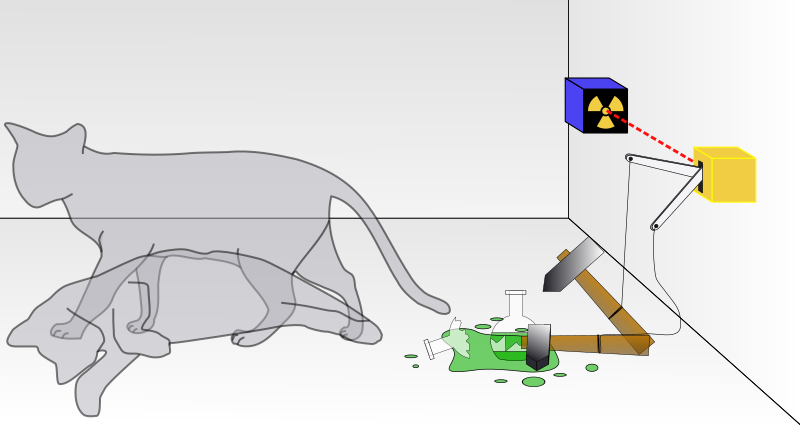
The same goes for Schrödinger's Cat. According to the "paradox", until you open the box with the cat, the cat exists as both alive and dead, and then your measurement (and, some people would say, consciousness) influences the reality.

(By the way, Schrödinger himself never postulated this as the state of events — he used his Cat as an argument ad absurdum to show that our understanding and mathematical apparatus of quantum mechanics are incomplete. But, interestingly enough, around the same time, Einstein, Podolsky and Rosen published a paper, in which they showed that, following mathematics of quantum mechanics, you can have a state of events when particles are separated spatially and yet are instantaneously linked to each other. I.e., just because they are far apart from each other doesn't mean they are distinct, independent entities. This was also an ad absurdum paper, but this phenomenon was shown to be true — it is now known as quantum entanglement. So, not all ad absurdums are absurd.)


Anyway, the point is that it doesn't require consciousness to collapse a function. What actually is required is measurement, but why that is the case is unclear. Some people say it's the interaction with the "macro-world" which collapses the function (in which case, Schrödinger's cat is exclusively dead or exclusively alive as soon as the electron interacts with the poisonous gas machine). But, recently they've done another experiment, in which they "labeled" the electron itself as having passed through either right or left slit (this way, one would know, once the electron reaches the screen, which slit it had passed through). Well, if you do that, you, as expected, collapse the interference pattern.


But then, if you put a "quantum eraser" between the slits and the screen, which will erase the "label" from the electron, you actually restore the interference pattern. So, when the electron interacts with the macro-world once, this collapses the wave function. But, if it interacts with the world twice, this restores the wave function! So, in the end, what's important is whether the electron's passage through one or the other slit is measured. If it is measured, the wave collapses. If the measurement information is erased, the wave is restored.


Again, this doesn't necc. say anything about the importance of consciousness. I think that we just have no idea what really happens when the electron wave collapses.

The unique thing about the Quantum Eraser experiment is that once electron wave collapses at the slit, there is no way that interaction of the electron's wave with itself can happen — but then, if you put up the quantum eraser, it restores the interference pattern... meaning, it is as if it told the electron: "Now go back to the past and actually interfere with yourself".

So, some people say that this shows that an electron is actually a four-dimensional wave. Its interaction with quantum labeler changes its energy such that it becomes collapsed. Its interaction with quantum eraser restores the same energy level and restores the electron's wave -- but, it restores it back in four dimensions (including the time), such that the electron is now a wave "again", not just in the space, but also in the time, including the point in the past where it passed through the slit. (I think this would be a good moshol for teshuva that Tzvi Freeman et al. could use. When a person makes a teshuva, he goes back and erases his sin — in fact, turns his sin into a mitzva. This is because, although to our perception, we exist as a point on the time line, always moving forward, in reality, we exists in all possible dimensions at the same time. And, by making teshuva, we interact, with G-d's help, with ourselves in the past.)

If you want an illustration of this concept, just watch this scene.

But, another interpretation of the Quantum Eraser experiment could be that when a wave function collapses, it does not collapse "completely", so to speak. It just passes from the state where it influences reality to the state where it does not, but it (and its interaction with itself) always exists in potential, alongside with the electron's "collapsed" path.

So, imagine that when electron passes through the two slits, all the possible paths it can take exist simultaneously — and interfere with each other in a wave-like fashion. Then, when the electron is "labeled", its wave function collapses, and only one of the paths exists "in reality". The other paths, however, do not disappear. They are still out there, hanging like punctured lines, "in potential".

If the electron is allowed to reach the screen, the potential paths and their potential interactions are never allowed to influence the reality of the electron's trajectory.

If, however, the electron interacts with the quantum eraser, the latter reverses whatever effect the quantum labeler did (by restoring the energy levels to the former, etc.). This restores the electron's state as a wave and all the "potential" possible paths become real (all at once) again — as well as their, so far only potential, interactions.

In this interpretation, there is no need to do something as esoteric as imagining the electron as a four-dimensional wave interacting with itself not only in space, but also in time. Although, perhaps the concept of potential paths existing in a state of semi-reality is even more esoteric.

Update: Regarding probabilities, a conversation in the kitchen:
— Did you know that on average, a human foot sweats a cup a day?
— Not my foot.
— I said “on average”.
— Just sayin’. My feet don’t sweat no cups per day.

Wednesday, April 6, 2011

Real and imaginary


(can you guess what function this is?)

Looking at the graph above made me think about how in "historic" sciences, such as Evolutionary Biology or Geology, we extrapolate the existing state of the world backwards in time to try to paint a picture of the past. This is like standing on the right part of the "blue" graph above (the "real" graph) and looking backwards, to x < 0.

But what if the world did not exist in the same state of "reality"? For example, it existed not in a material form, like today, but in some sort of spiritual form. And today, when we look at the world, we find the remnants of those "spiritual" processes (as they "materialized" themselves once the world passed x = 0) and, trying to interpret them, create a distorted picture of the past (since we have access only to the "real" part of the "function").

For instance, Evolutionary Biology shows relationship between species. Extrapolating back billions of years, it interprets it as descent with modification due to natural selection. And, considering that today descent with modification due to both natural and human selection is observed, that there is no reason to believe that it did not happen in the past, and that there is evidence consistent with the descent with modifications due to natural selection, all this seems to present strong evidence in favor of Theory of Evolution. (Even though many mechanisms are not clear, and many aspects of the evidence remain unexplained. So, nu, in every set of ideas you have holes and gaps. From physics to, lehavdil, Gemara. Just because there is a discontinuity in the function doesn't mean that we can't work with the function.)

But what if descent with modification did happen (and there may even have been selection), but not in "nature", since the nature, with the rest of the physical world, did not exist? Perhaps what really happened was some sort of evolutionary "spiritual" process that happened before the creation of the world and, during the first week 6771 years ago, "created" the species (which would not contradict G-d creating the species, since "He and His life-giving emanations are one; He and His garments are one" — i.e., G-d envelops Himself and becomes one with the spiritual tools with which He creates the worlds and all that is in them).

And now we see merely the material "shadow" of those spiritual events.

[string+in+five+dimensions.jpg]

(Yes, I know I am misusing the concept of imaginary and real numbers. This is just a graphic illustration. There need not be a strict coherence between the moshol and the nimshal. Also, you can interpret "imaginary" as a product of our extrapolation, or you can say that "imaginary" = spiritual, while "real" = material.)

Tuesday, April 5, 2011

Wave function build-up and the skier of Charles Addams: the gist

[Since people have ADD, I split my last post in two parts.]

This is known as a collapse of wave function.

In his book, Wheels, Life and Other Mathematical Amusements, Martin Gardner asks:
Single-panel gag cartoons, like Irish bulls, are often based on outrageous logical or physical impossibilities. Lewis Carroll liked to tell about a man who had such big feet that he had to put his pants on over his head. Almost the same kind of impossibility is the basis of a famous New Yorker cartoon by Charles Addams of a woman skier going down a slope. Behind her you see her parallel ski tracks approaching a tree, going around the tree with a track on each side and then becoming parallel again. 
Suppose you came on a pair of such ski tracks on a snowy slope, going around a tree exactly as in Addams's cartoon. Assume that they are, in truth, tracks made by skis. Can you think of at least six explanations that are physically possible?
In his Answers section, after listing the possibilities, he jokingly brings a cartoon by J. Hart. I call this situation a wave function build-up:

Wave function build-up and the skier of Charles Addams: background

Everyone knows about wave function collapse. (If you don't want to read about it, skip to the quote from Martin Gardner.)

In short, imagine you wanted to determine where I am right now. Without knowing my exact location, but knowing where I might be, you can assign probabilities to a number of locations. I can be at my home. I can be at work. I can be on my way in between. I can be in a grocery store. I can be shopping for a new pair of headphones at BestBuy. And so on. I can also be in Maryland — but with much lower probability than in the above places, although probability greater than zero. Probability of me being on the moon right now is very-very close to zero. Probability of me being in Alpha Centaura solar system is zero.

So, you can draw a "probability cloud", with each location's density proportional to the probability of my being there.


At different times, my probability cloud changes shape. For instance, on Shabbos, it becomes restricted to the walking distance around my house, and it's densest at my house, my shull, and the homes of the few people that I go to lunch to on Shabbos with my wife. Around Peisach time, my probability wave will shift to Skokie, when I will be visiting my in-laws. And so on.

The interpretation of the probability cloud regarding me is that I may be found in any of the locations on the cloud. In reality, however, at any given moment of time, I am at only one of those locations. It's not like 50% of me is at my work, 40% is at home, and 10% on the highway in between. The probability cloud is a result of your lack of precise knowledge about my location. If you put a GPS device on me, my probability cloud in your measurement will shrink to whatever the limitations of the device's accuracy are (e.g., plus-minus ten meters).

Well, in the quantum world, it's different. An electron's probability cloud has reality. The electron really exists at the same time in all the places represented by its probability cloud — the greater the probability, the more it exists there. It's as if the electron's metzius was smeared over the space.


(different shapes of electron's orbitals)


Well, if you make an experiment of shooting an electron (or any other quantum "particle") through two slots many times, as everyone knows, the collection of the marks on the screen where the electron hits will have interference pattern — a pattern similar to what you would see if you sent two waves of any kind through two slots (e.g., waves of water or a wave of light).

As waves go through space, they interfere with each other, partially cancelling each other in some places and super-imposing on each other in others, forming this pattern in the end:


In contrast, if you shoot a bunch of pellets through two slots, those pellets that pass through will form two parallel bars of marks on the screen — since the pellets don't interfere with each other (as waves do) when they fly.


(Watch this cartoon for a description of the whole experiment.)

Now, if you shoot a bunch of electrons at the screen, they will form wave-like interference patterns seen above. This suggests that electrons interfere with each other as waves when they fly through space. But, even more shockingly, if you shoot electrons one at a time, the interference pattern will be the same (with each bright bar representing places of greater probability for the electrons to hit the screen). It's as if the electron is interfering with itself when flying through space — which means that it doesn't fly as a particle, but as a probability wave, a wave of metzius, if you will, which interferes with itself just like a water wave passing through two slits.


In the last part of the experiment, if you put a detector next to one of the slits, to see if the electron "really" passes through the slit, the interference pattern forming on the screen will be only two bars. It's as if when you observe the electron, you force it to pick a slit. While flying unobserved, the electron is free to be as "scatter-brained" and indecisive as it wants (or as its wave function dictates). But, when meeting a detector (and, whatever Tzvi Freeman tells you, it's not the human consciousness that the electron meets, but simply a piece of macro-world, a detector, which will work even if the human being with his consciousness went to lunch), the electron has to make a decision, and it will decide for sure that it wants to fly through the one slot only or through the other.

This is known as wave function collapse.

[Continued in the next post.]

Thursday, March 31, 2011

Greatness in humility

“Where you find the greatness of the Holy One, blessed be He, there you find His humility.”
Talmud Bavli, “Megillah” 31a

What is the meaning of the above statement? What does it mean for G-d to be humble, to be great and to be both? In my mind, I see a few levels:
  1. In the simple meaning, His greatness and His humility can be found “in the same place”, at the same time. These two characteristics coexist, simultaneously, side-by-side. For instance, G-d creates the Universe every single second; He is holy, awesome and exalted; the angels praise Him daily, and the righteous are in awe of Him. Yet, He cares about the needs of every single worm, and we can address Him with the simplest of requests. “Kadosh, kadosh, kadosh...”, yet “poseach es yadecho...”.

    (In the words of Talmud, quoting from Dvorim: He is “The King of kings, the Supernal Being above all supernal beings, and Master of all masters — and yet, He judges on behalf of the orphan and the widow.”)

    This may teach us (who are supposed to “walk in the paths of Hashem”) that no matter how great and important we may (perceive ourselves to) be, we must still find time and space for even the most unimportant of creatures, events and people. Furthermore, we cannot be haughty about our station — the true greatness is evidenced by humility.

  2. Alter Rebbe asks a question in Tanya: how is it possible for us to say that G-d — the great exalted G-d — cares about what we eat, what we wear, what we do in our everyday lives? He answers: because Torah is really G-d’s Will and Wisdom, stemming from His Essence, and piercing each of the spiritual worlds, enveloping itself in the “garments” of each of the worlds, until it reaches the material world and envelops itself in the physical matters: in the physical food, in the meat of kosher animals for consumption and skin for parchments, in the wool for tzitzis, etc.

    And don’t say that G-d cares only about the spiritual because He Himself is so exalted and above the material. First of all, G-d is as high above the spiritual as above the material. Second, “where you find His greatness, you find His humility” — G-d’s “greatness”, i.e., His exalted Will and Wisdom, descend into this world to envelop themselves in the material matters, to become accessible to us, such that we, through performing mitzvos, can make a Dwelling for G-d in the physical Universe.

  3. Looking at Seider Hishtalshelus, the spiritual chain of the worlds and G-d’s Lights and Vessels, there is a point, where we see that we cannot go any higher. It’s the most “lifnei” and the most “le’ma’alah” one can get. Above all the worlds, above all tzimtzumim, above all definitions, powers and potentials. There, we say, is the true greatness of G-d. Well, “where you find His greatness, you find His humility”. Even that exalted level above all comprehension is merely G-d’s “humility” — His lowering Himself from His Essence to have connection to His creation.

    This is the concept of yedias ha’shlila, study through negation: one first learns about the worlds and Lights of G-d, how exalted, beautiful and awesome they are. About G-d’s creation of everything every single moment out of nothing. About His bringing of His spiritual Universe out of nothing through His Lights and His vessels, and all their intricate interactions and mysteries, a glimpse of which is barely accessible to human understanding after years of work. And after all that, we know that this “greatness” is nothing but G-d’s humility.

  4. Wherever you find G-d’s ability to reveal Himself (His “greatness”), through His Light — you find equally His ability to conceal Himself through His vessels and tzimtzumim. Both stem equally from G-d. “Hashem Elokeinu, Hashem Echod.” One cannot say that G-d is only infinite, for that way one limits Him too. G-d can express Himself through finitude as well as through infinity.

  5. At the moment where you observe G-d’s “humility”, His concealment of Himself, you actually observe His greatness. Revelations, Lights, spirituality, Upper Worlds, the souls and the angels — that’s not the true greatness of G-d. The vessels and tzimtzumim, the power to conceal and to limit and not to shine (“yecholto she lo lehoir”, or, lower, “koach ha’gvul”), the physicality and materiality — and, finally, the human body. All of these are, despite being expressions of G-d’s “humility”, so to speak, are actually expressions of His Greatness, expressions of His Essence.

    In that case, why do we need the Light? In order to reveal that His Humility is actually His Greatness.

Monday, March 28, 2011

Proving that G-d exists

From Wikipedia, Gödel's proof of G-d's existence:


The proof

Symbolically:

\begin{array}{rl}

\text{Ax. 1.} & \left\{P(\varphi) \wedge \Box \; \forall x[\varphi(x) \to \psi(x)]\right\} \to P(\psi) \\

\text{Ax. 2.} & P(\neg \varphi) \leftrightarrow \neg P(\varphi) \\

\text{Th. 1.} & P(\varphi) \to \Diamond \; \exists x[\varphi(x)] \\

\text{Df. 1.} & G(x) \iff \forall \varphi [P(\varphi) \to \varphi(x)] \\

\text{Ax. 3.} & P(G) \\

\text{Th. 2.} & \Diamond \; \exists x \; G(x) \\

\text{Df. 2.} & \varphi \text{ ess } x \iff \varphi(x) \wedge \forall \psi \left\{\psi(x) \to \Box \; \forall x[\varphi(x) \to \psi(x)]\right\} \\

\text{Ax. 4.} & P(\varphi) \to \Box \; P(\varphi) \\

\text{Th. 3.} & G(x) \to G \text{ ess } x \\
  
\text{Df. 3.} & E(x) \iff \forall \varphi[\varphi \text{ ess } x \to \Box \; \exists x \; \varphi(x)] \\
   
\text{Ax. 5.} & P(E) \\
   
\text{Th. 4.} & \Box \; \exists x \; G(x)
  
\end{array}

Modal logic

The proof uses modal logic, which distinguishes between necessary truths and contingent truths.
truth is necessary if its negation entails a contradiction, such as 2 + 2 = 4; by contrast, a truth is contingent if it just happens to be the case, for instance, "more than half of the earth is covered by water". In the most common interpretation of modal logic, one considers "all possible worlds". If a statement is true in all possible worlds, then it is a necessary truth. If a statement happens to be true in our world, but is false in some other worlds, then it is a contingent truth. A statement that is true in some world (not necessarily our own) is called a possible truth.
property assigns to each object, in every possible world, a truth value (either true or false). Note that not all worlds have the same objects: some objects exist in some worlds and not in others. A property has only to assign truth values to those objects that exist in a particular world. As an example, consider the property
P(s) = s is pink
and consider the object
s = my shirt
In our world, P(s) is true because my shirt happens to be pink; in some other world, P(s) is false, while in still some other world, P(s) wouldn't make sense because my shirt doesn't exist there.
We say that the property P entails the property Q, if any object in any world that has the property P in that world also has the property Q in that same world. For example, the property
P(x) = x is taller than 2 meters
entails the property
Q(x) = x is taller than 1 meter.
The proof can summarized as:
IF it is possible for a rational omniscient being to exist THEN necessarily a rational omniscient being exists.

Friday, March 25, 2011

A little cell magic in Matlab

Imagine we have four variables: x, y, std, and stdErr. Each variable is an array. So, we have a series of x-values, y-values, and, because each y-value is really an average of a set of values, we also have standard deviation and standard error assigned to each x.

These variables are part of a structure, called curve. So, we have our fields:
curve.x
curve.y
curve.std
curve.stdErr
Now, for whatever reason, I have pre-allocated 100 values (empty) to all my variables. Some of them are empty; some are filled. I want to get rid of the empty values. I know that I have N non-empty values. So, then:
newCurve.x = curve.x (1:N, 1);
% newCurve.x gets assigned values from 1st to Nth from curve.x along
% the 1st column

newCurve.y = curve.y (1:N, 1);
newCurve.std = curve.std (1:N, 1);
newCurve.stdErr = curve.stdErr (1:N, 1);
That does the job, doesn’t it? Well, surely so, but... it’s a bit boring. Unimaginative. Repetitive. Imagine I had fifty fields in my curve structure. I don’t want to copy-paste the same line fifty times, making corrections for a new variable each time. So, can we make this process a bit streamlined?

Well, my idea is to convert the structure into a cell; convert a cell into a matrix; use Matlab’s simple matrix operation (seen above for the matrix with size 1) to select the non-empty in the matrix; convert the matrix back into a cell, and convert the cell back into a structure. So, I have really only three steps — except that I have to tell the cell2struct function what the resulting structure’s headings are, so I have to have another line of code with those (Update: using fieldnames function, I can skip that step).


Thus:
    %% a little cell magic

    %converting to a matrix
    curve_mat = cell2mat( struct2cell(curve)' );

    %assigining non-zero values to a cell from the matrix
    shortCurve_cell = num2cell( curve_mat(1:N,:), 1);

    %converting back to a structure with field names = those of curve
    newCurve = cell2struct (shortCurve_cell, fieldnames(curve), 1);

With only four fields, I don’t really save much space (just one line of code), but you would with fifty... But that’s not the point. The point is that a soul of a former C-programmer sings when it looks at the second piece of code.

The next step is to automate the process further by writing a function outputCurve = removezeros (inputCurve, numFilled) that will take a curve structure and the number of filled values and return a structure with zero values removed. The above code will be in the function.

If you know of an even more elegant way of doing this (I am new to Matlab, so I don’t really know cell manipulation well), please comment.

By the way, in the end, if we plot the newCurve using errorBar function, we get the following:


Wednesday, March 23, 2011

Harnessing the mind: binah vs. tvunah


Source. (Click on the link also to read the text description of what binah and tvunah are, what the differences between them is and how to apply them.)

Monday, March 14, 2011

Two types of foolishness


In the ma’amor Bosi LeGani, we learn that we can create the Dwelling for G-d in this world by turning shtus d’l’yuma, the foolishness of the world, into shtus d’kedusho, the foolishness of holiness.

What is meant by the former? Being too absorbed in the wordly things for their own sake. Clothes, food, jewelry, gadgets, computer games, politics, your job. What is meant by “the foolishness of holiness”? Serving Hashem with utmost devotion, breaking even boundaries in holiness — the limitations and excuses one has set up for oneself not to grow in Torah matters. Regarding this the Rebbe says:

The way to break out of the bounds and restrictions imposed by the animal soul is to conduct oneself according to the Shulchan Aruch and to study ethical writings. This enables a person to realize that materiality is utterly worthless. As a result he will free himself of the restrictions of the animal soul, and of course from the restrictions of the body. However, when it comes to freeing oneself from restricting bounds in holy matters, that's quite a different story.

Exactly what are the latter restraints?

Concerning the study of Torah a man might argue: It’s enough for me that I am one of the “supporters of the Torah”; it's enough that I study “one chapter in the morning and one chapter in the evening”; the shiur after davenen will suffice; studying without exerting the soul or the  flesh will be quite enough; it's enough that I study nigleh, the revealed plane of the Torah: do I have to study Chassidus as well?!

Concerning avodah, i.e., davenen, the same individual argues that it's quite enough that he arrives at shul in the middle of davenen; according to the Shulchan Aruch he can then skip most of Pesukei DeZimrah, the psalms of praise — i.e., three-quarters of the davenen — so long as he prays together with the congregation. Surely it's enough that he hastily churns and chops his way through the words, without taking time off to think what they mean. If he does think about what the words mean, without meditating for a moment on Whom he is addressing, then surely that's more than enough. As to the earnest frame of mind that is supposed to precede prayer, he discharges this obligation by clasping his hands like a servant before his master; now, having done that, he can allow his thoughts to fly hither and thither...

Concerning tzedakah, this individual argues that the Shulchan Aruch itself lays down limits. There is a certain quota required by the Torah, deoraysa, and there is a certain quota required by the Sages,deRabbanan — and surely he is not obliged to give away more than the prescribed minimum. As to giving away more than a fifth of his income, then this is not only not obligatory, but (he argues) forbidden! For did not the Sages say that “he who gives freely should not give away more than a fifth”?

Besides, this individual argues, in no area of his life should a man make more stringent demands on himself than the Torah requires him to. For this stance he quotes the Talmud Yerushalmi: “Let the Torah's prohibitions suffice for you!” “Tell me,” he protests, “am I expected to be more pious than the Yerushalmi?!” In similar vein such a man contends that it is not proper to expect him to do things that go beyond the letter of the law: if only he would conduct himself according to the law, he says, according to the Shulchan Aruch…

These arguments derive from the limitations of one’s mindset — including the limitations of one’s mindset in holy matters.
 But what does it mean to convert the foolishness of the world[ly matters] into the “foolishness” of holiness?

The Rebbe explains in Bosi LeGani (Tes-Vov) that this means, on one level, taking the energy that you invest into the worldly things and re-investing it into holy things. You are not going to skip a meal, are you? If you’re hungry, you’re hungry — you will drop everything and go eat lunch. You are not going to go to sleep a little late, are you? “Sorry, I am tired; good night.” If you’re reading a book or watching a movie, you can become so absorbed in them that you will becoming completely unaware of the world around you.

Well, use the same attitude towards the holy matters. Don’t delay (or, G-d forbid, skip) learning or davening just like you wouldn’t delay or skip a meal or going to sleep. Become as absorbed in davening and learning Torah as you’re absorbed in, lehavdil, watching a fascinating movie or reading a captivating book. Run to do a mitzva as fast as you run to move your car if you know you may get a ticket. When you’re wondering whether you should “take it easy” in some concept of kedusha, replace mentally this concept with some aspect of your everyday material life, and ask yourself whether you’d take it easy there.

Then take that energy of mental investment into the worldly things (and for every one of us, this is individual: for instance, I don’t care about following sports, but I like reading fantasy; I don’t care about clothes, but I care about gadgets or computer programs; I am bored in a jewelry shop, but bring me to a bookstore, and I will get lost there¹ — for someone else, however, the list can be quite different) and apply that energy to kedusha.

_____________
¹ I know, “nerd alert”...

Sunday, March 13, 2011

Of vessels and shuckling


As I have stated in the last post, people show two extreme forms of davening: 1) davening with many outbursts of emotions in a form of exclamations, gesticulations, etc., and 2) davening very quietly and motionlessly.

Two reasons can exist for each form. For the first form, one of the reasons is that the person is fake. Or, giving him limud zchus, he is not faking his emotions intentionally, but he gets excited by the emotions (sometimes artificially induced) themselves, not by Elokus. I.e., he knows he must feel emotions about Eibeshter, and he thinks (erroneously) that when one feels these emotions, one is supposed to cry out and shake his hands, so he does the latter... and sure enough, he feels something, but it’s not directed at the Eibeshter; it’s directed at himself.

For the second form, a person can be quiet because he doesn’t really feel anything when he davens — either artificial or real. He just says the words, and maybe he even knows their meaning, but no emotions are produced in his mind. So, he is quiet.

But what about those who daven properly? Those who feel emotions, and the emotions are directed to Elokus, and yet they either cry out and express themselves outwardly or are very quiet.

When Alter Rebbe was nistalek, there was a question about who was going to be the next Rebbe of Chabad Chassidus. Some Chassidim favored the Mitteler Rebbe, Alter Rebbe’s son, and some favored Reb Aaron Strashiler, the Mitteler Rebbe’s former chavrussa. Now, to be sure, both had Rebbishe neshamos. But there was a difference in their avoida: when Reb Aaron davened, he was very expressive outwardly, and when Mitteler Rebbe davened, he was absolutely quiet and motionless.

One chossid remarked once on this difference. He said: Reb Aaron brings very great Oiros (Supernal Lights) into his neshama when he davens. But the lights are so great that they cannot be contained by the keilim (vessels) of his neshamo, and as a result, the Light “spills over” and creates a sort of emotional exothermic reaction, with Reb Aaron expressing himself very greatly.

Mitteler Rebbe, the chossid continued, also brings down great Oiros. But his neshama’s keilim are big enough to incorporate the Oiros into themselves. As a result, he davens motionlessly, because all the “energy” of the Lights is absorbed.

The difference is, said the chossid, that the Light that Mitteler Rebbe brings down stays, since it has become internalized into his neshamo...


The lesson for us (whose keilim are miniscule, and who cannot bring down great Oiros) is that we can become very emotional during davening and feel like we are surrounded by holiness. And then we can finish davening, take off tefillin and tallis, zip up the tallis bag, and go on being the same selves that we had been before the davening. That is a result of not internalizing the Light that one brings down into his neshamo during davening.

The way to avoid that is daven b’avoido — prepare oneself before davening by learning about Eibeshter and Elokus, daven slowly and deliberately, and think intently and deeply about what one has learned, trying to “see” Eibeshter in the words of prayer. To make sure, when talking to the Eibeshter, to force oneself to really address Him and not the pages of the siddur or the wall. And when one experiences emotions, not let them spill out, but keep them inside, burning like the hidden flame inside a coal.

It doesn’t always work — neither from day to day, nor from page to page, but it is important to keep trying and keep pushing.

Thursday, March 10, 2011

Quiet and dry


One rap star, who had once claimed to be a part of Chabad movement, remarked, upon his apparent “conversion” to a different branch of Chassidus, that he was not inspired by Lubavitch style of davening. “A Lubavitcher whispers when he davens,” he said. “[A member of another Chassidic group] screams.”

(When I heard this story for the first time, I remarked: “It is not polite to yell at the Eibeshter.”)

I have heard a story about one “Polish” Chossid remarking that Chabad is like a handgun without a flint. A complicated mechanism, with the many hammers and springs and wheels... but the spark is not there.

And true — Chabad Chassidim (the real Chassidim) and especially Rebbeim have always been known for the very quiet nature of their avoidas ha'lev, the service of prayer. Why is that?


I heard today a description of three levels of avoida in the Beis HaMikdosh. The first level was karbonos, the sacrifices. In order to burn all the meat, the kohanim burnt large pieces of wood, stacked on top of each other. The fire was roaring — Gemara remarks that sometimes things would be thrown off the platform by the fiery winds. The combustion of the fire was fighting with the moisture of the wood and the flesh: two opposites, one trying to overcome another in a roaring struggle.

When Menoira was lit, it was silent. The flame burnt the finest, purest olive oil. This was no struggle. A peaceful co-existence of the flame, the wick and the oil.

When the ketores (the incense) was lit, there was neither flame nor smoke. Apparently, when the incense was dried very well (and made into a very fine powder), it would not even give off smoke (the smoke is a result of moisture remaining in the incense); nor would it burn with a flame. It just quietly smoldered away, releasing the smell.


The first level of service represents the struggle between the spiritual (fire) and the physical (water), the struggle between the G-dly Soul and the Animal Soul. As the former tries to subdue the latter (in a process called iskafia), their fight releases much heat, passion and noise.

The second level represents a union between the spiritual and the physical — and, likewise, the union between the G-dly and the Animal Soul, where the first transforms the second in an act of ischapcha. The flame and the oil co-exist in shleimus, and there is no need for all the noise and outward expressions of the combustion. And yet, two distinct entities exist on this level — albeit at peace with each other.

On the third level, the level of ketores (which, according to Chassidus, corresponds to Atzmus Ve’Mahus of Hashem), not only is there no noise or struggle, not only is there no outward release of “emotions” (even in a form of a quiet smoke) — there is not even a separation between the flame and its fuel. There is complete unity. Similar to Achdus Hashem, the Oneness of G-d — Oneness not only in His Essence, but also with His Creation, both spiritual and physical, both Light and Darkness.


The first Rebbe of Chabad, Shneur Zalman of Liadi, was known to say, while davening: “Ich vil nisht Gan Eiden Tachton. Ich vil nisht Gan Eiden Elyon. Ich vil Dich Alein.” (“I don’t want the Upper Gan Eiden. I don’t want the Lower Gan Eiden. I want You Alone.”) Rebbeim Chabad were not satisfied with having His Light. They wanted His Essence too. And they reached what they wanted. But that is not what is special. What is special is that their shared Him with their Chassidim.


Also see on the subject: “Emotions which have not been internalized