Showing posts with label 19th century. Show all posts

Wednesday, February 15, 2012

Halachic basis for Medicare?


(George Washington, asking G-d whether he should socialize horse fodder production)

The Jewish Law blog, to which I am subscribed, linked to the following article in its recent post. You can read the article yourself, but basically, it argues that Halacha supports or even mandates some sort of socialized healthcare provided by the government through taxpayers' money. I urge you to read the article.

These are my two responses to it. The first one is rather brief and does not address my view of Dina D'Malchusa Dina fully, for I did not (nor do now) have time and all the necessary sources at my disposal for a full answer. This is my limited answer then:

First part:
A few comments: 
1. Of all the leaps of logic found in this article, this is probably the greatest in my opinion: 
“Applying this ruling leads to the conclusion that once a person is part of a community, there is a broad scope of public services that a community can compel its citizens to pay for. However, it would seem that the communal funds must be gathered for the purpose of meeting a public need.

It would be easy to imagine that public medical insurance could meet this definition. Medical care is a service that everybody needs at one point or another and if a town decides to create a communal insurance system to address the issue, the town would presumably have the right to set up such a system.”

I can include almost every aspect of everyday life under the logic of the last sentence and then (following the logic of the quoted passage) include it under “a need of the community” that needs to be provided for by the government through compelled taxation.

For instance, cell phone service. Everybody in modern society, at one point or another, needs to make a call.

Food. Shoes. Clothes. Computers. Cars. Chairs. Housing. Etc.

This logic leads straight to socialism — all the property of the populace is transferred to a secular (or religious) “beis din” and then redistributed back according to the political or social calculations of the beis din.

Meanwhile, socialization of medicine leads to real decrease in the quality of services provided. Israel is a good example of how a potentially good medical system can be ruined by socialization.

2. The author of the article does not define a “thieving government”. My perusal of various Halachic sources suggests that the US government may very likely fall under this category.

3. Is there a source extending the rights of a Jewish king to eminent domain to a secular king (a king who is not a Jew or a Noahide gentile)? The article does not provide one.

4. I found this footnote curious: “19 Ad loc sv mahu; also see Rashi sv vayatzilah holding that it is forbidden to save oneself with the money of one’s friend” (p. 102 in the text).

The system of society that the Americans have established in the Thirteen Colonies during and after the American Revolution is not that of monarchy. This is not a trivial point. According to the philosophy of the Founding Fathers (explicit in the Declaration of the Independence, Federalist Papers, the Constitution, etc.), American government does not own the people. The people are not its subjects, and the government is not a sovereign.

The people are the government’s clients. The people are considered to possess certain natural rights to their property and livelihood, and they hire the government to protect those rights. They delegate their rights to the government. Thus, for instance, if I have a right to defend myself, I can delegate that right to the government.

That is the relationship between the people and the government. Now, if you follow Rashi’s stated opinion, if I may not compel you to save my life with your property (or use your property by force to save my life), I should not be able to use a company that I hired as my representative to do the same.

Second part:
This is all ignoring the question of even if it permissible for the current governments to tax people for whatever transfer-of-property scheme, whether it is a good idea for us to allow it. I.e., just because something is halachically permissible, does not mean it is a good idea pragmatically. (One could even say that it does not necessarily mean it is moral.) One can find halachic sources allowing beating one's wife if she did not cook the dinner...

One point is the one I already raised in the [previous] post: allowing the government to manage any kind of industry (from shoe making to television to roads to medical care) basically ruins that industry. The best way that the decisions about direction of capital in an industry can happen is through free market — competition and cooperation between service-providers for the customers' business (and competition between the customers for the products and services in the cases when the latter are scarce). 
The government (or any other monopoly) does not have the necessary foresight to manage the resources most effectively. This argument is known as “economic calculation problem” and was presented by Jewish-Austrian libertarian economist Ludwig von Mises.

The other problem with government-provided medical care is that it violates people’s “natural rights” through taxation (the taxation is potentially justified from natural rights perspective only when the one taxed receives some products or services in return). Now, a frum Jew may not be worried about “natural rights” as presented by the Western philosophers of the 18th-19th centuries, but, unfortunately, the history has shown that once you allow the government to violate natural rights for the supposed “common good”, you open the door for it to violate many different kinds of rights and interfere in personal lives — including Jews’ religious personal lives (not to mention their livelihoods).

All the regimes that constricted Jews’ freedom of religion have done so under the premises of “common good”. Indeed, if you follow their logic, they were doing Jews a favor by forcibly converting them to Christianity, not allowing their children to learn Torah, forcing them to send kids to secular governmental schools, etc. In our times, there has been a proposal to ban bris in San Francisco. It was rejected — but in many European countries, shechita and bris are banned. Homeschooling is banned. (So, if there are no private Jewish schools available in one’s area, one has to send kids to a public school or have them taken away by the state. Chabad shluchim in Sweden are currently facing this problem.) The list, from the past, the present and the potential future goes on.

Even in Israel, frum Jews are forced to listen to kol isha in the army, because a posek in the army has declared that it’s muttar. Well, these Jews’ poskim disagree, but the opinion of this, more meikel, posek is imposed upon them by the state. We see that Jewish governments and frum elements within them can be just as tyrannical.

Therefore, it seems to me that even if the government may have a number of powers granted to it by Halacha (a statement that I personally do not necessarily agree with), it may still be a bad idea for us to support a government that exercises these rights. Until Moshiach comes, the government that governs least governs best.

Saturday, February 11, 2012

19th century vs. 20th century

Someone, in a conversation with me, has claimed that if we went back to the gold standard, or at least, if the Central Bank did not inflate the currency, there would be zero economic growth (or even a recession).

I countered that we certainly did not observe this happening in the 19th century, when US and UK economies grew very rapidly.

He answered: Yes, they grew, but not nearly as rapidly as in the 20th century.

Let's see if he is right. One thing about the growth of the economy is that it is an auto-catalytic process: the product catalyzes the reaction, so the more product you have, the faster the reaction rate. If you start off with $100, your business will grow slower than if you start off with $100,000. (Your business will grow as a result of you re-investing a portion of your profit. The more you invest, the more it will grow. But since your profit from $100,000 will be greater than from $100, your business growth rates will be different.)

To correct for this, it's useful to look at the logarithm of growth, as opposed to pure growth. For those who don't know much math, logarithm is a function inverse of exponential function. So, if a graph shows exponential growth (as in the case of growth rate of an auto-catalytic reaction), its log will show a straight line.

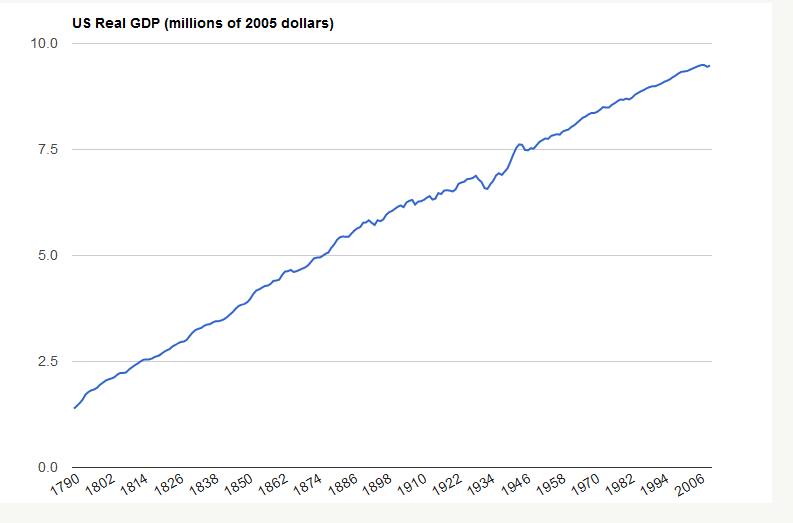
After this introduction, let's look at the data. The following figures show growth of GDP in the United States, from 1790 to 2010. The graphs are logs (including the second one, despite the label). "Real GDP" is adjusted for inflation, as I understand (I may be wrong).

I don't know about you, but to me, growth rates seem very comparable. And GDP is just the first measure of growth that came to my mind and not necessarily the "purest" measure of the growth of "real wealth".


(Source: Measuring Worth > Datasets > US GDP)


This is also a rather interesting graph — Consumer Price Index, in logs:


Here are raw data:


If you go to the interactive graph, you will see that the prices rose rapidly when US entered a war (the US Revolution in 1776, the War of 1812, the War of Northern Aggres... I mean, the Civil War in 1861, and the First World War in 1916). Then, FDR took away Americans' gold, and the prices rose for the duration of the Great Depression and the Second World War. Then, in 1967, the last tie to gold standard was cut, and the prices were rising ever since.

So, basically, the effect of US government on the prices of products and services is similar to that of a war.

Yeah, but if there was no inflation, there would be no growth, right? Go back to the beginning of the thread.

Some more background:

First, this: http://www.tomwoods.com/inflation/

Second, this:

Friday, February 3, 2012

Effect of income tax on technological progress

[A re-post with some new points]

Oftentimes people tell me that science would not flourish as it has in the 20th century had it not been sponsored by income tax. The idea of private sponsorship of science (either in a form of investments, like in any other business, or in a form of donations) would not work, or at least would not work on the same scale as it has under governmental sponsorship. Until recently, I thought so too.

Let’s see if this is true — what effect has income tax (introduced in the late 19th century and made permanent in early 20th century) and, in general, government’s funding of science had on the rate of technological breakthroughs?


I think the effect is pretty clear. Until the end of 19th century, technology has been developing at an extremely high rate. Then, in late 19th – early 20th century, the rate started to slow down and then started to decrease. Saying “look how far we got in 20th century in terms of technology after government started sponsoring its development” is the same as saying “look how far I got walking on my feet after I abandoned my car on the side of the road”.

Recently someone told me that without inflation, there is no growth (apparently, Rick Santorum believes the same). I answered that England and US have grown tremendously in the period of 1700–1900 (when the currency was not only not inflating, but was actually deflating). He said: "yes, but it was the fraction of growth US has experienced in the last thirty years". I challenged him to provide me with evidence that the rate of growth was higher in the 20th century than in the 19th. Meanwhile, Tom Woods claims the opposite:


Going back to the question of governmental funding of science — so, why would private businesses fund science (after all, aren’t they interested in immediate profit?), and why don’t they do so now? Also, even if the businesses did fund science (and of course, they still do), it would be only applied, not fundamental science, right?

This claim is repeated by most scientists I know. No wonder most of them love the government.

Well, think about this: oil companies invest money in geological research that will produce real profit 30 years from now. Sounds to me like investment into fundamental science that gives long-term profit. (I certainly hope that my personal discoveries will provide humanity, iyH, with some practical benefit, in addition to added theoretical knowledge, less than 30 years from now.)

Now, imagine if the government used taxpayers’ money to do the aforementioned geological research? Why would the oil companies spend money to do it then?

Meanwhile, the cost of doing science has risen greatly, because the companies that supply universities with materials know they can raise the prices, since the government will pick up the bill. The same is happening in medicine and education.

At the same time, the quality of service is going down. It is very hard to buy a good antibody nowadays (as opposed to, say, 10 years ago), since the market is full of antibodies that do not work or don’t work well. The companies mass-produce them and sell them, knowing that the government-sponsored labs will buy them no matter what, since they are less careful with their money spending (after all, the government will pick up the bill, and if you run out of one grant, there is always another to be applied for).

And this is just one example...

Wednesday, May 5, 2010

English vs. French

Richard Sharpe: Those men who’ve fought in a big battle before, one pace forward.

[no one moves]

Richard Sharpe: This place is called Talavera. There’s going to be a battle here tomorrow. You’ll fight in it... maybe even die in it. But you won’t see it.

[explosion]

Richard Sharpe: There’s a lot of smoke in a battle. Our cannon, their cannon. Our shot, their shell. Our volleys, their volleys.

[shots]

Richard Sharpe: You don’t see a battle. You hear it.

Black powder blasting by the ton on all sides. Black smoke blinding you and choking you and making you vomit.

Then the French come out of the smoke — not in a line, but in a column. And they march towards our thin line, kettledrums hammering like hell and a golden eagle blazing overhead.

They march slowly, and it takes them a long time to reach you, and you can’t see them in smoke. But you can hear the drums. They march out of the smoke, and you fire a volley. And the front rank of the column falls, and the next rank steps over them, with drums hammering, and the column smashes your line like a hammer breaking glass... and Napoleon has won another battle.

But if you don't run — if you stand until you can smell the garlic, and fire volley after volley, three rounds a minute — then they slow down. They stop. And then they run away. All you’ve got to do is stand and fire three rounds a minute. Now, you and I know you can fire three rounds a minute. But can you stand?

Friday, April 9, 2010

Subclavian, or aorta itself

In the post in which I quoted a passage about Patrick O’Brian’s Stephen Maturin performing a surgery on himself, a couple things should have caught your attention: 1) Dr. Maturin inquired whether the woman whom he asked Jack Aubrey to visit was wearing black, and 2) when he declined the offer of another doctor, he said: “No, sir. I do this with my own hand. If it could undertake the one task, it must undertake the other: that is but justice.”

Putting the two things together, one realizes where Maturin got his wound — at a duel over a woman! (And he was wondering whether she was mourning over the other fellow by wearing black — which she wasn’t.) As any red-blooded male, I like to read about duels (although I prefer swords to pistols), so here it is:

Thursday, April 8, 2010

Never you fret, sir

Recently I posted an account of a Russian doctor performing a self-surgery (an appendectomy).

A scene from H.M.S. Surprise, where Dr. Stephen Maturin operates on himself, removing a bullet from his own body: