Showing posts with label Middle East. Show all posts

Wednesday, October 3, 2012

Lacanian psychoanalysis of Chabad and Modern Orthodox Judaism


(Slavoj Žižek, post-modernist troublemaker)

I am going to try to analyze Chabad and Modern Orthodoxy using the psychoanalytic approach of Lacanian triad: 'the imaginary, the symbolic, and the real' (I'll explain below).

I want to do this because I have for a long time thought about the dichotomy of the 'real' and the 'imaginary' in the MO world. In addition, recently, I have read Iraq: the Borrowed Kettle by Slavoj Žižek (pronounced as 'Slah-voy Zhih-zhek'), a Marxist philosopher-psychoanalyst. I obviously disagree with many of Žižek's ideas and conclusions about capitalism and the Western world, but I find his analytic methodology entertaining. (So, keep this in mind as you read the bits of this post about the Iraqi war. What matters is not the contents, but the analysis.)

In Iraq, Žižek analyzed the motivations for the 2003 invasion of Iraq using Lacanian psychoanalytic triad:

1. The imaginary: the purpose of the war was to spread the ideals and the benefits of the Western democracy. This was the official propaganda line fed to the masses in order to garner their support.

2. The symbolic: the purpose of the war was to spread American political hegemony. This level is called symbolic because the invasion of Iraq really served a 'symbolic' purpose in the international diplomatic stance of the USA: it strengthened its roles as the international policeman and 'paved the way' for the possibility and acceptability of now starting the war on the 'imaginary' grounds, without support of the UN, and in a form of preemptive strikes.

3. The real reason for the invasion, according to Žižek, was economic control over Iraqi oil and, more generally, strengthening of US dollar against the euro. (Perhaps one can tie in the Keynesian motive for mythical 'stimulus' of the economy through defense spending.) This is classical of Žižekian analysis of political events: he envisions a nation-state, a government, or a culture (e.g., the USA) as an individual, and applies to it Freudian and Lacanian psychoanalysis, showing that (in his opinion) the sub-conscious drive is the real one.

Now, let me say at once that I do not necessarily agree with the above analysis of Iraqi war. Or, rather, I neither agree nor disagree. It is certainly the case that the invasion has failed on all three accounts: it did not help with spreading of democracy, either in the region or in the world; it has ruined US political image and led to diplomatic and military backlash, and it had an adverse effect on US economy on multiple levels, including, in the long-term, the current Great Recession. Of course, that doesn't mean that Zizek is wrong in his analysis of motivations.

As Kelsey Wood notes in Žižek: A Reader's Guide:
Žižek is careful to point out that in this Lacanian triad of imaginary-symbolic-real, each of these three levels has some degree of autonomy, and none of the is simply a mere semblance (Iraq, p.4). For example, ideological fantasy produces effects in people's behavior, and has an impact on people's lives. This indicates how fantasy is constitutive of symbolic reality. But again, with regard to the triad of imaginary-symbolic-real, 'it is not that one is the "truth" of the others; the "truth" is, rather, the very shift of perspective between them' (Iraq, p.6).
Again, I do not care whether or not Zizek's analysis is true. I care about using this method to analyse both MO and Chabad branches of 'frum' Judaism.

Let me start with Chabad, using davening as an example (I am crediting my wife for giving me this idea):

1. The imaginary: on this level, we look at davening through 'general' Orthodox Judaism. I.e., all the halachos of davening, the nusach, what davening consists of (the parts of davening), the zmanim, etc. Also, the purpose of davening as interpreted by Alter Rebbe: connection to Hashem.

The 'imaginary' level can also be termed 'ideal' or 'formal'. In a chess game, the 'imaginary' dimension of a chess piece is the rules by which it moves. A synonymous expression for 'imaginary' is 'make-belief', and that applies to the religious application of the Lacanian triad: the 'imaginary' aspect is not something that is not real (G-d forbid), but it is something one must believe in, or at least it's not something accessible to one's immediate experience; it is both a foundation and a goal, both of which must exist on the level of emunah-like commitment (you can read here more about the distinction between emunah and da'as).

2. The symbolic: when looked at through Chabad Chassidus, davening is not simply carrying out of the halachic obligation, but a path of self-development, literally an avoida ('service'). Again, I am using the 'symbolic' as merely Lacanian jargon. In an abstract sense, the act of prayer itself (i.e., what is literally a supplication) is a 'symbol' (an excuse, if you wish) for improving oneself and establishing a relationship with Hashem.

For that purpose, one must daven at length, with great concentration (oftentimes outside of the minyan), and, most significantly, one must learn Chassidus before davening, so that one can be hisboinen (contemplative, meditative) of the learned concepts (comprising either haskallah, the intellectual concepts, or avoida, the concepts of self-service, of Chassidus, or both). This has effect on the interpretation of Halacha (the first level), since, to fulfill the 'symbolic' aspect of davening, we must be lax with the zmanim, allow eating before davening, etc.

3. The real. In reality, you can find Shachris minyanim in 770 going on until almost after shkiah. Not because some chassidim use this much time to learn Chassidus, but because davening late has become a 'reality' of Chabad culture, independently of its 'imaginary' and 'symbolic' counterparts. The same goes for eating before davening (sometimes eating a quite substantial meal), etc.

Don't get me wrong: I am not saying that this is what happens to most Lubavitchers. (In fact, I don't really know what the numbers are.) I am just saying that this phenomenon (almost unique to Chabad) exists, and that's what its nature is.

Of course, it is also true that davening has become a completely different experience ('reality') in Chabad circles, both for the newcomers and the 'balabatim'. Many people would describe davening at Chabad as a richer, deeper, more vibrant experience, albeit annoying to the Jews belonging to other branches of Orthodox Judaism, whose 'imaginary' and 'symbolic' (and, as a result, 'real') expectations of davening are somewhat different.

The same analysis can be applied to many other aspects of modern Chabad 'culture', both in terms of shlichus and the 'Crown Heights' velt. I think it can also be used in a positive sense. For example: a person is stopped on the street and asked to shake lulav and esrog:

1. The imaginary: the person does the mitzva of lulav and esrog, the formal obligation he has to G-d. G-d's Will is carried out in this world.

2. The symbolic: the act of doing the mitzva connects to the essence of his neshama, revealing it (potentially). The act of doing the mitzva is important not because of its dry obligatory context, but because of what it accomplishes: the unification of G-d with this world through the act of mitzva and the subsequent creation of dira b'tachtoinim (the dwelling place of G-d in the lower worlds). I.e., the mitzva is not just a dry fulfillment of a contract, but a vehicle (a 'symbol') for the essential purpose of creation and revelation.

3. The real: it is possible that the person will become interested in Yiddishkeit and inquire about it (and, perhaps, about Chabad specifically) and this simple encounter will bring him 'back' (or, at least, closer) to frumkeit. In this, the circle of the purpose of mivtzoim is closed.


Now, let's use the same analysis in application to Modern Orthodoxy:

1. The imaginary: MO views itself as Orthodox Judaism. In fact, it does not view itself as a 'b'dieved Judaism', i.e., Judaism of a compromise. According to the MO philosophy, its path of Yiddishkeit is preferred. Torah is given to be lived, in this world. (Note that this is not the same as the Chabad concept of engaging 'der velt' in order to make dira b'tachtonim. For Chabad, 'der velt' is the goal. For MO, it's simply the status quo. When a Lubavitcher gets a job, he is being an idealist, at least as far as Chabad Chassidus is concerned. When a MO Jew gets a job, he is being a realist.)

Likewise, Torah is given to real human beings, with real desires and everyday circumstances; it was not given to the angels.

2. The symbolic: In order to accomplish the goal making Torah accessible to the modern mentality of the 'real, everyday' Jew living in the Western world in modern times, one must unite Torah with 'modernity'. Because this contemporary Jew is the one commanded with both performance of the mitzvos and learning of Torah, we must be able to interpret the meaning of the former and the content of the latter from today's, modern, perspective.

From here comes the MO view of Judaism. Mitzvos are patterns of behavior that bind us together in a Jewish community. Torah is G-d's revelation of His message of how to live a fulfilling and successful life in everyday world. The 'realism' of the mitzvos and of Torah is pushed to the shadows. It doesn't matter whether the world was created in Six Days, 5773 years ago. What matters is the message of the story to us, today. It doesn't matter whether I accomplish 'objectively' anything when I shake lulav and esrog. What matters is that that I feel and 'experience' something when I do it, that I focus on the symbolism of the act, in its historical and (constantly reinterpreted) everyday context.

3. The real: Having their significance reduced to merely symbolic context, mitzvos and Torah stop being religious phenomena and start being social ones. They are no longer an aspect of the Jew's (or the community's) relationship with G-d; they are an aspect of the Jew's relationship with other Jews and a way for him to see his own culture and self-identity on the national and international scale.

When a Chabad rabbi speaks before Musaf, he talks about avoidas Hashem and da'as Hashem. He uses some aspect of the parsha or the Yom Tov as an illustration of what our relationship with G-d must be, or how we can understand G-dliness -- G-d's revelation of Himself in the worlds, the purpose and design of His creation, etc.

When a MO rabbi speaks before Musaf, he talks about Israeli politics, using a symbolic interpretation of an aspect of the parsha (reduced almost to an anecdote). Or, perhaps, he talks about how we must approach our everyday work environment or a project: the parsha can teach us about successful interpersonal relationships or work ethic and give us peace of mind.

The interpretation of the mitzvos also suffers from the symbolic approach. Because hair covering is looked at from the symbolic point of view, not either strictly legal (as a Litvish Jew might look at it) or 'realistic' -- i.e., having a real, objective purpose outside of one's perception (a Chabad Jew's perspective), it is only important insofar as it binds a Jewish woman to a particular community of hair-covering women, or if it adds anything to her personal experience. Otherwise, it is discarded.

The same goes for many other mitzvos. The tendency of make Torah 'livable', armed with always-ready ability to assign a symbolic interpretation to a mitzva, allows one to be as meichel as one possibly can (or as Rav Moishe allows), and then perhaps some more.

In reality, therefore, MO Judaism is 'Orthodox' in name only. In practice, both its theoretical view of Judaism and its practical observance is almost closer to Conservative Judaism, from which, after all, it has evolved (as one MO rabbi said, a bit tongue-in-cheek, 'if the Hareidim build mechitza up to the ceiling, and the Conservative don't have a mechitza at all, the Modern Orthodox mechitza will be exactly half-way').


I don't know what my conclusion might be. Writing of this post was mostly self-therapeutic in nature and perhaps may be of some help to those whose encounters with MO Judaism (or Chabad, for that matter) were frustrating.

Next project: psychoanalysis of the 'yechi' culture. Just kidding!..

Monday, March 26, 2012

Tricky thing called "democracy"

Before I start, I’d like to note that this argument does not touch the morality of government in general or the religious appropriateness of having an Israeli (secular) state. It simply touches the question of peace and preserving Jewish lives, prosperity, and tranquility in the region.

Yungerman in Lubavitch posted the following video on Facebook:


So, it’s nice that Rick Santorum recognizes Israel’s rights to keep its "honestly" conquered lands, right? Let’s say that I don’t have a problem with that (within the realm of something called "international law", something whose legitimacy I am not sure I recognize fully, but that’s another issue). I am not actually sure, because I haven’t really thought about it for a long time. The logical nature of this principle evades me (why shouldn’t the defending state give the attacking state’s land back, with the attacking state paying reparations for the attack?.. of course, if the attacking state refuses, the defending state can keep whatever portion of the land is equivalent to the reparations). But then, most logical arguments about "states’ rights" evade me. So, as I said, let’s say I don’t have a problem with the concept of keeping the territory conquered in self-defense.

The problem is that, as everyone knows, Israel is not interested in making the presumed "Israelis" (as Santorum called them) that live in Gaza and West Bank into Israeli citizens because of a tricky thing called "democracy" and "abuse of minority at the hands of majority" — something which, incidentally, Rick Santorum is a fan of himself. That is why many Israelis themselves claim that they support the idea of a two-state solution to the crisis.

Also, the problem with what he is saying is that while US should not have to give Texas back to Mexico, if Texans wanted to have their own country (or go back to being Mexicans), US should allow it to happen, since whatever presumed "implicit contract" might have existed between the people and the government is broken as soon as the people want to be rid of the government. Therefore, after the contract is broken, the government is no longer "representing", but is simply occupying the land and its people in a state of tyrannic aggression. Americans did fight a War of Independence against a country which they were presumably citizens of, didn’t they?.

I think West Bank/Gaza, as well as Northern Ireland, as well as many other places on Earth are good examples of how a region could benefit from anarcho-capitalist (or voluntarist) society. A "No-State" solution: a lot of private companies, paid for by private citizens, ensuring safety and law in the land. The companies can have only Jews, Jews and Arabs, only Arabs, etc., as their clients and can negotiate between each other a state of peaceful coexistence. This would also require the land to be privatized — something that would solve many other problems. Jews could still have their "government" — i.e., a set of private protection and legislative companies that favored Jewish interests in the area (and had a lot of guns, a lot of money coming from Jews in the region and throughout the world, and a lot of negotiating power).

In this case, negotiation between companies may be quite tricky, and I do not think that a military conflict could always be avoided, at least at first. But the region is already in a semi-constant state of military conflict! How much worse could it get?

Plus, the companies would compete with each other for quality of service. Today you have a monopoly in the form of Israeli Army, which, frankly, we have no idea how effective it is. It’s more effective than its Arab colleagues, but so what? It’s also more effective than Eskimos. We are talking about the effectiveness using the same people, same technology, same place and time. Different managers, different business strategies (which, in war today, include things like effectiveness of defense, best management of resources, human and material, and as little as possible casualty to non-combatant civilians for humanitarian and PC purposes).

The same goes for Israeli legislature. Or, basically, any other monopoly in Israeli society. I would say most ills of the Israeli society today that I know of (besides rudeness) come from the existence of the state and a monopolizing government.

Note that I am not saying that Jews would be better off living under another state. It might be that Israeli State is the best slave-master/overseer that Jews in the region can expect under the current conditions. But why have a slave-master at all?

Thursday, June 24, 2010

A note

http://letustalk.files.wordpress.com/2008/07/obama-in-iraq-helicopter-2.jpg
(“If you use your free insurance, your teeth will look as shiny as mine”)

A note found in President Obama’s desk from his predecessor.
To: President Obama
From: President Bush
Subject: When [...] hits the fan

Dear Borya,

When things get tough, do the following:

1. Blame everything on me.
2. Do everything exactly like me.

Best of luck,
Garik
It seems our mighty leader has gotten to step two. (If you remember, President Bush started a war in Iraq. The war was going badly. Liberals and the press were screaming. Then the President found a proper general, who won the war. The same story, by the way, happened with President Lincoln.)

[via arbat]

Tuesday, May 11, 2010

Brotherly love


(click on the image to enlarge)

There are many “modern” ways to read into the deeper meaning of this ancient, proud Slavic song, but we shall stick to the traditional interpretation: that cossacks valued friendship and a warrior’s duty over love (and I use the last word in a very general sense).

The song is sung in a slow or quick tempo (the translation is not the best, but it will do):

From beyond the wooded island
To the river wide and free
Proudly sailed the arrow-breasted
Ships of Cossack yeomanry.

On the first is Stenka Razin
With his princess by his side
Drunken holds in marriage revels
With his beauteous younger bride.

From behind there comes a murmur
"He has left his sword to woo;
One short night — and Stenka Razin
Has become a woman, too."

Stenka Razin hears the murmur
Of his discontented band
And his lovely Persian princess
He has circled with his hand.

His dark brows are drawn together
As the waves of anger rise;
And the blood comes rushing swiftly
To his piercing jet-black eyes.

"I will give you all you ask for
Head and heart and life and hand."
And his voice rolls out like thunder
Out across the distant land:

"Volga, Volga, Mother Volga
Wide and deep beneath the sun,
You have never seen such present
From the Cossacks of the Don.

So that peace may reign forever
In this band so free and brave
Volga, Volga, Mother Volga
Make this lovely girl a grave."

Now, with one swift mighty motion
He has raised his bride on high
And has cast her where the waters
Of the Volga roll and sigh.

"Dance, you fools, and let's be merry
What is this that's in your eyes?
Let us thunder out a chantey
To the place where beauty lies."

From beyond the wooded island
To the river wide and free
Proudly sailed the arrow-breasted
Ships of Cossack yeomanry.

Now, amongst the historians there is a great degree of disagreement regarding the question of whether Stenka Razin really did drown the Persian princess (whom he held as a hostage) and if he did, what his reasons might have been. I have just perused a work analyzing this important chapter in Russian national history. It quotes different sources, going back to such authorities as Jan Jansen Streiss (1630–1694), Dutch “sailing master” working on a Russian ship, and Louis Fabricius (1648–1729), Dutch emissary to Persia. Let me tell you: the answer is not so simple.

Besides the traditional view presented in the mighty hymn above, another opinion says that she jumped herself after discovering that she was pregnant, but a careful analysis from military historians pointing at the time when the princess might have been captured debunks this view.

Some sources present a view that she was sacrificed to the cossack deity that was associated with either Caspian sea or Volga (like most Christians, the cossacks were rather liberal in their religious beliefs and were not bothered by the conflicts of mono- and polytheism; of course, when the time came to kill someone else for his religious beliefs, they became rather orthodox). You see, before the cossacks departed on a raiding expedition to Caspian sea (as all Russians know, river Volga flows into Caspian sea¹) they would bring sacrifices to both the river and the sea — oftentimes human ones. For Halachic reasons, I cannot tell you the name of their maritime deity, but what I can say is that it is also the name of one American hurricane of the past.

In any event, this wouldn’t be the first time someone sacrificed his (or her) family for religious beliefs. Although a counter-argument states that if Razin had a Persian princess as a newly-acquired captive, he would be sailing up river Volga, away from the Caspian sea and Persia, not towards them.

In reality, eastern Cossacks did capture Persian women and even settle in a colony called Persiánovka, where they started off families with their captives. Due to the mobile nature of their enterprise, however, the colony did not endure.

After the Shvuos, I will present, iyH, the different musical versions of the song.

______________
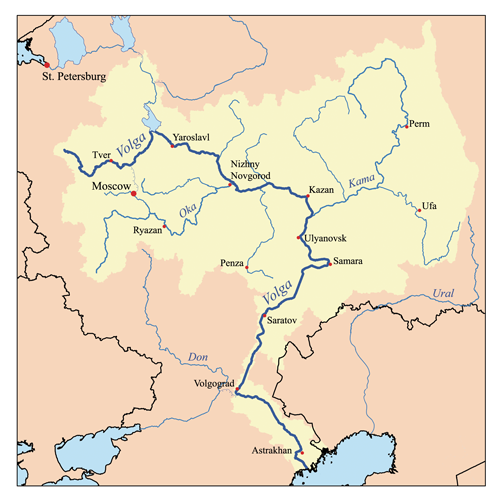
¹ “And Volga flows into Caspian sea” is a Russian way of saying “duh” — i.e., stating an obvious (and sometimes useless) fact. This map confirms this fact. Also, it shows how long the river is: it starts north of Moscow and goes all the way to Caspian sea, north of Iran. Russia in general is known for its long rivers.

By the way, these cossacks were known as Don Cossacks, because the river Don was their main base of operation. Don and Volga are two of the three mighty Russian rivers (the third one is Dnepr). There is a place where Don and Volga come close to each other. It is a site of the city called today Volgograd, although back in the day it was called Stalingrad and was the place where one third of the whole Nazi army was encircled and destroyed by the Soviet forces.

(Of course, the three mighty rivers are those just on the European side. Siberia also sports quite a collection of long and wide waterways. One of them is called Lena and was the source of the nickname of the first leader of the Soviet Union.)

I actually wonder how a Russian version of Three Men in a Boat (telling of a journey up or down Volga, for instance) would look like.

Wednesday, July 15, 2009

How Christianity was born

… literally. (Warning: somewhat R-rated.)

“Teen [alegedly] pregnant after swimming in a pool.”

I guess the whole “Holy Spirit did it” excuse has been so overused nobody would believe it anymore.

Monday, June 8, 2009

The circus is back in town


An interesting article on Voz Iz Neias: “What Obama taught me”.

Holocaust, schmolocaust.

Aren't those pesky Jews ever going to go away? Yes, denying the Holocaust is "hateful." But let's get a grip. Palestinians "endure . . . daily humiliations." Their lot's "intolerable." Israel "devastates Palestinian families." No wonder our president shunned wicked Israel during his trip - sending a clear, if unspoken, message that Jews are now fair game.

"America's strong bonds with Israel are . . . unbreakable." Yup. And they're issued by Chrysler.

Hamas is a legitimate, recognized voice of the Palestinians. Rocket attacks against civilians, suicide bombings and kidnappings really work.

Iran can have nukes.

Our president's acceptance of "peaceful nuclear power" for Tehran was coded language for "no pre-emptive military action."

Jordan doesn't matter.

So much for one Arab country's attempts at human decency. If you want attention from our president, you've got to be a desert gangbanger.

My wife wondered why Obama didn't make his speech in Indonesia, the world's most-populous Muslim state, where he would've been welcomed proudly as a home-boy. Obama just reinforced the stereotype that Muslim equals Arab.

Democracy isn't for everybody.

We're done peddling that particular drug.

What are my personal thoughts about our president’s speech? They are fully expressed in this video:

Sunday, February 1, 2009

A thought on Arabs

http://i62.photobucket.com/albums/h89/ffix1975-2/sub/w03.jpg
(German prisoners of war in Moscow)

WWII and post-WWII history teaches us a very important lesson applicable to the war with Arabs.

If we are to defeat the Muslim civilization in this war, like we defeated Germans and Japanese, there is only one way to do it.

Break them. Defeat them militarily, dominate and publicly humiliate (primarily in their own eyes) their culture, and turn them into soft-spoken, leather-wearing hippies. There is no other solution.

German and Japanese nations suffered a number of military and cultural defeats throughout history, yet they remained the same. They retained the same ambitions and goals and behaved the same way during subsequent wars. Until they were defeated, occupied, nullified and transformed.

One cannot domesticate a wolf. It needs to be turned into a dog.

* * *

Update: As this post notes, Israel has already achieved pretty good results with Egypt and Jordan. OK, not complete transformation like in Japan and Germany, but something one can live with…

Monday, January 26, 2009

Jimmy Carter’s world

PowerLine blog reports about the interview with Jimmy Carter.

I think the man became unhinged after the rabbit incident.

One-year truce

Very amusing news.

Thanks to Hesh of FrumSatire for the cartoon.

http://www.frumsatire.net/wp-content/uploads/2009/01/ceasefire-pic.jpg

(Actually, it would be amusing if it wasn’t sad. Let me refer you again to JEMnation’s presentation of the Rebbe’s view.)

Thursday, January 22, 2009

Where’s that button?..

...Oh, here it is. “Smite!”


Imagine if this is how IDF hunted Muslim terrorist leaders?

(Actually, who knows…)

Monday, January 19, 2009

Shoe-throwing journalist fears for his life

From here:
“He is in danger over there”, Poggia told The Associated Press in a telephone interview Monday. “He’s also in danger in other Muslim countries because people who support his action could try to make him a martyr.”
But… that’s… good for him, isn’t it? Or maybe all those virgins are not looking so good anymore? (I mean, after all is said and done, one is stuck with seventy-two wives. Not good…)

Thursday, January 15, 2009

Irrational war


I started learning this year’s Bosi LeGani for my birthday.

Amongst many things and mosholim that came to my heretical mind, one moshol was that of a war with middas ha’netzach (desire for victory). Such a war is not fought by a king to expand his sphere of influence or for riches or loot, but for an essential reason. Either it is a war of preservation or a war, in which all essence of the king has been revealed (if he does not wage this war, he will not be a king for much longer). In either case, no riches are spared, and no calculations of cost matter.

* * *

World War II was such a war. Actually, WWII in Europe. Actually, WWII in Eastern Europe. Between Nazis, yimach shmem, and the Soviet Union. For the former, it was a war that expressed their leader’s (yimach shmoh) inherent essential desire. A psychopathic desire, but nonetheless, a desire which had no calculation or reason.

For the Soviets (at least simple people) it was a war of self-preservation. That is why they displayed self-sacrifice and fanaticism that would be shocking under different circumstances. As a student of history may know, battles of Moscow, Leningrad and, especially, Stalingrad were clear examples of this: absolute irrational, animalistic, fanatical hatred and desire to be victorious and inflict damage on the enemy at any cost.


Lehavdil, war in Eretz Yisroel happening in our times is similar. On the one side, there are Arabs whose only essential desire is to wipe out Israel (whatever their leaders may say in Guardian, Newsweek, Pravda, etc.). No cost is spared or calculated — including cost of their children and (supposedly) innocent civilians.

And for Israel, of course, it’s the war of self-preservation. In which Israel, unfortunately, does do calculations and precautions — which are, of course, never enough for the sniveling bastards from the UN. But on the level of common people, soldiers ready to give their lives to protect their people, this war is the same essential war of self-preservation, where people are willing to defend themselves and be victorious over their enemy at any cost (I only wish this sentiment was shared by the government).

* * *

This is why the anarcho-libertarian “solution” for the war which I recently discussed would never work. Normally, the idea of libertarian anarchism is that under such a system, “organizations” providing law and defense would not go to war with each other because it would be too costly — and these organizations’ clients would not condone such wars and stop supporting these organizations financially (leading to these organization — like any other entity on a market — being replaced by others, more fitting to their consumers’ desires).

In the case of Arabs, however, this would never work — because neither terrorist organizations nor common people supporting them care about profit, loot, economic benefit, or justice and morality. They have an irrational hatred for Jews and will not stop at any sacrifice to fulfill this hatred. (For the liberal crowd out there, obviously, I am not talking about any inability on genetic level. I am talking about culture and... well, memotype.)

* * *


Everything was created in opposites. Those things one can find in darkness are also found in holiness. We must fight the spiritual war with the exile through middas ha’netzach. We must do it not for our own benefit, for our physical and spiritual comfort and growth, but for the victory — the fulfillment of the reason of this world’s creation. To repeat the words of Alter Rebbe, “I don’t care about this world; I don’t care about the Lower Heavens; I don’t care about the Higher Heavens. I only care about Him.”

We must fight — with the utmost degree of mesirus nefesh — against golus. And then we will realize that the treasures which Hashem is ready to “squander” for us to achieve this victory are already here — ready to be used for one final battle.

(Pictures taken from here)

Wednesday, January 7, 2009

What is taught at UN schools

Why would evil Israelis fire at a UN school for innocent Arab children (and by children I mean boys)?


Of course, this is not the angle most journalists have played it from. After all, would you expect journalist to go against their nature and be responsible, as Noah Pollak suggests?

Allow me to propose a metric for evaluating whether a journalist is behaving responsibly or not: If he reports that Israel bombed a UN school and killed 30 civilians, he is irresponsible.

If he reports that Hamas used a UN school as a weapons cache and base of operations for launching mortars at the IDF, and the IDF’s return fire killed the Hamas cell along, tragically, with a yet-unspecified number of civilians, then he is behaving responsibly. If he wishes to be particularly scrupulous, he might additionally note that Hamas had rigged the school with explosives which detonated after the IDF took out the mortar team, killing a large additional number of civilians.

And he might add that you can go to the IDF’s Youtube channel to view footage from 2007 of Hamas using the very same school as a mortar-launching base.

Journalists who abjure reporting the vital details of this story should be called what they are — activists masquerading as reporters.

Good luck finding a scrupulous journalist.

Sunday, December 28, 2008

C’est la vie

A Russian joke:
An English lord is sitting in his office; he hears noise outside his windows, loud shots. He calls his butler and asks:
— Barrymore, what is going on?
— London prostitutes are protesting; they say they need higher pay, sir.
— And are they really getting low pay?
— I wouldn’t say so, sir.
— So why are they protesting?
— Whores, sir.
OK, the joke (like most Russian jokes) is poorly translatable into English. But, why did I suddenly think of this joke? Well, I usually think about whores when I read about news media. This time, it was a little piece here by Istapundit.
American media opinionator Greg Mitchell at HuffPo, silent on missiles coming out of Gaza, decries American media opinion silence on missiles going back into Gaza.
There is nothing new under the moon.

Can you feel the love?

Between sister Muslim/Arab (or whatever the hell the inhabitans of Gaza are) nations…

Friday, October 17, 2008

Liberals meeting with foreign dictators unconditionally


In case you’re a student of history wondering: “What does Obama’s proposal to meet unconditionally with dictators remind me of?”, here is a collage for you:


(Carter with Venezuelan wannabe-Socialist dictator, Hugo Chávez)


(Carter with Romanian Socialist dictator and mass-murderer, Nicolae Ceauşescu)


(Carter with Palestinian terrorist leader, yimach shmo)


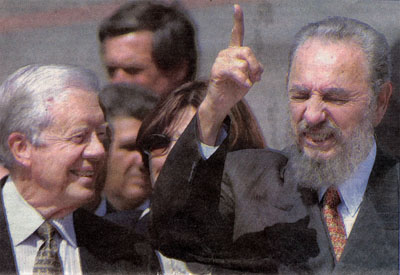
(Carter with Cuban Socialist dictator, Fidel Castro)

And just a sprinkle on the cake:

(British appeaser Prime Minister, Neville Chamberlain, meeting in 1938 with the Nazi leader, yimach shmo, to discuss how the latter would be allowed to have Czechoslovakia — as long as he doesn’t invade anything else. For stability’s sake. As a way to prevent a big war. “Peace in our times”, no less.)