Nadav Bachar (guitar) and Oren Tzur (violin):
(source — download the video)
I’ve never seen before a violin being used like balalaika. Can you do this with all stringed instruments (play them with fingers)? Can you use bow on guitar?
Also, at the beginning of the video (0:07–0:09), is that a monkey, a cat or a squirrel sitting in the yard?
More by Nadav Bachar (and on MySpace):
(download)
Showing posts with label music. Show all posts
Showing posts with label music. Show all posts
Monday, September 19, 2011

Wednesday, August 31, 2011
Dancing and fashion in a century
Definitely the 20th century will be known as the Little Dark Age. I think this is exemplified not just in politics, but also in fashion and dance/music. The clip below shows a man and woman being dressed in clothes of every sub-period from early 20th century to our times and doing the popular dance moves of the time.
I can’t really comment about the clothes (although to me, they eventually start looking not just more casual, but also more random and less thought-out), but after a certain point (after the War... or, should I say, after the reign of FDR), the music becomes more like sounds of a grandfather clock falling down the stairs, while the dancing looks increasingly more like epilepsy.
(This video obviously shows a man and a woman dancing. In the later parts of the video, the dancing is somewhat suggestive, but not pornographic. One could argue that since one is watching this video for illustrative/educational purposes, it's not, strictly speaking, ossur, but those who are makpid about such things, beware.)
Don’t get me wrong. Nobody who has seen me dress could ever accuse me of being fashion-conscious. My idea of a comfortable clothing is jeans with a striped short-sleeved collared shirt (and your regular penguin look for Shabbos with the simplest shirt and shoes possible). And my idea of dancing is a bunch of men in a circle with hands on each other’s shoulders.
Western culture is not my culture. And a spider’s web is not my idea of a house. But I can objectively observe that a spider’s web is becoming more intricate and laid with meaning or purpose as the time passes... or less so.
I can’t really comment about the clothes (although to me, they eventually start looking not just more casual, but also more random and less thought-out), but after a certain point (after the War... or, should I say, after the reign of FDR), the music becomes more like sounds of a grandfather clock falling down the stairs, while the dancing looks increasingly more like epilepsy.
(This video obviously shows a man and a woman dancing. In the later parts of the video, the dancing is somewhat suggestive, but not pornographic. One could argue that since one is watching this video for illustrative/educational purposes, it's not, strictly speaking, ossur, but those who are makpid about such things, beware.)
Don’t get me wrong. Nobody who has seen me dress could ever accuse me of being fashion-conscious. My idea of a comfortable clothing is jeans with a striped short-sleeved collared shirt (and your regular penguin look for Shabbos with the simplest shirt and shoes possible). And my idea of dancing is a bunch of men in a circle with hands on each other’s shoulders.
Western culture is not my culture. And a spider’s web is not my idea of a house. But I can objectively observe that a spider’s web is becoming more intricate and laid with meaning or purpose as the time passes... or less so.
Thursday, August 11, 2011
East and West, take 3
I mean, take five.
I think this is quite awesome. On multiple levels. (Source: Alex Exler.) The video starts at 0:08.
The original.
See also this (Soviet soldiers and breakdancing).
P.S. I am quite sure I saw a cartoon or a short clip with the Take Five music in the background. It was not the Pink Panther, but something quite similar to it in style. If someone remembers what it is, please comment.
P.P.S. Got it!
I think this is quite awesome. On multiple levels. (Source: Alex Exler.) The video starts at 0:08.
The original.
See also this (Soviet soldiers and breakdancing).
P.S. I am quite sure I saw a cartoon or a short clip with the Take Five music in the background. It was not the Pink Panther, but something quite similar to it in style. If someone remembers what it is, please comment.
P.P.S. Got it!
Wednesday, October 27, 2010
Paristocrats
Another wonderful piece from Gonzales. Despite somewhat noisy recording, it is a very nice clip; very strong performance.
Tuesday, October 26, 2010
A blitz duel on pianos; singalong
I love duels! And I love piano music. So, here goes:
More by one of the two pianists (Gonzales) — a singalong:
Besides the fact that I really like this music, I like the above because in the age when the music listened to by the majority (Jews and non-Jews alike) is not only bad music but in many cases not music at all (in that it fails to stand on its own feet and convey emotions successfully), this guy is doing propaganda of good music in general and piano music in particular.
[via Ilya Birman’s blog]
Damn, this is fine (another piece that I liked from the same album here):
More by one of the two pianists (Gonzales) — a singalong:
Besides the fact that I really like this music, I like the above because in the age when the music listened to by the majority (Jews and non-Jews alike) is not only bad music but in many cases not music at all (in that it fails to stand on its own feet and convey emotions successfully), this guy is doing propaganda of good music in general and piano music in particular.
[via Ilya Birman’s blog]
Damn, this is fine (another piece that I liked from the same album here):
(click ↑ on 720p for higher quality)
Thursday, June 10, 2010
Left march
I like the music. :)
“Anarchist sailors’ march”. Although, wrong kind of anarchists (the socialist ones).
Those of you who don’t understand the words (Google-translate this), you can appreciate at least the rolling rrrr’s.
Wednesday, June 9, 2010
Albert Einstein on music
If I were not a physicist, I would probably be a musician. I often think in music. I see my life in terms of music. I get most joy in life out of music.
— Albert Einstein
As is well known, Einstein played a violin. I find it interesting how strong his opinions on music were. (Also, this touches the question of taste vs. objective quality, but I won’t go into that here.) From here (quoted from Albert Einstein: The Human Side, where I read it first when I was doing a paper on Einstein’s Dreams by Alan Lightman). From his answers to a questionnaire regarding his taste in music:
(1) Bach, Mozart, and some old Italian and English composers are my favorites in music. Beethoven considerably less — but certainly Schubert.It certainly makes me feel better about my tastes. Not in the sense that they “agree” with Einstein’s — I am rather fond of Beethoven, for instance — but in the sense that I feel less guilty not appreciating some famous musicians (I don’t particularly like Chopin, for example, to my chavrussa’s disgust). On the other hand, it is more likely that I don’t appreciate them because I have bad or undeveloped taste and no first-hand knowledge of music, while Einstein’s taste was probably grounded on something more substantial.
(2) It is impossible for me to say whether Bach or Mozart means more to me. In music I do not look for logic. I am quite intuitive on the whole and know no theories. I never like a work if I cannot intuitively grasp its inner unity (architecture).
(3) I always feel that Handel is good — even perfect — but that he has a certain shallowness. Beethoven is for me too dramatic and too personal.
(4) Schubert is one of my favorites because of his superlative ability to express emotion and his enormous powers of melodic invention. But in his larger works I am disturbed by a certain lack of architectonics [German: "Architektonik"].
(5) Schumann is attractive to me in his smaller works because of their originality and richness of feeling, but his lack of formal greatness prevents my full enjoyment. In Mendelssohn I perceive considerable talent but an indefinable lack of depth that often leads to banality.
(6) I find a few lieder and chamber works by Brahms truly signficant, also in their structure. But most of his works have for me no inner persuasiveness. I do not understand why it was necessary to write them.
(7) I admire Wagner's inventiveness, but I see his lack of architectural structure as decadence. Moreover, to me his musical personality is indescribably offensive so that for the most part I can listen to him only with disgust.
(8) I feel that [Richard] Strauss is gifted, but without inner truth and concerned only with outside effects. I cannot say that I care nothing for modern music in general. I feel that Debussy is delicately colorful but shows a poverty of structure. I cannot work up great enthusiasm for something of that sort.
Tuesday, May 11, 2010
Brotherly love

(click on the image to enlarge)
There are many “modern” ways to read into the deeper meaning of this ancient, proud Slavic song, but we shall stick to the traditional interpretation: that cossacks valued friendship and a warrior’s duty over love (and I use the last word in a very general sense).
The song is sung in a slow or quick tempo (the translation is not the best, but it will do):
From beyond the wooded island
To the river wide and free
Proudly sailed the arrow-breasted
Ships of Cossack yeomanry.
On the first is Stenka Razin
With his princess by his side
Drunken holds in marriage revels
With his beauteous younger bride.
From behind there comes a murmur
"He has left his sword to woo;
One short night — and Stenka Razin
Has become a woman, too."
Stenka Razin hears the murmur
Of his discontented band
And his lovely Persian princess
He has circled with his hand.
His dark brows are drawn together
As the waves of anger rise;
And the blood comes rushing swiftly
To his piercing jet-black eyes.
"I will give you all you ask for
Head and heart and life and hand."
And his voice rolls out like thunder
Out across the distant land:
"Volga, Volga, Mother Volga
Wide and deep beneath the sun,
You have never seen such present
From the Cossacks of the Don.
So that peace may reign forever
In this band so free and brave
Volga, Volga, Mother Volga
Make this lovely girl a grave."
Now, with one swift mighty motion
He has raised his bride on high
And has cast her where the waters
Of the Volga roll and sigh.
"Dance, you fools, and let's be merry
What is this that's in your eyes?
Let us thunder out a chantey
To the place where beauty lies."
From beyond the wooded island
To the river wide and free
Proudly sailed the arrow-breasted
Ships of Cossack yeomanry.
Now, amongst the historians there is a great degree of disagreement regarding the question of whether Stenka Razin really did drown the Persian princess (whom he held as a hostage) and if he did, what his reasons might have been. I have just perused a work analyzing this important chapter in Russian national history. It quotes different sources, going back to such authorities as Jan Jansen Streiss (1630–1694), Dutch “sailing master” working on a Russian ship, and Louis Fabricius (1648–1729), Dutch emissary to Persia. Let me tell you: the answer is not so simple.
Besides the traditional view presented in the mighty hymn above, another opinion says that she jumped herself after discovering that she was pregnant, but a careful analysis from military historians pointing at the time when the princess might have been captured debunks this view.
Some sources present a view that she was sacrificed to the cossack deity that was associated with either Caspian sea or Volga (like most Christians, the cossacks were rather liberal in their religious beliefs and were not bothered by the conflicts of mono- and polytheism; of course, when the time came to kill someone else for his religious beliefs, they became rather orthodox). You see, before the cossacks departed on a raiding expedition to Caspian sea (as all Russians know, river Volga flows into Caspian sea¹) they would bring sacrifices to both the river and the sea — oftentimes human ones. For Halachic reasons, I cannot tell you the name of their maritime deity, but what I can say is that it is also the name of one American hurricane of the past.
In any event, this wouldn’t be the first time someone sacrificed his (or her) family for religious beliefs. Although a counter-argument states that if Razin had a Persian princess as a newly-acquired captive, he would be sailing up river Volga, away from the Caspian sea and Persia, not towards them.
In reality, eastern Cossacks did capture Persian women and even settle in a colony called Persiánovka, where they started off families with their captives. Due to the mobile nature of their enterprise, however, the colony did not endure.
After the Shvuos, I will present, iyH, the different musical versions of the song.
______________
¹ “And Volga flows into Caspian sea” is a Russian way of saying “duh” — i.e., stating an obvious (and sometimes useless) fact. This map confirms this fact. Also, it shows how long the river is: it starts north of Moscow and goes all the way to Caspian sea, north of Iran. Russia in general is known for its long rivers.
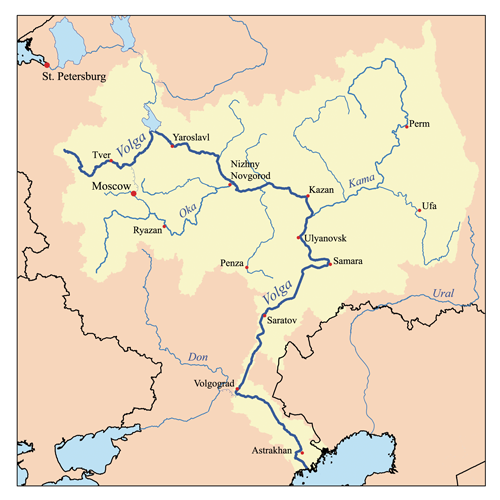
By the way, these cossacks were known as Don Cossacks, because the river Don was their main base of operation. Don and Volga are two of the three mighty Russian rivers (the third one is Dnepr). There is a place where Don and Volga come close to each other. It is a site of the city called today Volgograd, although back in the day it was called Stalingrad and was the place where one third of the whole Nazi army was encircled and destroyed by the Soviet forces.
(Of course, the three mighty rivers are those just on the European side. Siberia also sports quite a collection of long and wide waterways. One of them is called Lena and was the source of the nickname of the first leader of the Soviet Union.)
I actually wonder how a Russian version of Three Men in a Boat (telling of a journey up or down Volga, for instance) would look like.
Sunday, April 11, 2010
Rossini and sphiras ha’oimer
The best of all are those people that refuse to shave all 49 days of the Omer to be acording to the shita of the Arizal and Kabballah, and then they shave Erev Shavuos with a “leshem yichud” beforehand.
For those of you whose spirits have been sombered up by the seriousness of the previous post, a little sphera-friendly entertainment:
On a related topic, does chochmas chitzoinius even refer to science, or merely to stuff like this?
Thursday, March 25, 2010
Thursday, March 18, 2010
Theodore Bikel
Of his Yiddish songs, I like Kum Aher du Filozof (a snag friend of mine used to say he liked this song because it makes fun of both chassidim and maskilim).
His Russian accent is most charming:
From Songs of Russian Gypsy.
Tzu veystu vos der Rebbe tit
Beshas er zitst bi’ychides?
In eyn minut er in himl flit
Un pravet dort shalesh-shides.
His Russian accent is most charming:
Dark Night (original). I used to listen to this song over and over on a record.(For the last two songs the titles in the player are wrong.)
What’s sadness to me?
Gypsies coming home (a rather liberal interpretation, but a very nice one)
From Songs of Russian Gypsy.
Tuesday, March 9, 2010
Od yeshama...
Typical scene in Western Ukraine... (For TRS and other fundamentalists who don’t watch YouTube — Jewish content here.)
Monday, March 8, 2010
Living in times of Moshiach through study of Chassidus
From Mitteler Rebbe’s biography:
* Incidentally, I was given Imrei Binah as a present for my birthday, so if someone wants to be my chavrusa in learning it, please contact me.
[Mitteler Rebbe’s] greatness was not just in the abundance of ma’amorim he said or their length, it was also because of the tremendous depth of his explanations.___________
Commenting on that depth, the Rebbe Rashab said, “My hair fell out from concentrating on the Mitteler Rebbe’s Imrei Binah*.”
As for publicizing Chassidus among the chassidim, the Mitteler Rebbe encouraged his chassidim to constantly discuss Chassidus among themselves. This desire of his became their reality.
Perhaps this is why the chassidim say that the Mitteler Rebbe’s chassidim felt as if they were living in the days of Moshiach. The Rambam writes that when Moshiach comes, the world will be filled with the knowledge of Hashem. For the Mitteler Rebbe’s chassidim, this was their reality. They were constantly immersed in the study of Chassidus.
* Incidentally, I was given Imrei Binah as a present for my birthday, so if someone wants to be my chavrusa in learning it, please contact me.
* * *
In other news, this dude looks so Russian! Look at his energy and see the sparks which Chassidus Chabad absorbed.
Tuesday, February 23, 2010
On snobbism
Is one still a snob when his snobbism is justified? (A reference to TRS saying recently that I am a snob because I think that classical music is much better at expressing emotions than rap.)
Monday, February 15, 2010
Masculinity...
...is when you wear a pink shirt and still feel like a man. I actually like the lyrics of the song — very romantic (not joking). Mixed singing, but honestly, I can’t even hear the women; I think men’s voices are higher.
This video just shows once again that Russians (or, in this case, Byelorussians) can beat Americans at anything — even at looking metrosexual.
Now that we are on the topic of classy songs, I can’t help but bring this one out:
This video just shows once again that Russians (or, in this case, Byelorussians) can beat Americans at anything — even at looking metrosexual.
Now that we are on the topic of classy songs, I can’t help but bring this one out:
Sunday, February 14, 2010
Roinnt ceoil, le do thoil
For my rabbi who likes Celtic music. In this particular sequence, I like the first reel more than the others.
I apologize to le7 for this one:
There is a Jew attending a local school who, like me, likes Martin Hayes. And just like me dislikes assholes.
For a long time my roommate thought the following song was about McDonalds. This is one of the songs I use to illustrate to English speakers how American songs sound to me (not in quality, in which they are greatly inferior, but in the percentage of words I understand).
After years of listening to this song in my car, I understand almost all the words:
I apologize to le7 for this one:
There is a Jew attending a local school who, like me, likes Martin Hayes. And just like me dislikes assholes.
For a long time my roommate thought the following song was about McDonalds. This is one of the songs I use to illustrate to English speakers how American songs sound to me (not in quality, in which they are greatly inferior, but in the percentage of words I understand).
After years of listening to this song in my car, I understand almost all the words:
Thursday, February 11, 2010
Russian field and billiards
Also, the same song from Dmitriy Khvorostovsky, with some landscape images from Russia:
As one of the comments on Youtube says, "La musique russe il n'y a pas mieux, les chanteurs vivent leur musique. C'est l'âme d'un peuple, on ne s'en lasse jamais."
Thursday, January 21, 2010
A musical pause
Something Classical (I assume everyone knows Chopin):
Something classy (I assume everyone knows the tale of Bremen Musicians):
Something Russian (I assume most Americans don’t know Garik Sukachev):
Something classy (I assume everyone knows the tale of Bremen Musicians):
Something Russian (I assume most Americans don’t know Garik Sukachev):
Thursday, January 14, 2010
Gypsies!
My Byzantine history professor once said something like: “Civizalitions of Eurasia from time to time were shocked by invasions of barbarians that were mass-produced in the factories somewhere on the steppes of Russia.” It’s quite amusing that whenever Hashem wanted to stir things up in Europe (or in China), he sent a wholesale order for some barbarians to somewhere in Siberia, Mongolia or Central Asia. And things would start moving: civilizations would fall and rise.
Well, from musical point of view, gypsies remind me of this somewhat. Although originating in India (in most languages of Eastern Europe they are called “tziganeh”, pointing at the valley between Indian rivers Tzi and Gang), they’ve had a disproprtionate influence on music of Europe. Russian, Czech and Hungarian music comes to mind, but I am sure there are other examples.
Well, from musical point of view, gypsies remind me of this somewhat. Although originating in India (in most languages of Eastern Europe they are called “tziganeh”, pointing at the valley between Indian rivers Tzi and Gang), they’ve had a disproprtionate influence on music of Europe. Russian, Czech and Hungarian music comes to mind, but I am sure there are other examples.
Subscribe to:
Posts (Atom)