Monday, July 18, 2011

Pnimiyus ha'keili


In Chassidus, there are three basic components of spheroes, the specific expressions of Hashem in Seider Hishtalshelus:

1. Oir Ein Soif — Infinite Light of Hashem
2. Pnimiyus ha'Keili — the Essence of a Vessel
3. Chitzoinius ha'Keili — the outer aspect of the Vessel

It makes sense the the Vessels should be of a lower level than the Light. Light is infinite, simple and expresses Hashem. Vessels are finite, have specific properties or aspects (or, rather, because of them the specific aspects of Light that had been so far hidden in potential are expressed), and conceal and define/shape the Light. Vessels come from Hashem's Potential Not to Shine (Yecholto SheLoi L'hoir), while the Lights come from Hashem's Potential to Shine (Yecholto L'hoir).

On the other hand, if you look at the specific sub-divions of the Vessels, something interesting is revealed: the second level in the enumeration above, the Essence of the Vessels, is not only higher than the outer aspect of the Vessels; it's even higher than the Infinite Light itself!

How are we to understand this?

From Kabbalistic point of view, we can explain it this way. The essence of the vessels is the reason, the motivating force of their action, while their outer aspect is the action itself. The Infinite Light is an expression of Hashem. The ultimate desire of Hashem, however, is that His expression reaches its specific target in the Seider Hishtalshelus. For this reason, the Light must be limited and shaped.

Therefore, as we learn from Kabbala of Arizal and from hemshech Ayin Beis of Rebbe Rashab, the force that motivates the action of the Vessels is actually mushrash b'Atzmus — its source is in the Essence of Hashem! Therefore, it makes sense that it is higher than the Light; since Essence of Hashem is infinitely higher than His expression through the Light, the "motivating force" for the keilim that stems from it (and becomes pnimiyus ha'keilim) is also higher than the Light.

* * *

To give an example from music, a melody consists of notes. Notes result from a string being divided — for instance, by pressing on it at a specific spot with a finger. Where exactly the string is divided determines what frequency it will vibrate at, which determines the note. If you only divide the string, however, no music will result. The string also has to start vibrating (through someone plucking it, or bowing, or striking it with a little hammer).

So, there are two aspects to making a note: the vibration of the string and the fact that it is divided and thus is vibrating at a particular frequency (pitch). [Of course, there is also how hard it is plucked, which determines the volume of the note, but we won't go there.]

So, division of the string is the keili, and its vibration is the oir.

But there is a third component: the one who divides the string. The purpose of the division. That is the pnimiyus ha'keili.

* * *

One can also give an example from a relationship. Let's say, one buys flowers for his wife. Why does he buy them? Because he wants her to feel nice. So, the intention is the oir, and the flowers are the keili, the way of expressing that intention. But there is the third component: remembering to buy the specific flowers that the wife likes. That's pnimiyus ha'keili.

And perhaps we can say that remembering which flowers she likes (or what kind of specific favor she wants at the moment) is even higher than the whole act of buying flowers altogether.

Different devils

Interesting difference between the portrayal of the Satan in Russian and American movies.

Russian (the content is not important; I am more interested in look and feel of the character):


American:

Depressive animals


As we know from Tanya, depression comes from Nefesh Ha'Bahamis, and it takes Nefesh Elokis to battle. So much the harder this is to do so for those who don't have the latter.
Interfax: A ferret and a monkey ran away from Chita's cirque chapiteau, followed by an Australian necklace parrot.
As the creative director of the circus Janna Lazerson told to news reporters, the cause of the escape is depression caused by bad weather: "We think that the animals escaped due to depression, since it has been raining hard in Chita."
According to Lazerson, only the monkey was found. It was discovered sleeping in a cage with a dog, which the monkey was hugging in its sleep. The two other escapees have not been found yet.
Creative director of the circus explained that the parrot is missed by the female parrot, who was his partner during the show. According to Lazerson, the trained ferret could go for a visit to one of Chita's families. She mentioned that the main features of the ferret are laziness and gluttony.
Representatives of chapiteau hope that in the nearest time, the ferret and the parrot will return to the circus. 
[source]
I can't figure out if this is for real or a joke.

Update: according to this article, the ferret was discovered in the city park by one of the city's citizens. The ferret was hand-trained and friendly, "knew how to open doors and responded to a clap on the leg". (The reason why in the above article it was hypothesized that it would go looking for humans is that it is both lazy and gluttonous and thus seeks human contact. I was planning to make some politically incorrect joke here about liberals and minorities, but felt too lazy to do it...) It was brought to a local zoo, where it was fed and put to bed, until the owners of the circus came to claim him.

The parrot is still missing. Its female friend really misses him. If the parrot is reading this, he should consider at least sending her a message.

P.S. I am really annoyed at how unbalanced the colors and brightness/contrast are in the above picture, but I don't have ImageJ on this computer. I will fix it when I get home, iyH.

P.P.S. The bottom line is: even the animals are depressed in Russia. I mean, sure, blame the bad weather. I don't hear of animals escaping English zoos.

Blast from the past

Looking through my old e-mail messages, found these pictures in a draft. I am not sure why I had wanted to share them in the first place, and why I never did. But here they are:


(on the left — former Russian President and current Russian leader, Vladimir Putin)


[source censored due to past nisht pictures; re-open the above pictures to see the source url]

Sunday, July 17, 2011

Three men in a boat, Russian version

This post is not sarcastic or critical of Russian culture. There are still intelligent and talented — if wacky — people left in Russia. The designer Artemiy Lebedev who organized ethnographic expedition down Russian rivers is one of them.

Preparation (the labels you see on the sides of the boat are from the companies that sponsor the expedition, which, in turn, provides an advertisement for them):


I like the part where he goes through the junk food and says: "No expedition can go without this."

Passing through river locks (if you get bored, you can skip down to a more interesting third video or to Jerome K. Jerome's humorous description of passing through 19th-century English locks):


Morning of the third day (the most picturesque of the three videos):


As Lebedev posts more videos, so shall I (perhaps).

Speaking of river locks (source):

For myself, I am fond of locks.  They pleasantly break the monotony of the pull.  I like sitting in the boat and slowly rising out of the cool depths up into new reaches and fresh views; or sinking down, as it were, out of the world, and then waiting, while the gloomy gates creak, and the narrow strip of day-light between them widens till the fair smiling river lies full before you, and you push your little boat out from its brief prison on to the welcoming waters once again.They are picturesque little spots, these locks.  The stout old lock-keeper, or his cheerful-looking wife, or bright-eyed daughter, are pleasant folk to have a passing chat with.  You meet other boats there, and river gossip is exchanged.  The Thames would not be the fairyland it is without its flower-decked locks. 
Talking of locks reminds me of an accident George and I very nearly had one summer’s morning at Hampton Court.
It was a glorious day, and the lock was crowded; and, as is a common practice up the river, a speculative photographer was taking a picture of us all as we lay upon the rising waters. 
I did not catch what was going on at first, and was, therefore, extremely surprised at noticing George hurriedly smooth out his trousers, ruffle up his hair, and stick his cap on in a rakish manner at the back of his head, and then, assuming an expression of mingled affability and sadness, sit down in a graceful attitude, and try to hide his feet. 
My first idea was that he had suddenly caught sight of some girl he knew, and I looked about to see who it was.  Everybody in the lock seemed to have been suddenly struck wooden.  They were all standing or sitting about in the most quaint and curious attitudes I have ever seen off a Japanese fan.  All the girls were smiling.  Oh, they did look so sweet!  And all the fellows were frowning, and looking stern and noble. 
And then, at last, the truth flashed across me, and I wondered if I should be in time.  Ours was the first boat, and it would be unkind of me to spoil the man’s picture, I thought. 
So I faced round quickly, and took up a position in the prow, where I leant with careless grace upon the hitcher, in an attitude suggestive of agility and strength.  I arranged my hair with a curl over the forehead, and threw an air of tender wistfulness into my expression, mingled with a touch of cynicism, which I am told suits me. 
As we stood, waiting for the eventful moment, I heard someone behind call out:
“Hi! look at your nose.” 
I could not turn round to see what was the matter, and whose nose it was that was to be looked at.  I stole a side-glance at George’s nose!  It was all right—at all events, there was nothing wrong with it that could be altered.  I squinted down at my own, and that seemed all that could be expected also. 
“Look at your nose, you stupid ass!” came the same voice again, louder. 
And then another voice cried:
“Push your nose out, can’t you, you—you two with the dog!” 
Neither George nor I dared to turn round.  The man’s hand was on the cap, and the picture might be taken any moment.  Was it us they were calling to?  What was the matter with our noses?  Why were they to be pushed out! 
But now the whole lock started yelling, and a stentorian voice from the back shouted:
“Look at your boat, sir; you in the red and black caps.  It’s your two corpses that will get taken in that photo, if you ain’t quick.” 
We looked then, and saw that the nose of our boat had got fixed under the woodwork of the lock, while the in-coming water was rising all around it, and tilting it up.  In another moment we should be over.  Quick as thought, we each seized an oar, and a vigorous blow against the side of the lock with the butt-ends released the boat, and sent us sprawling on our backs.The photographWe did not come out well in that photograph, George and I.  
Of course, as was to be expected, our luck ordained it, that the man should set his wretched machine in motion at the precise moment that we were both lying on our backs with a wild expression of “Where am I? and what is it?” on our faces, and our four feet waving madly in the air. 
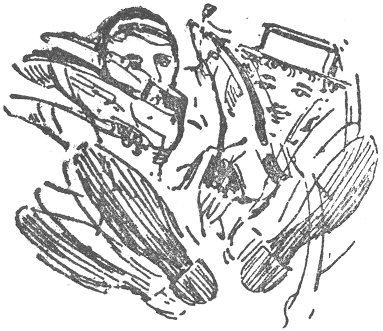
Our feet were undoubtedly the leading article in that photograph.  Indeed, very little else was to be seen.  They filled up the foreground entirely.  Behind them, you caught glimpses of the other boats, and bits of the surrounding scenery; but everything and everybody else in the lock looked so utterly insignificant and paltry compared with our feet, that all the other people felt quite ashamed of themselves, and refused to subscribe to the picture. 
The owner of one steam launch, who had bespoke six copies, rescinded the order on seeing the negative.  He said he would take them if anybody could show him his launch, but nobody could.  It was somewhere behind George’s right foot. 
There was a good deal of unpleasantness over the business.  The photographer thought we ought to take a dozen copies each, seeing that the photo was about nine-tenths us, but we declined.  We said we had no objection to being photo’d full-length, but we preferred being taken the right way up.

Messed up nation

Background: Moscow government decided to chop down some trees in a park in front of a few apartment buildings to build a parking lot. The people who lived in those buildings — some of whom planted those trees themselves or grew up playing among them — got angry. (This, as an aside, is a beautiful illustration of how well the concept of "public property" works.) Also, they wanted to prevent the rest of the park from being destroyed.

As a protest against chopping down the trees, the people blocked a major highway that runs by the apartment building. People in the cars got angry. People from the apartment building got angry. The government was no longer the villain here: it was one group of people against the other. Not letting people to get to the airport. Driving through the crowds. Pulling out people from the cars and beating them up. Sitting on cars in front of windshield wipers. And so on.

Footage:


I have always said: people get what they deserve. Yes, Russian society has always been "ruled" by psychopathic lunatics that made their people's lives hell. But it was the people themselves who tolerated these lunatics, and, having gotten rid of them, elected new lunatics of almost exactly the same character. (Psychopathic tzars got replaced by psychopathic communists who got replaced by Putin.)

From reading Russian literature and from my own experience of living in that society for half my life, I get the impression that there have always been two Russias, one (in minority) alongside the other. Now, after the borders have been open for two decades, and most Jews and Russian intelligentsia have been leaving the country, I expect Russia to go into the dumpster.

— I have kids at home.
— Everyone has kids at home.

Typical Russian logic. "My life is messed up, so I will mess up your life and feel justified doing so."

I have always said that Russia is a perfect society to implement libertarianism, but I am actually having my doubts. Giving these people freedom is like giving a gun to a monkey (or a group of them).

[source]

Saturday, July 16, 2011

Talking heads

I love it when liberals say phrases like "talking heads on Fox". Look at the guy they elected.

BHO in 1999:


Now:


So, 2013... after he's re-elected? And after that... deluge?

[source]

Friday, July 15, 2011

Something that everyone seems to be missing...

Two horrible things happened. First, an innocent child was slaughtered. I hope that his family and all Yidden shall be consoled. And his neshama won't linger much before entering the Gan Eiden. Whatever tikkun it was supposed to accomplish in this world, it surely has done so. And something good will come into this world as a result of this tragedy, not just hidden and wrapped in mystery, but also in a revealed way.

But there is another side to this story. A person whose soul is literally a piece of G-dliness above committed a terrible, horrible crime. It doesn't matter if he is mentally ill, or if he did it deliberately. Whatever it was, it was his out "garments" that lead him to the murder. And buried deep inside him, there is that spark of Holiness, plunged into a dark, painful exile, screaming out in horror every second at what he has done.

(Read the "Note" at the end here.)

We must cry out and pray to Hashem and complain that just like this act was senseless and evil, this exile is also senseless and evil, and it must end. Not just because we are suffering, spiritually and physically. But because Hashem's Presence is in exile and darkness. And this is not right. It must not continue.

Everyone that feels empathy to Leiby's parents and the horror of this situation must realize that the global situation in which we have been living since the start of this final golus two thousand years ago is equally or even more horrible. And no matter how comfortable we are, physically or spiritually, no matter how many yeshivos we build, or how safe we are, we cannot be consoled until Beis HaMikdosh is here, Moshiach Tzidkeinu is revealed, and the world is full of knowledge of G-d as the oceans are full of water.

Yud Beis Tammuz and Parshas Pinchas


Farbrenging today in the local shull, with Rabbi Lieberman, Rabbi Yaffe and Rabbi Krinsky (and other chassidim), I heard the following idea:

Many people wish to portray Pinchas as a radical. Or as a first revolutionary. The truth is: he was not a radical. Before he did what he did he consulted with Moshe Rabbeinu, asking him: "Didn't you tell us...?" And then he did something which was, on the surface, extreme. But he did not do it for the purpose of being extreme, or a zealot, or a radical. He did it because it was necessary at the moment.

The same can be said about the Frierdiker Rebbe. On Tuesday, I picked up my grandmother, who, boruch Hashem, had come to US for a visit from Israel. She told me that in our city, in Ukraine, there were many frum families who were not able to pass on their frumkeit fully, because the process of passing was crushed by the Soviets. Speaking in Yiddish could hurt one's prospects at work, in school, or in one's social circles. In secular schools, children obviously were not taught Yiddishkeit, but, what was worse, they were implanted with anti-Jewish ideas. (And the parents that did not send their kids to the government schools could be jailed or worse.) Shulls, schools, mikvehs were closed. My grandmother said: everyone lived in fear. Rabbis of the city (including the Rebbe's father) had been arrested.

So, there were Yidden who remained frum, in private. There was a schochet, to whom our family (and others) brought chickens to be schechted, but he sent his kids to the government school, gave them Russian names, then sent them to universities to get secular professions, and who knows if his kids grew up frum or remained frum.

So, one can't really blame the families for letting go of their Yiddishkeit under the conditions. People retained what they could, but their survival was their first priority.

On the other hand, Frierdiker Rebbe went on the path of mesirus nefesh and demanded the same from his chassidim. He demanded that they did not send their kids to secular schools (and many would not, despite knowing that they were going to be sent to Siberia). He would send a telegram to a chossid to become a melamed. In two months, the chossid would get arrested. Frierdiker Rebbe would then send another telegram to another chossid to replace the first one. And the story would repeat itself.

And he himself lived on the level of mesirus nefesh, for which he was jailed, beaten, and almost murdered by the Communists, y"sh. But, even while being jailed, he did not give in to them. He would speak Yiddish. He would demand his tallis and tefillin. When he had left Russia, he left after himself an underground network of chassidim keeping Yiddishkeit alive, like heat burning inside a coal, ready to spring into a full flame. And I saw that happen. When the Rebbe's shliach came to my city in early 90s, the effect on the Jews of the city was that of bringing a match close to a powder keg.

Frierdiker Rebbe and his chassidim lived on the level of everyday mesirus nefesh. But that was not because they were radicals. That was because it was what was necessary. They did not seek out mesirus nefesh like Rabbi Akiva. They just served Eibeshter b'emes. And when they encountered a need to do mesirus nefesh, they did it, like Avraham Avinu (which, the Rebbe says in his first ma'amor Bosi L'Gani, is a higher level of avoida).

So, nowadays, in America, we also encounter need to live on the level of mesirus nefesh. For each person, it includes different things. Keeping Halacha. Keeping Halacha b'hidur. Learning more than we are accustomed to. Davening every day. Davening b'kavana every day. Not speaking during davening. Learning Chitas and Rambam. Keeping a higher standard of kashrus. Not eating food with unpeeled vegetables on Peisach. Not saying loshon horah. Being nice to others and giving them benefit of the doubt. Controlling yourself and not getting angry. Sending one's kids to a Jewish school. Sending one's kids to a better Jewish school with worse secular program and then supplementing their secular education with private lessons. Approaching someone to do a mitzva, though you're not comfortable. The list goes on...

For each person, at different moment of his or her life, it's something different, and once one reaches a certain level, it's important to continue pushing oneself further. As Reb Zushe said: "They won't ask me: 'Why weren't you Avraham Avinu?' They will ask me: 'Why weren't you Zushe?'"

All these things to us are mesirus nefesh, because we are giving up an aspect of our lives, an aspect of our identity, or desires and thoughts for Hashem. Other people (our friends, our family members) will say that we are radicals. That we are crazy. That there are people who are perfectly frum and don't do X or Y.

But we are not doing this because we are radicals or are crazy. (And it is important to make sure that we takeh are not being radicals — because then it's not frumkeit, but ga'ava. I am talking about taking extra chumros, etc.) We are doing this because this is emes. Because this is what is necessary nowadays.

How do we know what's necessary? We have a Rebbe.

We are not asked to do much. But for us, that's everything. And so it is for Hashem and for the Rebbe. As my rabbi's father said, we are not just the heels of Am Yisroel. We are the dead skin on the heels. But we are the ones who will bring Moshiach.

Wednesday, July 13, 2011

Don cossacks and Italian children

The song's contents:

In boundless steppe, with –40 degree temperature, Tzar's cossacks are travelling. In woolly hats and in boots, they are trying to get towards river Don. But one of them, Popov, is sniffing, sniffing, and gets stuck in the snow. Popov has everything: woolly hat and boots — but, it turns out this is not enough.

Brave cossacks with curly mustache keep walking forward, but Popov is not among them. He lies breathless, curled up. What a loser is this poor Popov! But, Popov does not give up; he lies a little and then starts going on his stomach towards river Don.

Hey, Popov! Cossacks don't travel this way!

But, the cossacks are tired. Their mustache are frozen. And they haven't reached river Don. In the boundless steppe, with the –40 degree temperature, they turned to stone from the frost.

But Popov did not lose heart. Like a snowball, he rolled towards the river. And was the only one to reach river Don.

And now the song, in Italian:


[Source]

Interestingly, the little boy is now a member of Italian parliament. I guess he took to heart the idea of hopeless enterprises in a company of idiots.

Here is a cartoon version of this song, in which Popov (called Popoff by the Westerners) is, for some reason, a dog:


More on Don Cossacks: "Brotherly Love".

And the pseudo-karaoke that I had promised (the karaoke's joke makes sense only to those who know Russian, Soviet songs, and Russian history, so basically almost nobody who reads this blog, but that's fine, since I post these things for myself anyway):

Monday, July 11, 2011

Meriting Eliyahu


(a re-post)

The cartoon above is interesting, because it’s possible to interpret it in a number of ways. If you’re an eidel Jew, you can take what the cartoon says, and what the message of Baal Shem Tov was, literally: there is G-d (and Eliyahu) not just in sitting on your bench the whole day learning Gemara, but also in doing a mitzva, out there in the world. In other words, ein od milvado, without exceptions.

On the other hand, if you’re a grub apikores, it’s possible to say that revelation of Eliyahu and all that holy stuff is merely a metaphor for doing a good deed. As I was thinking while driving just now (incidentally, to do a mitzva), a religious scientist tries hard to see G-d in the world. A secular scientists thinks what he is studying is G-d. A chassidic scientist knows both of them are right. (A Lubavitcher scientists knows why and how they are both right.)

And so the lesson is (going back to the cartoon) that this is why Alter Rebbe created Chassidus Chabad. Because Ba’al Shem Tov’s Torah and its message, ein od milvado, are too eidel for a regular grub person. They need to be chewed; they need to be explained such that a person sees not Martin Buber’s version of Ba’al Shem Tov’s Chassidus, but, lehavdil, Torah version.

But another point is that there is an advantage in Talmud Bavli over Talmud Yerushalmi, even though that advantage comes as a result of a lower spiritual level. When a person comes into a lit room, he sees where the exit it and goes straight towards it. When a person comes into a dark room, he has to tap his way towards the exist. He taps, he taps, he taps. He gets to know every object in the room, intimately, by touch. Sure, it takes him longer to go through the room, but once he is through, he knows more about this room than about the lit one.

Therefore: when you have a question about something that the Rebbe did, don't hesitate to ask it.

More on the topic:
Love is Not Enough
Uniqueness of Chassidus Chabad

Sunday, July 10, 2011

Market vs. state


[source]

From the comments:

Oh BTW.
Those NASA rockets?
They are too expensive and wasteful to actually be used in any practical way. Most of our communication satellites are put into space by Russian and Chinese rockets, not American ones.
Instead of using expensive liquid nitrogen fuel, the biggest of those ‘communist’ rockets use kerosene to launch our communication satellites into orbit.
NASA is so corrupt and worthless at actually being a space agency that the USA has been long been surpassed by Asia for practical space flight.

Friday, July 8, 2011

Defend yourself

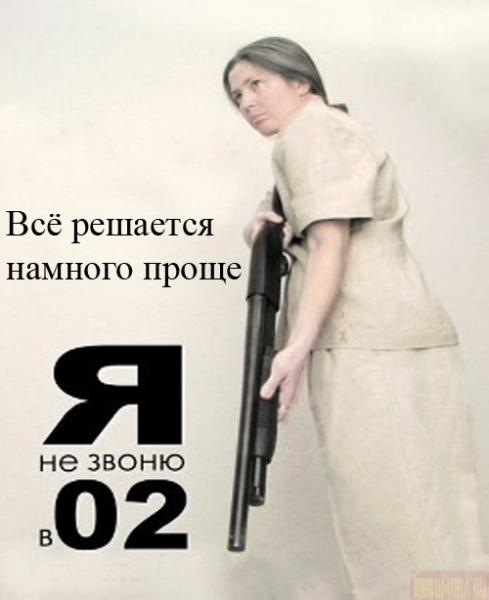
Russian poster:


“Everything is solved much more easily. I do not call 02.” (Russian equivalent of 911.)

The image is in response to a story where nine Russian settlers of the village Sagra defended themselves against sixty Azerbaijanian drug dealers who were angry at the villagers’ having kicked out a drug dealer from their village.

The response of Russian “authorities” is brilliant: they are trying to figure out if it’s possible to put the villagers in prison for not waiting for the police. Unable to prove that the villager Zubarev who killed one of the drug dealers committed murder, the police are trying to prove that this was “a case of hooliganism”.

Instructions, in Russian, how to get yourself a legal gun (I like the mottos in Latin letters, such as “Si vis pacem, para bellum”):

Thursday, July 7, 2011

Kum aher, du filozof

[MikhailLevit.jpeg]

A rather funny post on the practice of writing to Igros (re-formatted and corrected for spelling mistakes by yours truly):
I was having big shaalos about this whole Igros issue, pro and con, so I decided to ask the Rebbe: 
I took a volume at random, opened up to a page and I found a letter against "segulos"! (Vol. 14, p. 394). 
But — being skeptical (and it doesn't always work the first time) — I tried again. This time I grabbed another volume, opened it, and found a letter dealing with Tomim thiyeh im Hashem (and not segolos, chochmos hayad, etc.) — vol. 15, p. 64.
I wasn't satisfied, and having heard something about asking three times, I decided to try again. With bated breath, I went to my bookshelf, closed my eyes, took a volume, opened to a page, and slowly opened my eyes. Leaping out of the page at me, w[ere] the words: "Go away from this; if you davka want a sefer segulos, there is the trusted segulo, our holy Torah," etc., and he again brings the posuk Tomim thiyeh im Hashem! — Vol. 10, p. 184.
My question: Is this my answer, or do I try again?
This is all ignoring the issue whether Igros actually works (which could have three or four possibilities). The question is whether it's appropriate to use it this way. Secondly, as one of my rabbis says, of course it's appropriate to use the Igros! If you have a question about having shidduch doubts, or looking for parnosso, or animal cruelty, you search what answers the Rebbe gave to people regarding your specific question.

Another interesting post based on the interview of Rav Braun about the instances when he is asked a sha'alah about the content of Igros "divination". And there is the shiur by Rabbi Paltiel at the end of which he says that the practice of writing to Igros is similar to a practice of asking nevi'im too often. Which is ossur. Not because it's not effective, chv"sh, but because it goes against the concept of "Tomim tihiye".

Finally, if you listen to Rabbi Gottlieb, the sin of the golden calf was not avoida zorah. It was the fact that Yidden did not listen to their Rebbe and started looking for their own "solutions".

Without future, there is no past


I love this: “Scientists and astrologists predict terrible future for Russia”. Which, if you read the article (not recommended), means: “Unstable economic and political situation and hot summers with forest fires.”

So... terrible future, not to be confused with the similar present? I don’t think one needs to be a scientist or an astrologist to say: “In the nearest future, things in Russia will stay just as bad and might very likely get worse.” One just needs to know basic history.

From here:
Russian forests constitute 22 percent of the world's total woodlands, an area larger than the continental United States. "Our planet has two lungs — the Amazon rain forest and the Siberian taiga," said Vladimir Gandzha of Russia's Nature Protection Society, the nation's oldest environmental group. "The latter is blazing now."

A top government official accused illegal loggers of starting some of the Siberian fires to conceal the traces of their work. "They set it all afire — and covered it all up," Deputy Prime Minister Viktor Zubkov was quoted by the Itar-Tass news agency as saying.
Brilliant. I am surprised he didn’t mention the "agents of the Western regimes". Whose fault is it that Soviet agricultural system failed? Foreign capitalists and lazy peasants, of course.

Some background on the Russian forest fires and their causes: 2010.

Photographic art and artistic photography

Which of these two do you think is a photograph and which is a painting?


vs.


(sources [spoilers!]: Joe Simpson, original, and a sketch)

Dense intellectual climate

A “beautiful” story of a European pseudo-journalist and malaria-stricken natives.

In one of his comments, the author speaks about “dense intellectual climate of France”. What a fitting description.

(I don’t really see what the outrage is all about. So, it’s fake. So what? How is this radically different from the rest of journalism nowadays? It’s not fake; it’s “creative”.)

Wednesday, July 6, 2011

On the tails of spring


From Wikipedia article about springtails:
Various sources and publications have suggested that some springtails may parasitize humans, but this is entirely inconsistent with their biology, and no such phenomenon has ever been scientifically confirmed, though it has been documented that the scales or hairs from collembolans can cause irritation when rubbed onto the skin.[36] They may sometimes be abundant indoors in damp places such as bathrooms and basements, and incidentally found on one's person.
    More often, claims of persistent human skin infection by springtails may indicate a neurological problem, such as Morgellons Syndrome, or delusory parasitosis, a psychological rather than entomological problem. Researchers themselves may be subject to psychological phenomena. For example, a publication in 2004 claiming that springtails had been found in skin samples was later determined to be a case of pareidolia; that is, no springtail specimens were actually recovered, but the researchers had digitally enhanced photos of sample debris to create images resembling small arthropod heads, which then were claimed to be springtail remnants.[36][37] However, Hopkin reports one instance of an entomologist aspirating an Isotoma species and in the process accidentally inhaling some of their eggs, which hatched in his nasal cavity and made him quite ill until they were flushed out.[11]

Still, better than fleas:

You are my sunshine

From Russian designer Artemiy Lebedev’s Business Lynch.

Question:

“This is a logo for a web-based advertisement agency. We wanted to have a symbol for sun, energy and joy. What would you advice?”

image.png


Answer:

“I only see a filleted fish, sorry.”

filleted_fish.png

Tuesday, July 5, 2011

Avinu loi meis

In the honor of Gimmel Tammuz, a re-post of a portion of Rabbi Posner’s parsha class.

What does Gemara mean when it says that we can learn that Yakov did not die from Torah not stating explicitly that he did die? “Did not die” in what sense? What is this concept of dual realities of Egyptians (in which Yakov Avinu died) vs. Jews (where he did not)?

To understand why Yakov did not die, we need to understand first what it meant for him to live. I think it’s a really important concept that should be understood very carefully, for a number of reasons. So, pay attention. Rabbi Posner briefly goes off on a bit of a tangent in the middle explaining about the Four Worlds, but then he returns to Yakov Avinu at 10:00.


And a story (heard from Rabbi Posner over Yom Kippur):

Most Chassidic groups have a custom called shirayim: the Rebbe eats a little bit from his plate, and then his Chassidim come and take each a peace for themselves. The source of this custom is the idea that everything that a tzaddik owns becomes holy too, since tzaddikim serve Eibeshter on the level of b’chol meoidecho (“with all your might”), which means that ther serve Hashem with everything they do, own or touch — and impart the essence of themselves and revealed holiness of their avoida on their possessions.

So, whatever the Rebbe partakes of becomes holy. And then his Chassidim partake of it to attach themselves to the Rebbe.

Well, for a number of reasons, this is not a custom of Chabad Chassidim. In short, one attaches oneself to the Rebbe b’pnimiyus, not b’chitzoinius. By studying his teachings (which the Rebbe makes accessible to the Chassidim), not by holding on to his gartel, so to speak. Even though elements of attaching oneself to the Rebbe through chitzoinius also exist in Chabad (after all, chitzoinius is a part of the equation), pnimiyus is the ikkar and chitzoinius is de-emphasized.

Anyway, the story goes that a Jew from a different Chassidic background had become a Lubavitcher chossid, but did not yet know that in Chabad they don’t do shirayim. So, when he was in the presence of the Frierdiker Rebbe, as soon as the Rebbe started eating, he came over and attempted to take some food from the Rebbe’s plate. The Rebbe smiled at him and gave him the shirayim and then said: “By others, getting shirayim is a privilege. By us, getting shirayim is also a responsibility.”

I also remembered something that Rabbi Posner said over a dinner one time. He had been to a farbrengen in Crown Heights, where a rabbi who had never seen the Rebbe in his life was telling people about the greatness of the Rebbe. An amazing feeling. He also talked about the love that one felt during the yechidus. “I was not going to speak, but then he asked me to speak, so I said: ‘You know, I've been to a yechidus with the Rebbe. When I was fourteen. And I did not feel love. I felt awe. I felt an overwhelming sense of awe. When you meet a person, you see him, his personality, character, history. When I saw the Rebbe, there was the sense of great Nothing. Just a source of pulsing power, of very direct purpose. He was there for a reason, and his whole life, his whole essence, his interaction with other Jews was geared towards that reason, that goal. And one was being overwhelmed by this [singular feeling] when standing in front of him.’”

Sunday, July 3, 2011

A conversation with a liberal

Me (looking at the picture of Obama with family): he has my haircut. [It's a long story involving an accident with electric clippers.]
A liberal: yeah, your hair looks similar.
Me: That's about one thing that we have in common.
L: Well, that's probably not the only thing you have in common. He is a very intelligent man.
Me: How is that revealed?
L: Well, he wrote a very good book.
Me: How is that revealed in his presidency? [Not that I agree that his book was any good. Also: ahem.]
L: Well, his mistake is trying to please everyone.
Me: Such as Islamic Brotherhood and Taliban?
L: We did not start talks with Taliban.
Me: Yes we did. As someone said, ‎"Obama is willing to negotiate unconditionally with Iran. He started talks with Islamic Brotherhood in Egypt. He started 'preliminary negotiations' with Taliban. But of course, one must draw a line somewhere, over which he won’t allow the enemy to step over and won’t negotiate. That line is discussion with Republicans about the budget."
L: Republicans think that rich people should not pay taxes. Those rich bastards can afford it. My brother is a rich man, but he says he would never vote for Republicans, because they don't care about the common man. And now we will bentch.

I am sure the doctors who practiced bleeding also cared about their patients.


Tuesday, June 28, 2011

Music, passion and shining eyes

This post started off with the video below, and then I went off a bit on a stream-of-consciousness tangent about copyright. Feel free to peruse any part of the post.


I think there are many thoughts here that the Rebbe would agree with. "A true leader is the one who has absolute faith in those following him." Or: "What measures one’s success is not his power or money, but the number of shining eyes surrounding him."

And, after you’ve watched the above video, watch this:


And some copyright idiocy:


(It seems that just like klipah is always attracted to kedusha, stupidity and bureaucracy are always attracted to something intelligent and creative.)

Update. This is the original pi video:


* * *

Just to remind everyone, the reason why one cannot own information is that "ownership" implies violence towards someone — the person you’re preventing from using the object you own. Such violence can be justified only if you’re doing it in self-defense: i.e., to defend yourself against an act of violence from another person. For example: if I own a pencil, it means I can prevent you from using my pencil. So, that’s violence. But it is justified, because if you use my pencil, it means I cannot use it. So, you’re doing violence to me. Since one of us is going to have to do violence to the other, let it be the one who found (bought, made, created ex-nihilo) the pencil first.

In other words, the concept of ownership only applies to scarce resources. If there is a competition for a resource (such that only one person can use it), let the person who "owns" it have rights to it — i.e., justification to use force to restrict someone else’s use of it.

But in the case when a resource is non-scarce (like information is), there is no justification. Just because I am using the concept you developed, I am not preventing your use of it.

* * *

The other problem is that we don’t have a clear idea what ontology of information is. I.e., what the information is. From materialist point of view, information is nothing but the matter that contains it. So, if you write a poem, and I memorize it, you cannot own my knowledge of your poem, since that would imply your owning my brain.

From a version of idealist point of view, information is not matter; it’s properties of matter. It is something which is associated and created by the matter. So, brain and mind are not the same thing, but the mind is created by the brain. The same argument goes here. If the song that you wrote is created by my brain while I am thinking about it, you cannot own it. You cannot own my mind, since it’s a product of my brain, which you don’t own.

From platonic point of view, ideas actually exist in a separate reality — an ideal "world". All material objects are instantiations of these ideas. So, a physical chair is a material instance of an ideal chair. Therefore, one might say, by creating an idea, I am actually creating an ideal object existing in a separate ideal reality. Or, perhaps, it always existed there, and I am merely discovering it. Either way, you might say, I have rights to the idea.

There are two problems with the latter argument. First, in order to claim ownership to this platonic version of idea and then use force to restrict my use of it, you have to bring evidence that the platonic world of ideas actually exists. It's a nice philosophical model, and it's something nice to talk about over a cup of tea, but you can't claim ownership on a piece of my brain or a physiological process happening in it (which, a priori, is what information seems to be), unless you bring clear empirical proof. You can't use force to take someone's money, shut down a video he posted somewhere, or put him in jail, unless you have a clear evidence that the phenomenon which is claimed to have been stolen actually exists in reality, outside of the philosophers' imagination.

Second problem is that even if the platonic world and its ideas actually existed independent of human mind, we are back to the non-scarcity argument. Yes, you have discovered (or invented) a resource. But you can't claim to have rights to it if it is non-scarce. You have no justification to use force to prevent my use of your song, if my use is in no way limiting your use of it.

And saying "I own it, because it's the law" is a meaningless statement. All you're saying is: "I own it, because Joe will shoot you if you try to use it". Imagine if I said that about your car. Remember, saying: "I will use the government to make X illegal" is no different from saying "I will take a gun to prevent someone from doing X". If you do not think it's moral for you to do that yourself, there is no way it can be moral for the government to do it. For instance, I can shoot someone attacking me. Therefore, it's moral for a government employee to shoot him (since the government is just an organization which I hired to protect my rights — or, rather, that hired itself... or made me hire itself... but that's a separate topic). But if it is immoral for me to go to Bill Gates's house with a gun to take his money and give to some poor guy on a street, it's immoral for the government to do so as well.

So, saying "it's a law" does not imply morality. I always find it curious that the defense that TSA officials use for searching the diapers of 90-year-old ladies ("I followed the procedure") is the exactly same defense that Nazis used at Nuremberg trials.

* * *

© None of the ideas written above may be reproduced in any form without my explicit approval. In other words: get off my platonic farm before I get my shotgun.

Monday, June 27, 2011

What the history of Soviet agriculture teaches us


It’s interesting how the brutal implementation of socialism started: by declaring land "common property", the fallacy that the state nowadays uses to convince us that roads, waterways, parks, etc., should not be privately owned and to justify our paying taxes (even though most of the taxes do not go towards maintenance of roads or revenue of the government).

Any intelligent person should realize that the concept of "common property" is just a legal and philosophical fiction.

(a post on whether it’s muttar to learn science coming up... stay tuned)

Wednesday, June 22, 2011

The place of Troubles


I think in places like Northern Ireland one can most readily see the damage done by the concepts of statism and nationalism, as well as by the specific governments or government-like groups. On can also clearly see the the advantage of the alternative: more than one "governing" company, not linked to a particular territory, akin to today's cell phone companies.

Having watched bits and pieces of a documentary on the conflict in Northern Ireland, I have little doubt that had the organizations representing the British, as well as the Catholic and the Protestant Irish been free-market anarchist "protection agencies", voted for by the people with their money and interested in maximizing their profit, they would very quickly come to a peaceful resolution of the conflict — since the alternative is so bloody expensive and wasteful.

This is the answer to the question: "Won't the protection agencies go to war with each other under anarchy?" Well, first of all, it can't be too much worse than what we've had, throughout human history, with the governments involved (the governments have been the single greatest source of death, injury and general misery in the history). Only the organizations whose basis is political support could drag out the ridiculous bickering conflict over three decades with thousands of people dead on all sides. Second, why would they? If their goal is not some idiotic nationalist agenda, but maximizing the profit, they would realize that carrying out a wasteful war is not wise from economic point of view and would quickly reach a solution.

A comment from an article about Ireland:
I’d long dreamed that the “six slave counties” of Northern Ireland would become independent and the first truly libertarian “state.” (In [quotation marks] because a state without taxes wouldn’t be a state as states are known to be.) The North’s mostly-Protestant “Unionists,” so called, favor union with Great Britain as a buttress against being ruled by Catholic Irishmen, which would happen if the North became part of the Irish Republic. Loyalty to Britain extends no farther than staving off Catholic rule, for Unionists have been ready to take up arms against British forces whenever the North was threatened with being dumped by the Brits into the Republic.

Mostly-Catholic “Republicans,” on the other hand, favor becoming part of the Irish Republic to the south primarily as a means of escaping rule by historically tyrannical Britain or its surrogate unionist government. Republicans haven’t forgotten the fact that their Irish brethren to the south, with whom they joined in battle against British rule in the years leading up to the establishment of an Irish Free State, negotiated a treaty establishing a semi-Irish independence that left them behind and under surrogate-British (Unionist) rule, which proved to be even more oppressive of Irish Catholics than the Brits had been.

With the population of the northern slave counties divided roughly equally between adamant Unionists and adamant Republicans, each unequivocally opposed to being ruled by the other, what better place could there be for establishing a country where nobody rules anybody? Unfortunately, at least for the time being, the so-called “leaders” of Unionists and Republicans have chosen “power-sharing” as a solution to the Irish “Troubles,” rather than renouncing the power to rule over others as the only sure means to lasting peace.
More on the subject (despite the problems with punctuation, it is a very interesting article).

The situation described above actually reminded me of the one in Somalia. There, the warlords go to war with each other only when the "peace-keeping" UN troops get involved, with their repeated attempts of establishing a "democratic government". Each warlord starts feeling threatened that the other warlords will gain political power, backed up by the West, and thinks that he has to make his move first. When the UN troops are not involved, the warlords live in an equilibrium with each other, with traditional tribal laws being the legal framework for the society.

Monday, June 20, 2011

Why bother having ambition? You already got paid thanks to a politician...

An interesting bit from the interview with famous popular-classical musician Gozales:


The bit from Reason.TV about three reasons for the US government not to support art:


Gonzales playing Paristocrats:


Doing a sing-along:

Tradition, tradition!

http://latimesblogs.latimes.com/.a/6a00d8341c630a53ef01156fa4cd3c970b-500wi
(a re-post... sorry it’s late)

Notes from a Torah class by Rabbi Posner of Boston on Parshas Shlach. So, please forgive the choppiness.

It all starts with Jews sending the spies, who come back with the unfortunate report. When Hashem tells them they would travel in the desert for forty years as a punish… I mean, consequence of their actions, some people suddenly come to their senses. And decide that are ready to do it. Yep, ready to do it. Come on, let’s do it, let’s do it.

And then Moshe Rabbeinu says: “Don’t go, for Hashem is not with you.” And, as one might expect, they still go (into a battle) and get killed. So, what’s going on? OK, here come the notes:

Hinenu: we are ready (like Hineini). We are ready to go and to fight. What changed?
  • Every Jew is inherently a believer in G-d
  • When Moshe Rabbeinu screamed at them, they realized they were being foolish, and restored the connection
  • But, MR said: don’t go, because G-d is not amongst you.
  • Amalek came down and killed them.
    • What did these people do wrong? It seems they did what Hashem wanted them to do…
      • Moshe Rabbeinu told them not to go…
      • You can do all teshuva in the world you want, but you still need MR and Aaron go with you
      • You cannot divorce the soul of Torah from Torah itself
      • You can talk about the beauty of customs and traditions – but if you change it, it is not going to last
      • Needs to be steadfast connection to bris Hashem
    • Who asked you to make decisions? You can’t make decisions either when you’re a spy or later, when you decide to attack on your own…
    • If MR tells you: don’t go on, then it will not be successful.
      • The power of tradition…
      • What does it say, how do we know?
Within structure of Halacha itself – things that are permissible!!! Why not? It’s not the way it’s ever been done. It’s not the way that Jews have been doing it.

But, Chabad is the biggest rebellion ever. It’s not the way it’s been done; it’s not the way to do it.
Rabbi P. in Young Israel. In weekday shull. An old man giving a class. Rabbi P. saying Tehillim. The man was talking about the Blessing for the Sun. He was saying it’s really not such a big deal. People do it, but they don’t celebrate it. Don’t make a whole event out of it. Some people take regular things and blow things out of proportion about them. Like Chabad putting tefillin on in the street. Tefillin has always been a regular quiet thing – and suddenly you make a big deal out of it?!

In the year of 2009 of common era, someone should say this! Are you joking? Do you realize what happens here in the shull: groups of kids from Reform, Conservative families come learn about Shmura Matza in your shull (because Chabad brings them). Bridges between secular and religious worlds.

The world today is completely different world – majority of Jews have never and will never put on tefillin, until someone does it with them.

The mindset that existed in 1950s – this has never been done. Sending shluchim to places that have nothing to support them religiously: this has never happened in the history of Jews. Jews are very community-oriented. If you are a frum Jew, you need a minyan, and you need all that the community provides. How did Jews do it?

They never have.

The answer: If you walk by a lake, you don’t jump in it in your suit. But if your brother is drowning, of course you would jump in – so, you will wet your suit a little, nu…

So, yeah, there is a concept of doing things traditionally: daven in a shull, not in the middle of a street. But sometimes you need to make a change. The question is: why do you need to make a change? Why make a change?

When Jews tried to conquer EY for the heck of it, without Hashem’s and MR’s protection, it was not successful. They died. Just like families of Reform and Conservative Jews. They implemented changes for themselves, not for Hashem. You can’t have personal motivation – I think it’s a good idea, I think I want to do it.

So, when the Rebbe became a leader of the generation, he explained that when a Lubavitcher puts on tefillin with someone else, he doesn’t do it as his own thing but under guidance of the Moshe Rabbeinu of the generation.

Ad kan.

Wednesday, June 15, 2011

Living in a beehive

From Lebedev's Mandership, §163, "Russian postal address format":
Some cities and towns [in Russia] use rather uncommon addresses.

Zelenograd, Moscow, Russia, for example, has just building numbers, like bldg. 1001A, instead of full street addresses. The first two digits represent the district (number 10). People who live in the house may not even be aware that their street is called Kolkhoznaya, because no one uses the name.

In Naberezhnye Chelny, Republic of Tatarstan, Russia, everyone knows cluster and construction numbers of the houses. So, if you ask which way 60 Prospekt Mira is, no one will be able to tell. But if you ask for 3/19, you’ll instantly get directions.

In Kaliningrad, Kaliningrad Oblast, Russia, a building may have several numbers, because the city has kept the German entrance numbering scheme. Apartments sharing a common staircase at each building entrance are numbered from one.
I suppose it's not necessarily very different from living in a grid-like city, with streets having numbers and letters as opposed to names.

Cheers to all readers,
Blogger 04129716759837282565

Tuesday, June 14, 2011

Herring vs. hamburger

Fascinating interview with Swedish economist Andreas Bergh who discusses whether it is true that Sweden’s socialism was the cause for its growth, whether the “socialist-democratic heaven” has perfect health care system, and, most importantly (for Americans), whether Swedish socialism (whether or not it was beneficial) can even be attempted to be implemented in America.


What do I mean? Well, some people say that just because socialism failed in Russia doesn’t mean socialism is a bad idea. Everything fails in Russia (except things run by Jews, like chess). Russian society was not fit for socialism to be successful. Well, the last bit might be true about American society. In the video above, Mr. Bergh explains that Swedish public sector is more efficient than its counterparts in other countries. Its decisions and involvement still lead to economic problems, but at least it didn’t produce so much waste of heat due to friction. Americans do not have such a public sector and will probably never have it. American society cannot support it. It does not have the cohesiveness, organization and good spirit of the northern Europeans necessary for it.

So, his last point at the end of the interview is: by increasing taxes in Sweden, you get more of Swedish public service. It may not be as good as private service, and its decisions may affect the economy in a bad way, but at least it's efficient, polite and benevolent. If you increase taxes in the US, you get more of American public service: more irritated ladies at the DMV yelling at you to fill out the blue version of form RAX69415.B68 and then go back to the end of the line. Or, rather, more of these ladies in more areas of your life.

Interesting excerpt from a paper called Libido for Ugliness by H.L. Mencken. It deplores general American lack of taste in the architecture. I wonder if there is some correlation with inability to produce civil, friendly and efficient bureacracy and nice architecture. The Soviets also suffered from it. I think it’s correlated with the love of CAPS.
I award this championship only after laborious research and incessant prayer. I have seen, I believe, all of the most unlovely towns of the world; they are all to be found in the United States. I have seen the mill towns of decomposing New England and the desert towns of Utah, Arizona and Texas. I am familiar with the back streets of Newark, Brooklyn and Chicago, and have made scientific explorations to Camden, N.J. and Newport News, Va. Safe in a Pullman, I have whirled through the gloomy, God-forsaken villages of Iowa and Kansas, and the malarious tide-water hamlets of Georgia. I have been to Bridgeport, Conn., and to Los Angeles. But nowhere on this earth, at home or abroad, have I seen anything to compare to the villages that huddle along the line of the Pennsylvania from the Pittsburgh yards to Greensburg. They are incomparable in color, and they are incomparable in design. It is as if some titanic and aberrant genius, uncompromisingly inimical to man, had devoted all the ingenuity of Hell to the making of them. They show grotesqueries of ugliness that, in retrospect, become almost diabolical. One cannot imagine mere human beings concocting such dreadful things, and one can scarcely imagine human beings bearing life in them. 
Are they so frightful because the valley is full of foreigners — dull, insensate brutes, with no love of beauty in them? Then why didn’t these foreigners set up similar abominations in the countries that they came from? You will, in fact, find nothing of the sort in Europe save perhaps in the more putrid parts of England. There is scarcely an ugly village on the whole Continent. The peasants, however poor, somehow manage to make themselves graceful and charming habitations, even in Spain. But in the American village and small town the pull is always toward ugliness, and in that Westmoreland valley it has been yielded to with an eagerness bordering upon passion. It is incredible that mere ignorance should have achieved such masterpieces of horror. 
On certain levels of the American race, indeed, there seems to be a positive libido for the ugly, as on other and less Christian levels there is a libido for the beautiful. It is impossible to put down the wallpaper that defaces the average American home of the lower middle class to mere inadvertence, or to the obscene humor of the manufacturers. Such ghastly designs, it must be obvious, give a genuine delight to a certain type of mind. They meet, in some unfathomable way, its obscure and unintelligible demands. They caress it as "The Palms" caresses it, or the art of the movie, or jazz. The taste for them is as enigmatical and yet as common as the taste for dogmatic theology and the poetry of Edgar A. Guest. 
Thus I suspect (though confessedly without knowing) that the vast majority of the honest folk of Westmoreland county, and especially the 100% Americans among them, actually admire the houses they live in, and are proud of them. For the same money they could get vastly better ones, but they prefer what they have got. Certainly there was no pressure upon the Veterans of Foreign Wars to choose the dreadful edifice that bears their banner, for there are plenty of vacant buildings along the track-side, and some of them are appreciably better. They might, indeed, have built a better one their own. But they chose that clapboarded horror with their eyes open, and having chosen it, they let it mellow into its present shocking depravity. They like it as it is: beside it, the Parthenon would no doubt offend them. In precisely the same way the authors of the rattrap stadium that I have mentioned made a deliberate choice. After painfully designing and erecting it, they made it perfect in their own sight by putting a completely impossible pent-house, painted a staring yellow, on top of it. The effect is that of a fat woman with a black eye. It is that of a Presbyterian grinning. But they like it.
Now, considering that language is one of the most important things to make a society cohesive, I wonder how socialism is working out in Denmark:

Monday, June 13, 2011

Chicken soup

Interesting figure (source):


(one question I have is: why are the labels capitalized? are they proper nouns?)

Since this is the time of exams (my wife is giving one tomorrow to local Beis Yakov girls), I will ask this in a form of an exam question.

What is the interpretation of the figure? Pick the best answer:
a) Obama's economists have proven themselves to be incompetent
b) Recovery plan at best did nothing to unemployment and at worst hurt it
c) American tax-payers were swindled out of hundreds of billions of dollars
d) American economy has been hurt by Obama, and America is on its way to becoming the Sweden of 1970s
e) This is a perfect example of a situation when doing nothing is better than doing something (which is almost always the case with the government)
f) All of the above

Now, from the above web-site:
Romer and Bernstein defend their estimates with the argument that the economic situation turned out worse than they had anticipated; and so the economy would have done even worse without a stimulus.
I love this! Compare this to:
The spirit healer defended her treatment using burnt incense that even though the patient had flu for the same (if not longer time) as would be predicted without the incense, the illness, in fact, was much stronger than anticipated in this case, and the patient would be even sicker without the incense.
Speaking of chickens:
[E]ven if you buy the White House’s argument that the $800 billion package created 3 million jobs, that works out to $266,000 per job. Taxing or borrowing $266,000 from the private sector to create a single job is simply not a cost effective way of putting America back to work. The long-term debt burden of that $266,000 swamps any benefit that the single job created might provide. 
My only question is: Obama is on his way to joining the ranks of the worst US Presidents. Right now I would rank him between FDR and JFK. When he is gone from the office, what abbreviation will they give his name and what piece of public property will they name after him? BHO sounds too similar to HBO. (On the other hand, Woody the Wilson didn't have his name abbreviated.)

Lastly: "Ziggy" stands for Sigmund Freud.

Saturday, June 4, 2011

Alternating current

I have heard someone in the shull today, at the farbrengen, say: "You know how goyim say 'BC' — 'before Yoshka'. And Jews say 'BCE' and 'CE' — 'before common era' and 'of common era'. Well, for a while I thought that they said 'before common error'. As in 'before the period when everyone en masse bought into the same shtuss'."

The thing is: the year 1 CE was computed retroactively by some monk a bunch of centuries later as the year when Yoshka must have been born. It had later been shown that the monk used flawed assumptions about the presumed life of Yoshka and events surrounding it in his calculations (plus, his abacus would freeze up and produce the Blue Screen of Death from time to time), and even if Yoshka had ever lived, and one were to use the same calculations as the monk did, but entering the correct data, the mamzer's birthday would end up being some fourteen years BCE. So, besides the fact that Christianity is, as Rabmam calls, one of the biggest stumbling blocks ever invented by civilization, the current year is literally the year 2011 of common error.

I wonder if it's possible to calculate when the masses bought into the concepts of modern liberalism (or pseudo-liberalism as I have started calling it) and start calculating years "of common error" from that time point. I would reckon it would have to be at some point in the 19th century, when Herbert Spencer was writing:
The laws made by Liberals are so greatly increasing the compulsions and restraints exercised over citizens, that among Conservatives who suffer from this aggressiveness there is growing up a tendency to resist it. Proof is furnished by the fact that the “Liberty and Property Defense League”, largely consisting of Conservatives, has taken for its motto “Individualism versus Socialism”. So that if the present drift of things continues, it may by-and-by really happen that the Tories will be defenders of liberties which the Liberals, in pursuit of what they think popular welfare, trample under foot.
Or, if you want to see when it was made official in the United States, we could say 1913, the year when the income tax has been written into the Constitution, making the document an oxymoron.

Thursday, June 2, 2011

Solid argument

From Wikipedia article about bloody Russian Tzar Nicholas II and his Prime Minister, Stolypin:
By the time of Stolypin's assassination by Dmitry Bogrov, a student (and police informant) in a theatre in Kiev on 18 September 1911, Stolypin had grown weary of the burdens of office. For a man who preferred clear decisive action, working with a sovereign who believed in fatalism and mysticism was frustrating. 
For example, Nicholas once returned a document unsigned with the note: “Despite most convincing arguments in favour of adopting a positive decision in this matter, an inner voice keeps on insisting more and more that I do not accept responsibility for it. So far my conscience has not deceived me. Therefore I intend in this case to follow its dictates. I know that you, too, believe that ‘a Tsar's heart is in God's hands’. Let it be so. For all laws established by me I bear a great responsibility before God, and I am ready to answer for my decision at any time.”
The beautiful thing about emunah pshutah is that you can’t argue with it.

Funny thing is that in the end, Nicholas II was right. He did bear a responsibility before G-d — responsibility for all his actions, including instigating multiple mass murders of innocent Jews of his so-called empire (not to mention bleeding his empire dry by not allowing it to move beyond 12th century and imagining that starting wars with useless army is an honorable thing to do). And when he and his whole family faced the guns of the Bolsheviks who shot them in cold blood and tossed their bodies into a coal mine, he answered for his decisions before G-d.

I think Russia and Russian people are the clearest examples of what a terrible “service” a government provides. Looking at the two opposite poles of Europe, one sees two countries. The country that prospered the most, England, had the greatest freedom — meaning, the least involvement of the government in the people’s lives. And the country that suffered the most had an autocratic pimple as its ruler. At the best of times.

But then again: people always get what they deserve (not the minorities, but the majorities, the masses that support the regime).

Watery grave

How the decision by Obama Hussein to bury Osama in the water came about.

Thursday, May 26, 2011

A matter of balance


Which two objects (two balls, two fishes, two triangles, two bars, or a combination thereof) must be hanged in the place of the question mark in order to keep the system in balance? (Ignore the weight of threads, but do not ignore the weight of the bars.)

[Source: Kurzweil Duch Mathe, Johannes Lehmann]

Wednesday, May 25, 2011

We don’t need no education, part 2

[a re-post, brought about by this post]

(Part 1 was a post on giving birth and has nothing to do with science.)

One can hear from many people that learning science is bad for your soul. I agree. Having a sample size of 1, I can confirm: it is.

Then there is an argument that a Jew needs to know enough to survive in this world. A Jew needs to get to work in Lexington, while he lives in Brookline; so, he needs a car (ever tried mass transport in Boston area?). So, he needs to know how to drive a car. Doesn’t mean he has to be a mechanic or watch TopGear on Youtube, right?

But here comes the question: how much education is enough?

Let me give you an example. Most frum families have little kids. Most frum families at one point or another come to a fork in their lives where they have to make a decision: to own a microwave or not. There are two ways a modern Jew can answer this question: 1) write to Igros, 2) see what the secular world has to say on microwaves.

At this point, a frum Jew comes across this study by Reynolds et al. (2006). You can read the study on the web-site, but since a picture is worth a thousand words, I’ll just post the picture:


So, based on this picture, what does a person with no scientific education above 5th grade level conclude? Microwaves, like organic chemistry or theory of evolution, are the work of the devil. Indeed.

Now, I could tell you my thoughts, but since I work in science industry, and my older sister works in microwave industry, some could think I am biased. So, I will quote some statements from this here website. Let’s see:
I took two people, fed one an egg breakfast every day, the other toast and jam.
Guess what, the toast and jam guy died. I guess toast and jam kills people.
Sample size is everything...

By "double blind", you mean both the experimenter AND the plants need to be unaware of what is being administered? [OK, this comment is just for fun.]

Microwaves heat by exciting water molecules (or other molecules). Although things can be heated unevenly and complex molecules could (possibly) break down if they were heated enough, WATER does not change with a microwave. If you microwave distilled water, and cool it down again, it is STILL distilled water. Any "scientific" experiment which shows otherwise has an error and in this case there are many possible sources.

A plastic container introduces hydrocarbon residue in a microwave which could affect growth. One plant is not nearly enough. Try 50 of each. Then do it again.

1947 called, they want their poor understanding of technology back.

You know, "Think about it" isn't really a good substitute for actual evidence. My stove is black, the color of death; think about it!

Hooray little girl who will learn about control as she gets older!
OK, I am having way too much fun, so I will stop. The point, of course, is very simple. If you flip a penny and it lands on heads, then flip a quarter and it lands on tails, it’s not a reason yet to write to the Scientific American about the correlation of the size of the coin and the side of landing. You need to repeat your experiment, oh, I don’t know, maybe one hundred times.

But my point is not about the science. Or microwaves. Well, a little about the microwaves. My point is: we live in this world. Here is an example of a question that Chanie and her husband Berl might ask themselves: should we feed little Mendel and Mushkie food heated up in the microwaves? How should they get the answer?

Personally, I would just write to the Igros.

* * *

Update. From the study’s Discussion section:
On top of that she was wanting the microwaved ones to do poorly, and although most scientists would dismiss the idea, it is possible that her thoughts toward each plant had an effect as well.
I would not dismiss it. Of course, cynics would say that it’s possible that the little girl didn’t water the plants equally (either consciously, because she is a cheater, or unconsciously). But I think this proves that when you think bad thoughts about your neighbor, and his beard doesn’t grow as fast as your friend’s (or his wife’s sheitel becomes all frizzled), you are to blame.

The problem, illustrated

As they say, a picture is worth a thousand words. This is a visual illustration of the source of the disagreement between American and Israeli "political leaders" over the security of Israel.

Bibi and Barry in their 20s (source):


Update: interesting video: