Sunday, April 12, 2009

Of onions and lemons

http://archive.seacoastonline.com/news/4_12it.jpg

This was the most enjoyable pair of seiderim so far. I was the Simple Son. And it was truly great. But, as Rebbe Rashab said, “It takes twenty five years of hiskafiya and hiskafka to realize that putting on tefillin once [not during Chol HaMoed obviously] is greater than twenty five years of hiskafiya and hiskafka.”

So, learn Chabad Chassidus — otherwise, you’re just an am ha’aretz. And in order to understand Chabad Chassidus (and, generally speaking, know what to do and do what you have to do), learn already Gemara, Halacha, Tanach, and the rest of Yiddishkeit. But at the end of the day, be Hashem’s simple son. Who is there not because He wants a present from Hashem (even a spiritual present), but simply because He wants Hashem.

At one point, someone asked a question: “What does Dayeinu mean?” My answer: just be grateful to be part of G-d’s Universe, His grand plan. Just be happy you exist. Sure, if there is a chance, we should always strive for greater — but to say that G-d owes something to us?

* * *

What does it mean that we have bechira (free will) and yet G-d creates the world every single second? So, if I move a pen, who caused the pen to appear in a new place — G-d or, lehavdil, I? The answer is: both. I have a ratzon (desire) for the pen to move, and G-d creates the world with a pen in a new place.

So, if I do everything according to G-d’s Will — and this doesn’t mean only obeying all His wishes and never disobeying something He doesn’t want me to do, but also making sure that nothing is for no reason, “just ‘cause” — I am making sure that there is still one G-d in the Universe. His wishes are my wishes, my actions are His actions (which I will to be so), and the fact that He is the Master of the World is affirmed.

But when I do something (G-d forbid) against His Will, or if I don’t carry out His Will, or if I do something which has nothing to do with His Will and is pointless or is simply for my pleasure (like chatting with a friend about soccer), then I make it that it is as if there were two “gods” in the Universe (G-d forbid): G-d and, lehavdil, I. Of course, there is still one G-d only, but this truth is not upheld. And it is akin to doing avoida zara (idol worship) then.

So, which one is it gonna be?

* * *

And finally, you should always say “ha’adamah” on onions according to Alter Rebbe, because their taste is decreased (“ruined”) by cooking. I.e., a boiled onion doesn’t taste as good as a raw onion — so, you should say “shehakol” on it. On the other hand, because a fried onion does, perhaps you should say “ha’adama” — consult your Rav.

According to some Polish posek whose name I don’t remember, you should say “shehakol” because people normally eat onions fried or boiled, not raw (but they are edible before cooking — so they don’t gain the status of a vegetable only when cooked, like potatoes). But — in Russia they do eat raw onions. So, according to the second shitta, which brocha should a Jew from Russia make? (And before you say it doesn’t matter where a Jew is from, Russian Jews or descendants of thereof, or Jews belonging to a Russian Jewish community like Lubavitch are not allowed halachically to remove beard — even with scissors. But German Jews are.)

Now the question becomes: what about lemons? In US, people are barbaric and don’t normally eat lemons only using them to squeeze juice out of or to add to their fish, chicken or tea as a spice. In Russia, people are civilized and do eat lemons. Not necessarily in tea (although they do even sometimes eat lemons that they have squeezed into tea). Not necessarily as a form of medicine (if you ever have soar throat, sucking, chewing and eventually swallowing a lemon — with some sugar on top if you’re a wimp or from California and have to constantly smile). Just by themselves. So, should I now say “ha’eitz” or “shehakol”? I am still waiting for an answer from my rav.

Saturday, April 11, 2009

You are wrong!

[I am re-posting this.]


(I was thinking of finding a picture appropriate to the topic of machloikes, but then thought that nothing would fit better than this video, which I like very much.)

I’d like to thank Dixie Yid for a link to “the comment thread at A Simple Jew’s Post, The Essence of Emunah [of] an interesting back-and-forth discussion between R’ Micha Berger & R’ Micha Golshevsky regarding the inner unity behind the major machlokes’n in history”.

As I was reading the discussion, I thought this (not necessarily regarding any side of the discussion):

It seems to me that sometimes our American sensitivity and tendency to make peace and accommodate everyone’s opinion (commendable though this tendency may be) gets in a way of understanding the machloikes. Back in the day, people didn’t have a problem saying “I disagree.” Not “I am right on some level, you are right on another level”, but “I am right, and you are wrong.” Doesn’t mean they didn’t respect the other side’s opinion (depending on the nature of machloikes, of course), but they still thought it to be wrong.

* * *

[Beginning of a long digression — feel free to skip to the next asterisks]

There is a second level of justification — from spiritual perspective. Obviously, in Judaism we have the statement that “eilu v’eilu dvorim Elokim chayim” (“these and these are words of the living G-d” — regarding the dispute between Shammai and Hillel, but more abstractly regarding most other disputes). What is sometimes overlooked, as I mentioned before, that Shammai and Hillel themselves still believed the other party to be wrong. More importantly (for us), we follow only one of their specific opinions for Halacha purposes. And in many cases when we say that a certain halachic opinion is for this community, while other opinion is for another, it’s only due to the circumstances of us being in golus, as Rambam explains in the introduction to Mishnei Torah.

On the other hand, in many cases, of course, this is not true. We accommodate for multiple opinion in our psak din, and indeed, this is the beauty of Torah both from spiritual/metaphysical and sociological point of view (I can hear teeth grinding). From the latter perspective, says Reb Shlomo Yaffe, accommodation of multiple opinions in the final ruling (since all of them are right, despite sometimes obvious disagreement and even mutual exclusivity), the “bottom line” of Jewish law tends towards the middle. On the other hand, in case of, lehavdil, X-ity and Islam, with passage of time these religions acted like a centrifuge, pushing their choice of the ultimate interpretation of their texts towards the outside, the extreme.

Of course, we, as religious Jews, don’t care so much about sociology (this was just an interesting point explaining the difference between Abrahamic religions — the principle of “eilu v’eilu” vs. “my way or the highway”). From philosophical point of view, the principle of “eilu v’eilu” becomes interesting, because it reveals fully the unlimited and undefined nature of G-dliness, from which Torah stems.

I had a conversation once with an apikoires, who asked me if G-d can create a square circle (a more intelligent way to put the question with the stone). I told him that according to the school of chakirah, He cannot — but it’s a limitation not on G-d, but on our reality, or, as Rabbi Gottlieb put it, one our language (i.e., our logic). “When you say square circle, I hear words, but no meaning enters my mind. So, you’re asking me, can G-d create _____, and there is nothing in the blank. You did not ask any question.” Or, to put it differently, G-d could create a square circle, but it would be incompatible with our reality (it’s a slightly different statement from Rabbi Gottlieb’s, but I’ll just lump them in one category for now).

On the other hand, I said, the school of mysticism teaches that G-d indeed can create a square circle and even make it compatible with our reality. In fact, in our history, such things have happened (if you are lazy to read the whole post, in the case of Menoira oil both burning and not burning at the same time, or in the case of Aron Koidesh not taking any space). Now, how the square circle would look to us is a different story. Perhaps it would look like a hologram or, more simply, like a Necker cube, only not on the level of illusion or perceptual ambiguity, but in reality.

“This is interesting,” the apikoires said. “But this means that G-d could tell you to do X and not to do X at the same time. What would you do then?” He thought he had me, but he made a trap for himself. In fact, I explained, every law that G-d gave us is like this. Torah derives from G-dliness, which is multidimensional (infinitely-dimensional, even, one might say). It is the job of our authorities, then, to bring down a specific dimension of each law to this world — and this is where the disagreement stems from, when one authority’s spiritual level is different from that of the other, and as a result, they disagree on the practical “interpretation” of the law, since the particular dimension of the law that one brings down is different from that of another authority.

In practice, sometimes we rule in favor of one opinion, and sometimes in the other (because only one opinion may be appropriate for this world, for this particular place and this particular time), but sometimes we accommodate for multiple opinions. An example I give sometimes is that of dipping chalah in soup on Shabbos. On Shabbos, a Jew is not allowed to cook. Skipping many details, this means he is not allowed to put something defined legally as uncooked into a hot soup still in the first or second vessel of cooking. What about challah? Is baking the same as cooking? If it is, then he is allowed to dip challah in that soup (since something already cooked cannot be further cooked). If it’s not, then he is not allowed to dip challah in the soup (since that would be tantamount to cooking the challah). There is a disagreement in opinions.

We rule that lehatchilo one should not dip challah in the soup, but bediyeved, if someone already dipped the challah (e.g., having not paid attention), one is allowed to eat it. Thus, in our ruling we accommodate for both opinions, despite the fact that they are opposite and mutually exclusive.

Furthermore, from mystical perspective, we learn that even those opinions that were presented in Gemara and were clearly rejected as unsupported by our tradition, are still true on some spiritual level. In fact, they are even higher (from the point of view of gilui) than the opinions that were accepted — and this is why they were rejected, being incompatible with this lowly world (of course, b’etzem, the accepted opinions are higher, since they allow for dira b’tachtoinim). See this beautiful chapter (“Co-existence of Contradictory Truths”) from the Gutnick edition of Rambam’s 9th and 10th principles (with commentaries ranging from classical to those of the Lubavitcher Rebbe) for further discussion on the topic of the spiritual origin of different opinions and the reasons for their inclusion in Gemara (even those that were rejected).

[End of the long digression]

* * *

I think despite all of the above, however, we still overlook the other, non-accomodating side of the machloikes. Yes, sometimes we rule in favor of both parties. And sometimes we say that this is right for us, and this is right for them. But sometimes we rule in favor of only one opinion! Sometimes we say that only one opinion is more appropriate for everyone.

Or, more specifically, sometimes we follow a particular shitta, and even though we recognize the other shitta as beautiful, and part of Torah, and “words of the living G-d”, and shining brightly on some high spiritual level — but here, in this world, where we are trying to bring Mashiach, this shitta is less appropriate than the one we accept. Of course, people who hold according to that shitta may think the same about ours. And we think they are wrong in practice (or at least less right than we are), and they think we are wrong. And guess what? There is nothing wrong with thinking someone is wrong. There is not always a need to sweeten the pill.

Wednesday, April 8, 2009

Chag sameach

Kosher and liberating Peisach to everyone. Liberate yourselves from yourselves. Let the events repeat themselves not only spiritually, but physically, with coming of Mashiach and the purpose for which the world was created finally being fulfilled.

Don’t forget to learn Soiteh.

Tuesday, April 7, 2009

Regarding Birchas ha’Chama


My friend, a chossid, wrote in the Facebook:
Birkat Hachamah (Blessing on the Sun): The existence of nearly all life on Earth is fueled by light from the sun. Some may call this phenomenon nature. We will gather on April 8th, 2009, and declare otherwise.
My answer:
No we don’t. Sun comes up every morning and goes down every evening. This is Nature — constancy. To say that this does not exist is stupid, ignorant. Or, if you are more elevated and say that ein od milvado, and therefore, nature is nullified before Hashem, then you are right, but you’re not doing your job.

Hashem doesn’t want you to destroy the Nature. He wants there to be Nature — davka oilam ha’tachton. But — Hashem within the Nature.
More about this here.


So, tomorrow we declare that the sun does exist, and the nature does exist (for the sun is a sign of constancy — as opposed to moon, which changes all the time), but at the same time, they are one with Hashem. The ultimate proclamation of Hashem’s Oneness — that He is true and present even within the world, which by its definition, design and (forgive my pun) nature is a lower world — separate and distinct from Hashem, yet one with Him.

By the way, make sure to wear a new piece of clothes tomorrow for Shehichiyanu.

Masterclass vignettes

With only little time left for listening of instrumental music before the coming of Mashiach (iy”H), one more music video — of the famous Russian cellist Mstislav Rostropovich “critiquing” the play of a young musician as a part of the Masterclass series.


(click on HQ for better picture and sound quality — in this case it may be necessary to understand Maestro)

It may seem that these videos I post are videos of music that I enjoy. This is true. But they are also videos of Judaism (as all my posts are — well, the serious ones, anyway). This one in particular.

From the same concerto, “critique” by Paul Tortelier:


And finally, a very important part (listen to the part starting from 1:52 — related to this comment to TRS’s post about Jewish music):

Feel the difference


Now I see why people buy iPhone.

Quickly create TinyURL in Firefox

To see how to create a tinyURL link in Firefox and have it automatically copied to your clipboard, read this.

Monday, April 6, 2009

Government repair service

OK, I was going to write a whole rant about government as a prelude to a video by ReasonTV and then decorate it with a simple cartoon or video about a man-orchestra.

But then I found this great illustration of the idea that something that is done by private, specialized businesses is better than by jacks-of-all-trades that each socialist government tries to be. (The video also shows what happens when two socialist government fight for the control of the simple people’s money, and how the people will always get more money when they go back to the idea of specialization.)


(HQ may be unavailable)

And now the original rant:

The government extinguishes our fires, sends our mail, builds and fixes our roads, educates our children, cures our sick, makes our poor richer and our rich poorer, takes our money and directs it to the science projects that we certainly will benefit from, takes our garbage, explores space for us, watches the volcano activity, fixes our electric lines and plumbing (and selects which utility companies should become monopolies), negotiates international trade treaties, runs buses, subway trains and streetcars (but alas, not railroad trains, long-distance buses, taxicabs or airplanes — at least, not yet), extends credit to and bails out businesses (with our money, of course) that we would certainly bail out had our money belonged to us; the government protects us from ourselves and makes sure we don’t make any decisions that would be bad for us (too bad it doesn’t tell us which brand of laptop to buy next or which cell phone carrier to sign up with).

Did I miss something?

Oh yeah, the government also passes laws from time to time and sometimes even fights crime, safeguards our rights and protects us from the enemies, but that’s secondary. Just like nobody buys an iPhone as a phone — it’s a toy that is also a phone — nobody expects the government to be just a safeguard. This original idea of the Founding Fathers — that the government should only guard our rights allowing ourselves to do everything else — is as ridiculous as a telephone that is used only as a telephone (or, at most, a communication device) and not also as a ping-pong racket, a grand piano, a lighter, a flashlight, a beer can opener, a micromanipulator and a car key.

Therefore, this suggestion by ReasonTV actually makes absolute sense. And I don’t want to hear any sarcastic snickering!

Sunday, April 5, 2009

Of chickens, tzaddikim and Chassidim


(pictures taken from Artemiy Lebedev’s travels blog)

A very simple thought, consisting of a combination of my thoughts, my rabbi’s thoughts and my friend’s vort. If you think you know what I am talking about, just keep reading. Perhaps you don’t. Also, apparently, coffee helps ADD. I personally prefer pictures of Stokholm subway.

Last night, my friend Boruch told the famous story of Baal Shem Tov about a prince who thought he was a chicken. [Those of you who know the story can skip until the next brackets, after the picture.] Sitting under the table, without pants, clucking away, etc. Then came a big chochom and told the king he would cure the prince. He sat under the table, also without pants, also clucking away and eating corn. This went on for several days, and the prince started getting used to another “chicken”.

Then suddenly, one day, the chochom showed up wearing pants. Prince asked: “I thought you were a chicken?! How can you be wearing pants?” The chochom answered: “Sure, I am a chicken. Do pants define me? I know I am a chicken, so what does it matter that I wear pants?” To the prince this seemed reasonable, and he also started wearing pants. Then, in a few days, the chochom started wearing a shirt, then wearing shoes, then eating at the table, etc., etc. The prince followed his example every time and gradually started behaving again as a human being (or, even better, as a prince), still thinking, nevertheless, that he was a chicken.


[Those who knew the story can resume here.] What’s the point of the story? We are all souls in this world that think we are like goyim. In reality, we are not. There is nothing wrong with being goyim, but we are not them — we are something else. We do, however, look, feel and behave like them. After all, why not? So, this is the purpose of the tzaddikim — to show us that we are not goyim but Jews. The tzaddikim come down to our level, sit under the table with us, eating corn, and slowly they elevate us to what the appropriate behavior for Jews, for princes, is.

Add to that what the Alter Rebbe says in Tanya about how tzaddikim are like a head of the body, and each cell receives its livelihood from the head and therefore needs to attach itself to it — and therefore, we need to attach ourselves to the tzaddikim — and you have Chassidus.

But you do not yet have Chassidus Chabad. Because being a Chossid of the Lubavitcher Rebbe is something additional. The Rebbe is not simply a tzaddik who tells us that we are not chickens and shows us how to behave ourselves. He is not simply the source of our livelihood, a channel through which Hashem’s blessing reaches our souls. He is the Lubavitcher Rebbe. Let me repeat myself: I am not talking simply about the Rabbi Menachem Mendel Shneerson. I am talking about the Lubavitcher Rebbe (whom, in our generation, the aforementioned Rabbi merited to become, fifty eight years ago).


What difference does this make? Very simple. The Lubavitcher Rebbe is a particular tzaddik whose Torah will not just connect a Jew to Hashem, and elevate him, and allow him to progress in his avoida and his middos, etc., etc.

The Lubavitcher Rebbe is a channel through which Chassidus Chabad enters this world — and as a result, he is the particular tzaddik whose Torah will teach a Jew how to bring geulah, how to bring Mashiach. He is a tzaddik whose Torah (combined with Torah of all the preceding Rebbeim Chabad) will teach a Jew how to connect the world with Hashem. How to realize on all levels, that literally ein of milvado, there is nothing but G-d (in this world, in the spiritual worlds, in all of reality, in all of behavior, in all of thoughts and in all of Torah), allow that realization completely transform his soul and behavior and bring closer the time when this will be revealed in and through this world.

Because this state of affairs (when Hashem will be revealed in and through this particular lowly world) is the reason and purpose with which Hashem created all existence, spiritual, physical and in between (i.e., not only our world, not only our world and the spiritual worlds “above” it, but also the infinite number of worlds that exist within the Simple Purity of His Light as it existed before the creation), and this state of affairs will be brought through our efforts, in this generation, specifically as a result of us following the teachings of the Rebbe that influence our generation — because of all this, Chassidus Chabad is the essential point of all Torah.

And the Rebbe, as a result, is Nosi HaDor, the leader of our generation. Let me repeat myself (because some people, including some very smart people who know much more Torah than me, seem to be confused about this): I am not talking about Rabbi Menachem Mendel Shneerson. I am talking about the Lubavitcher Rebbe, the source of Chassidus Chabad.

Now, being Nosi HaDor, the Rebbe is the source of instructions of how to bring Mashiach. He is also the channel through which we receive our livelihood, as Alter Rebbe writes in Tanya. This is true regarding all Jews — whether they know about this or not. Chabad Chassidim know about this (i.e., they do not think this way because they are Chabad Chassidim; they are Chabad Chassidim because they know this).


This is a special privilege. And a special responsibility. Not only do we have to know everything that all the Jews know and do everything that all the Jews do, but we need to know it and do it better. Because we are the shluchim of the Rebbe — through whatever medium this happens. And when we realize this and allow this to penetrate our consciousness, our perception and our actions, we receive a special blessing from the Rebbe in all we do.

Because we don’t do it for ourselves. We don’t do it for our physical pleasures, we don’t do it for the spiritual pleasures. We don’t do it for this world, for the world-to-come, for Lower Gan Eiden or for Higher Gan Eiden.

We do it for G-d alone. For the day when He and His Name will be One.

Friday, April 3, 2009

Interaction on a new level

Everyone knows, if you’re smart, you use Firefox.

This, however, may soon change with introduction of new interactive features from Opera.

Saving the planet

I am not sure if there is a better example of a typical liberal action and its consequences than this. This even beats my car-turning example.

Meanwhile, what’s really saving our planet is its magnetic field. Where does it come from? From the liquid metallic core churning inside the planet (your car’s alternator works similarly). Why is the core churning? Because of the moon, which is exactly right distance from the earth not only to cause the tides, but to make the liquid core move.


(source)

Had there not been the moon, the magnetic field would not exist, resulting in massive solar radiation preventing all life on Earth from existing. Not only due to the damage of the radiation itself, but because the “solar wind” would destroy and “strip” the atmosphere away — as can be observed in the North, where magnetic field is weak, and the solar radiation “burns up” the atmosphere (many miles above the Earth surface), resulting in the northern lights.

Demonstration of magnetic field (and the basic principle of an electric motor, i.e., opposite of alternator):

Thursday, April 2, 2009

What if it’s too hard?

Very little of value can be gained from television. Yet, here we are. Dedicated to people who look for spirituality in Judaism and try to find the paths that are attractive to them — what Chabad has to say about that.

Wednesday, April 1, 2009

Science progress in giant strides

Already we can see the effects the One President’s Wise Programs — in this case, on science. Let no evil tongues tell you otherwise.


And people are asking, what the hell does the Spendulus money go to? Why spend $500 million on monitoring volcano activity? Now you know, you dummy.

Heimish vs. Aimish


One time my rabbi was asked if a non-Jewish girl can come and observe the Kabbalos Shabbos, Friday night dinner, etc. I don’t remember if this was for a paper or a project or just out of curiosity.

He answered: “This is not a zoo.”

I don’t really understand this phenomenon (see also the article on CrownHeight.info).

What was the point of this? So, to go to a theater is past nisht, because it’s a public act of bittul Torah. But to walk around Crown Heights with Aimish, showing off Chassidim to them as “not so different from you” and to the rest of the world as “cute little cartoon characters” (yes I stole this phrase from Stranger Amongst Us) is fine?

What exactly was the point of this? In what way is it Kiddush Hashem to associate ourselves with backward, primitive people who distrust technology because it will supposedly ruin their lives and push them away from G-d?

Let those who ban Internet associate themselves with the Aimish. The Chabad way is: “Everything that G-d created, He created for His glory” and “just because the fools worship sun, moon and stars, should G-d destroy His Universe?” We use technology and the rest of this world for G-dly purposes and thus make a dwelling place for G-d in this world. Also, we don’t draw the strength from banning things and creating walls around ourselves — we draw strength from making sure Judaism is internalized, deep and meaningful for us, not superficial and based on emotions and only simple faith. “Chochma—Bina—Daas”, man. (Even as Chassidim, we don’t hold on to our Rebbe’s gartel, but learn his teachings. The theology of Judaism.)

Yes, it is important to influence the “outside”, both Jews and, lehavdil, non-Jews. But these are religious, fundamentalist Christians. The whole time they were thinking: “This is all very nice, but these people killed our god.” They don’t allow technology take over their lives — good for them. Nu, so what does this have to do with us? They are superficially similar to Chassidim; yeah, this thought has passed through many people’s minds. It’s cute. But only superficially. It seems that the Aimish themselves saw this clearly too:

John Lapp and his wife, Priscilla, brought their three children on the tour. John Lapp said the ties to the communities might be more surface than substance.

"In some things we are alike, like our clothing and our traditional beliefs," he said. Priscilla Lapp added, "And in some things we are not. The biggest thing is that [that man] is our savior."

Also, everyone knows that journalists lie. And that they will paint anything two feet to the right or to the left of Brad Pitt as exotic and backwards. This tendency stems from liberals’ love to observe foreign primitive cultures and, as Arbat writes, to become distressed when the natives’ “natural culture” is disrupted by immunization shots or installation of toilets in their houses.

So, the best thing to prevent this is control what reaches the media. When you invite a bunch of Aimish to Crown Heights, you are sure to get these pearls:

Today's Lubavitchers wear the black hats and beards of their 18th-century forebears, speak Yiddish and refrain from turning on electricity or driving cars on the Sabbath. ...

However, both groups use one modern amenity — cell phones that kept ringing as they wandered through Crown Heights. And the Hasids ironically operate the famed B&H electronics retail store in Manhattan that serves customers from around the world. [What is ironic about this, I have no idea.] ...

The groups also toured a Jewish library and a "matzo factory," where round, unleavened bread was being made for the Passover holiday.

There, a cross-cultural misunderstanding caused one of the Jewish men to look at the Amish, and ask, repeatedly, "Are you from Usbekhistan?"

An Amish man, also confused, asked, "Afghanistan?"

Finally, as they were leaving, another Amish man announced to the matzo-makers: "We're from Lancaster County, Pennsylvania!"

The whole article presents Chabad, the community that brings to the world the essence of the primordial thought Hashem had before creating this world, as a lemming colony described in a National Geographic issue. Good job. Perhaps Rabbi Beryl Epstein would be better off by helping his wife clean the house for Peisach.

Update: I get it. This was an April Fool joke. Wow. Got me.

Monday, March 30, 2009

Dead Souls

Based, of course, on Gogol’s famous work.


One of my favorite composers. One of my favorite pieces of music.


After all this, only one question remains: why, despite my best efforts, am I still subscribed to the mailing list of the Archery club and every day receive detailed reports of their activities, practice sessions, canceled practice sessions (mostly because of weather), and, lately, announcements about club T-shirts?

Turbulence


Having had a crazy day, been late to every appointment, driven on average 30 mph above speed limit for at least an hour, and slept through my rabbi’s Tanya class (to be posted, in addition to a post on Jewish music) on Ch. 32, I barely have enough energy to share this song and go make French Liberty toasts (although in current times, shouldn’t they be called Hope toasts or something?).

Well, also — doesn’t your soul just sing while looking at this? An ode, an anthem, a hymn to capitalism.

If you accept someone, does it mean that you accept his differences which you originally disagreed with or found wrong, or does it mean that you accept him despite his differences, which you still disagree with and still find wrong?

To be continued…

Sunday, March 29, 2009

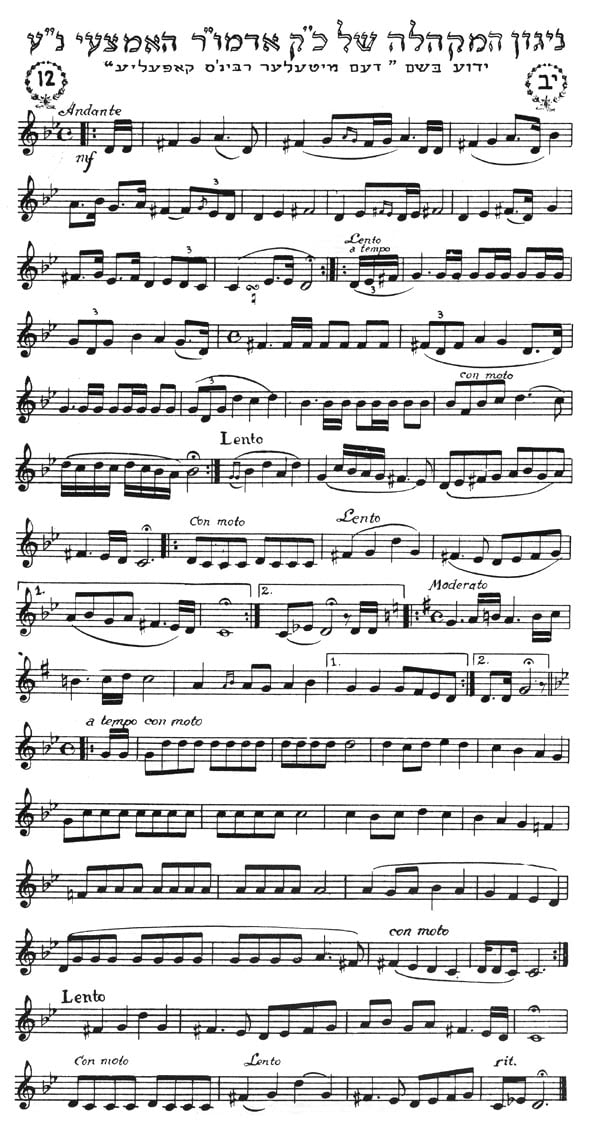
Mitteler Rebbe’s Kapelyeh

Adapted for piano.


This melody is […] divided into four sections, symbolizing the four rungs on the ladder of approach and devotion of man to G-dliness.

The Tzemach Tzedek explained that the purpose of the orchestra which played on certain occasions for his father-in-law, the Mitteler Rebbe, was to prevent him from reaching the state of termination of earthly existence (kelos ha’nefesh). In his supreme [earning for] the Almighty, the Rebbe could have literally expired unto G-dliness.
Another version of the Kapelyeh, with notes.

Chapters 10, 18 and 32 from Mittler Rebbe’s Sha’ar HaYichud.

Thursday, March 26, 2009

Religion of peace on the march

Some headlines from Pajamas TV on the wonderful and rosy world of the religion of peace (some terrorist attacks, a girl burned alive, a woman jailed and losing her children from having tea with another man), followed by an interview with Dr. Zuhdi Jasser, the producer of a new film about Islamic society and state.

Rosh Choidesh Nissan


Individual first? Or the nation first? As far as being members of the secular society, the individual of course (and that’s the best answer for the nation).

As far as being members of a family, the family first of course. As far as being members of Jewish people — the Jewish nation and a Jewish individual are the same thing. To separate them is ridiculous (which is the spiritual source for the mitzva of Ahavas Yisroel). Yet, when a choice comes in the emphasis of mitzvos… From Sichos in English:
There are many days between Pesach and Purim, and by Divine Providence, this gathering is being held on Rosh Chodesh Nissan. Consonant with the Baal Shem Tov’s dictum that everything can and should provide a lesson for one’s service to G-d, there is a special lesson to be learned from Rosh Chodesh in general, and Rosh Chodesh Nissan in particular.

Rosh Chodesh is the birth of the moon, every succeeding day seeing the moon wax greater and greater. Jews are “destined to be renewed like the moon,” and it is incumbent on every Jew to know that he is being given new strength and blessings from G-d so that he can ascend in matters of Judaism — just as the moon waxes greater each day. And when a Jew ascends in matters of Judaism, his life becomes illuminated with the light of Judaism, affecting his family and all Jewry.

This is connected with the redemption, for at the “sanctification of the moon” we say “Dovid king of Israel lives and exists” — and the redemption is associated with the House of Dovid. Notwithstanding the situation of Jews in exile, when they increase in a “candle which is a mitzvah and Torah which is light,” they effect and draw down the great and true light that will be in the true and complete redemption.

The idea of the redemption is emphasized even more strongly on Rosh Chodesh Nissan. When the Jews were in exile in Egypt, they were commanded on Rosh Chodesh Nissan about the Pesach sacrifice and the other matters of Pesach, together with the tidings about their deliverance from Egypt. On every Rosh Chodesh Nissan this strength in regards to the redemption is renewed — and in greater measure than on Rosh Chodesh of other months. Just as the Jews were informed on Rosh Chodesh Nissan of their imminent deliverance from exile in Egypt, “so may it be with us” — that on this Rosh Chodesh Nissan all Jews should be informed of the true and complete redemption.

In addition, when the Jews were in the desert, the Mishkan was dedicated on Rosh Chodesh Nissan, and on that day the princes of (the tribes of) Israel brought special offerings. Besides the offerings brought by the individual princes on successive days (starting from Rosh Chodesh Nissan), on Rosh Chodesh Nissan itself, all the princes brought an offering together — “the princes offered their offerings”. It was only after the princes had thus emphasized the essential unity of all Jews as “one people” that they brought their individual offerings.

On every Rosh Chodesh Nissan each year, each Jew has special strength to unite with all Jewry, all of them helping to erect the Mishkan and its general service. Afterwards, the individual service and mission of each Jew is performed.

This is the special lesson to be learned from Rosh Chodesh Nissan. First and foremost, each Jew’s service must be such that it is openly seen that he is part of the “one people,” and that each Jew takes a share in the building of the (general) sanctuary to G-d; then follows the individual service of each Jew.

For example, in regard to Jewish children, there are certain things applicable only to boys: wearing tzitzis, and preparations for putting on tefillin. Likewise, there are certain things applicable only to girls: kindling the Shabbos and Yom Tov lights. Involvement in these particular mitzvos follow after the uniting of Jews into “one people,” and simultaneously knowing that these actions add to the light of Judaism in all Jewry. Through this, the last days of exile are illuminated and made joyous, and become days of preparation to the true and complete redemption.

Paved with good intentions

http://graphics8.nytimes.com/images/2009/03/25/world/25czech2-600.jpg

There is a Russian saying: “A fool without initiative is better than a fool with initiative.” At least the first fool doesn’t do anything — he is just being an idiot quietly. The second one wracks havoc with his well-intentioned idiocy.

But of course, the lovers of the current President seem to think that as long as he has good intentions (something I also find quite hard to believe), all will be good. Everyone will try really-really hard and believe in our success, and we will succeed. Against the cynicism and the laws of nature.

It’s a bit like saying, “Dude, you’re trying to go from Boston to New York, but you got on I-95 North, not South”, and hearing in response: “Well, yeah, we may disagree about the direction in which we are supposed to go, but at least I am driving fast. You can’t disagree that I am driving fast, right?” Yeah, you’re driving fast — in the wrong direction. At this pace, you will get closer to New York by breaking down. Which is my answer to all those hurting souls who ask Conservatives: “Whyyyy would you want our President to faaaaail?! Doesn’t our country have enough problems?” Yes — people like you and the president you elected.

In any event, as Mises Economic Blog comments, “There are still elected people [...] who make sense.”
PARIS — The European Union’s crisis of leadership during the economic downturn was thrown into sharp relief on Wednesday, as the current president of the 27-nation bloc labeled President Obama’s emergency stimulus package “a way to hell” that will “undermine the stability of the global financial market.”

The blunt comments by the Czech prime minister, Mirek Topolanek, whose country holds the rotating presidency of the union, came just a week before a crucial meeting of the Group of 20 that was called to show global solidarity in fighting the recession. The comments were greeted with embarrassment by many Europeans who believe that the Czech leader does not represent a European consensus. [source]
Of course not. The European consensus is to cure an allergic response through a blood transfusion: by drawing blood from the leg and injecting it into the arm. What? It’s the problem with blood, stupid. We will inject some fresh blood into the system, and “jump-start” the body…

* * *

The classical model of a liberal from everyday life is that driver who lets someone waiting to make a turn go in front of him, while there are fifty cars standing in the traffic behind him. It’s the typical description of liberal thinking that Henry Hazlitt warns about in his book, Economics in One Lesson: any time you make a decision about success or appropriateness of some policy, you can’t just think about one specific group of people. You have to look at everyone affected, including those not immediately in front of your nose.

You may bail out a company, saving a thousand jobs. So, you helped out a thousand people in front of you. But you hurt tens and hundreds of thousands by the same move! But no, the liberal never looks in a rear-view mirror. Emotion—reflex—response. Thinking too hard is cruel and immoral.
The art of economics consists in looking not merely at the immediate but at the longer effects of any act or policy; it consists in tracing the consequences of that policy not merely for one group but for all groups.
So simple. And at the same time, so ungraspable for a liberal mind.

* * *

Now that we are on the topic of Czechs, a cute commercial about Czech beer and Bedř ich Smetana, the famous composer who wrote a piece called “Má Vlast” (“My Fatherland”) while already deaf:


— I can’t compose for you a national song, gentlemen, because I can’t hear anything.
— But sir...
— I can’t hear, gentlemen!..
A servant brings in beer; Smetana looks at it.
— Pen!..

Wednesday, March 25, 2009

A car crash

http://i13.tinypic.com/2qd0iub.jpg


The original:


Well, the original original (skip to 3:45 if you have to):

Tuesday, March 24, 2009

Davening

“When a Lubavitcher davens, he whispers.”

Look at this man’s hands.


Or, a little more energetic:

Sunday, March 22, 2009

Halachic process — 1

Following a discussion with my rabbi and my pianist friend.

Is this what psak din is? (PG-613.)

Tuesday, March 17, 2009

Leaves a bit too much to imagination

From the article “Which Vodka is the Best?”

Grey Goose
$29.99 for 750 milliliters; 80 proof
French; distilled from wheat, rye, and barley

Made in Cognac but owned by the American Bacardi Corp., Grey Goose was introduced in the United States in 1997 and has since won a great many industry awards.

We were underwhelmed: Grey Goose is sweet and smoky, with hints of anise and citrus in the finish, but it all adds up to only a sort of smooth, uninteresting neutrality. And so, while the more generous half of our panel praised Grey Goose's "long, silky aftertaste" and "pleasing burn," detractors found it "bland," "spineless," and "vaguely medicinal."

In the end, seven tasters agreed that the vodka's softness and subtlety made it a solid, if unremarkable, choice. Four found it to be too unremarkable and lacking the bite or character they expected from a self-described "ultra-premium" spirit.

Final Verdict: "Leaves a bit too much to the imagination."
Grade: Three Shot Glasses


I still find it remarkable (not Grey Goose). Absolutely amazing.

For whom was Tanya intended?

The answer, of course, is “everyone”.
The Baal Shem Tov, in a famous letter to his brother-in-law, tells of the time he experienced an elevation of the soul to the celestial spheres. When he came to the abode of Mashiach, he asked, “When will the Master come?” Mashiach answered: “When your wellsprings shall spread forth to the outside.”

The Baal Shem Tov was the founder of Chassidus and the Chassidic movement. Mashiach’s answer meant that the world would be ready for his coming when the wellsprings of Chassidus would reach all Jews [revelation of essence of Toireh drawing down the revelation of the Essence of Hashem]. Ever since, the dissemination of Chassidic doctrines and teachings has assumed top priority.

Chabad Chassidus, founded by the Alter Rebbe, conveys the concepts of Chassidus in an intellectual framework, enabling them to be understood by man’s chochmah (wisdom), binah (understanding) and daas (knowledge) — ChaBaD. The doctrines of Chassidus were made comprehensible to all Jews, thereby infusing life and vitality in every aspect of a person and his service to G-d. The fundamental text of Chabad Chassidus, its “Written Law”, is the Tanya, authored by the Alter Rebbe.
But it doesn’t mean that everyone can study it by himself, as Alter Rebbe mentions in the Introduction to Tanya. One must find a mashpia. Is Tanya unique in this aspect? Not at all — it’s a feature of all Judaism.

And I am not talking just about pshat, the literal meaning. I am talking about being on the level at which Tanya is relevant for you, accessible for you, and your soul, your intellect and your emotions are strong enough for Tanya.

Some people say that Tanya was written only for the talmidim of Alter Rebbe. Rabbi Paltiel answers, in the name of the Frierdiker Rebbe: “people that I know and recognize” means any people from the time of Alter Rebbe till Mashiach who make an effort to study Tanya.

He also tells a story, elsewhere, about a bochur in Tomchei Tmimim who had a health condition, for which doctors prescribed him to take an hourly walk every day. This meant that he had to miss on hour of the seider. Of all things to miss he chose Tanya, since he has learned it numerous times already.

His mashpia told him that the bochur should miss an hour from any other subject, but not Tanya. The bochur’s brother, who was also a mashpia, disagreed — why should the bochur have to listen to the subject he already knows and miss the subject he is not yet acquainted with? When both of them were in yechidus with Rebbe Rashab, they asked who is right. The Rebbe agreed with the first mashpia and explained: there is value in learning and listening to Tanya just for its own sake, even if one already (supposedly) knows the information written.

ולא ידחוק עוד ליכנם לדבר עמי ביחידות

No longer will one need to press for a private audience,

כי בהן ימצא מרגוע לנפשו ועצה נכונה לכל דבר הקשה עליו בעבודת ה׳,

for in [these Likutei Amarim] one will find tranquillity for his soul, and true counsel on everything that he finds difficult in the service of G‑d.

ונכון יהיה לבו בטוח בה׳ גומר בעדינו

Thus his heart will be firmly secure in G‑d who completes and perfects everything for us.

ומי שדעתו קצרה להבין דבר עצה מתוך קונטריסים אלו

He whose mind is too limited to understand how to derive advice from these pamphlets,

יפרש שיחתו לפני הגדולים שבעירו, והם יבוננהו

let him discuss his problem with the foremost scholars of his town and they will enlighten him.

ואליהם בקשתי שלא לשום יד לפה

Of [these scholars] I request that they not lay their hand upon their mouth, i.e., not to keep silent when asked for advice, for fear of appearing to be proud in their knowledge,

להתנהג בענוה ושפלות של שקר, חס ושלום

to conduct themselves with false modesty and humility — for misplaced modesty is falsehood.

וכנודע עונש המר על מונע בר

It is well known how bitter is the punishment of him who “withholds food” [i.e., who withholds Torah knowledge from him who seeks it],

וגודל השכר, ממאמר רז״ל על פסוק: מאיר עיני שניהם ה׳

and also how great is the reward granted to one who provides [such knowledge]. This is well known from the comment of our Sages on the verse, “G‑d enlightens the eyes of them both.”

כי יאיר ה׳ פניו אליהם, אור פני מלך חיים

Thus G‑d will cause His face to shine upon them, with the light of the countenance of the King [which provides] life.

ומחיה חיים יזכנו ויחיינו לימים אשר לא ילמדו עוד איש את רעהו וגו׳ כי כולם ידעו אותי

May He who provides life to the living grant us the privilege of living to see the days when “no longer will one man teach another... [to know Me], for they will all know Me [from the smallest to the greatest],

כי מלאה האר׳ דעה את ה׳ וגו׳

for the knowledge of G‑d will fill the earth as the waters fill the sea.”

אמן כן יהי רצון

Amen. May this be His Will.

TopGear on Communist cars


My favorite part — 12:38:
In Russia, you had to work hard on car factories, or you’d suddently discover how difficult it is to mine Siberian salt, while wearing a hat made from your wife’s head.

British Communists didn’t really bother with any of that. Mostly, in fact, they didn’t bother turning up to work at all. They’d simply make their way to factory’s gates, where they’d spend the rest of their day chatting.
See also 9:12 for British Communist car (“The nerve to call it ‘super’. I suppose you couldn’t just call it ‘Trotskyite crap’. Maybe that’s what TC stands for”).

More on UK liberals.

I wonder what American cars bailed out by Obama and the rest of Politburo will look like in a few years.

It’s also always amazing how, given a choice of two syllables in a Slavic word, an English speaker will always put a stress on the wrong one. It must be the English and American way of distinguishing themselves — after all, they can’t speak through their noses like French.

And, finally, how difficult is “Zaporozhetz” to pronounce? It’s not like we are forcing you to say “Dnieprodzerzhinsk”.


(full version)

Wednesday, March 11, 2009

A brief outline for the question of G-d and suffering

http://media.collegepublisher.com/media/paper573/stills/ipk95046.jpg

I don’t have time to post the whole argument, but I am posting the outline. I may address the specific approaches in future posts (promises, promises…), but for now, this should suffice for those of understanding.
The outline for the debate on existence of suffering vs. omnipotence and benevolence of G-d:

1. Introduction
  • Moshe Rabbeinu and his question
  • two schools of thought in Judaism: rational and mystical
  • G-d is good; G-d is Good; Good is G-d
  • Square triange — is G-d bound by laws of logic? Limitation not on G-d but on the world, stemming from the definition of the world
  • synopsis of the three lines of argument
2. Rational argument (listen to Rabbi Dovid Gottlieb’s shiur)
  • Who is more G-d–like: people or angels?
  • In the image of G-d — sharing His essential aspects; freedom
  • Freedom of will entitles ability to cause suffering, no way around it (square triangle)
  • Story of Yosef and brothers
3. Intermediate argument (listen to Rabbi Paltiel’s shiur on Samech Vov)
  • Can’t know why the reason for creation of the world is what it is, can know what it is (can’t know why a man made the microscope, can know what the purpose of a microscope, built-in into it, is)
  • Moshol of fire and burning wood with O₂ vs. stone burning under water — need a place of concealment to reveal the essence
  • This worls is a world of concealment for this reason, manifests in:
    — atheism (projection on a screen vs. picture on the wall)
    — free will (including being able to cause suffering)
    — suffering coming from the world itself (natural)
  • Right now we are not there (the Messianic Era), but the world is one nekuda, with space, past, present and future as one whole
4. Mystical argument (Ch. 26 of Tanya)
  • A theist knows that everything comes from G-d, just in revealed vs. in concealed form
  • Revealed good cannot come from the essential aspect of G-dliness, since its revelation would either destroy the world or go "through" the world
  • Therefore, good from essential aspect of G-dliness must be in a concealed form — packaged in the form of suffering
  • Not an excuse for causing or not preventing suffering
    — post factum (b’dieved) vs. a priori (lehatchilo)
    — free will vs. Divine Providence
    — slavery in Egypt: Egyptians accepted the role of slave owners, didn’t have to, despite the fact that it was destined
    — the story of the tzaddik and breakfast
    — it’s about your free will: that’s between you and G-d; what a person is destined to get is between him and G-d, has nothing to do with you
5. Summary, answer to Moshe Rabbeinu (“If you know the true cause of suffering, you will stop caring about preventing it.”)
(Sorry for bad formatting. The blog freaked out when I posted the text in a formatted form.)

The outline doesn’t talk about the idea of tzaddik ve’rah loi or the idea of reincarnation. And of course, Chabad Chassidus can destroy all of the above with two words (literally).

Mazal tov

When a grandmother becomes a great-grandmother (not to mention a nobody becoming an uncle), especially on Purim, it’s always a cause for celebration.

Sunday, March 8, 2009

Thoughts on Theory of Evolution


One of several thoughts from starting to read The Hand by Frank R. Wilson.

My problem with obsession with the Theory of Evolution is not that I don’t believe in TE. I do. I mean, I believe the facts. If the facts contradict each other, I can try to find the way to reconcile them (as in contradiction of Quantum Mechanics and General Theory of Relativity), bend one set of facts to another, or just let the contradiction be. And I believe that I really can reconcile Evolution and Judaism.

So, I accept Evolution as a fact, albeit perhaps interpreted by me differently from the most. The problem appears when people start defining their lives according the Evolution, defining the essence of humanity. Defining me, after all.

Because I don’t believe that. Whatever facts I may believe, I am still a theist, a Chassidic Orthodox religious Jew whose outlook on the definition and essence of life, its purpose and its meaning derives from Judaism. Facts are facts. They are out there. The world looks old. Nu. The species look like they share common ancestry. Nu. Perhaps they do — in physical, or, more likely, in mystical sense (which practically yields the same consequences). Nu.

But these things don’t define me. The purpose with which my Creator sent me into this world does.

At the same I could see how these things would most meaningfully define an atheist’s life. Or perhaps not — I don’t know what would meaningfully define an atheist’s life (just like I don’t know what would be his meaningful definition of morality) without him being intellectually dishonest, ignorant, stupid or lying to himself.

But perhaps this is what irritates the Conservatives about TE, which I never understood (the theory being for me just a scientific, biological fact and a useful model for interpreting and representing data, not any life-defining or -changing set of principles or ideas).

You talkin’ to me?..

PG‒613:


A little critique of populism:

Something to consider

“Mench tracht un G-tt lacht” (“Man plans and G-d laughs”).

But we have to try our best. And more often than not our best is not good enough — so, we need to try to do better. Because we are expected to. Otherwise, what’s the point? Tell me, what is the point otherwise?

Exactly…

Saturday, March 7, 2009

Friday, March 6, 2009

Science is fun


(source)


Question:
J.M. Kearsey et al. “Does the p53 up-regulated Gadd45 protein have a role in excision repair?” Science 270, 1004–1005 (1995)

Answer:
G. Barreto, G. et al. “Gadd45a promotes epigenetic gene activation by repair-mediated DNA demethylation.” Nature 445, 671–675 (2007)
Another answer:
S.G. Jin et al. “GADD45A does not promote DNA demethylation.” PLoS Genet. 4, e1000013 (2008)

Thursday, March 5, 2009

Isarusa d’leila vs. Isarusa d’lesata

Isarusa d’leila — inspiration from above. When Hashem inspires you as a favor; you suddenly have energy for your avoida. Amazing, but is not earned, so it doesn’t stay.

Isarusa d’lesata — inspiration from below. When you work hard, and Hashem sends inspiration to you proportional to your work. Less abundant in energy, but more internalized.

Monday, March 2, 2009

Puzzled in Gaza

THERE WERE empty beds at Shifa Hospital and a threatening atmosphere. Hamas is reduced to wielding its unchallengeable authority from extensive air raid shelters which, together with the hospital, were built by Israel 30 years ago. Terrorized Gazans used doublespeak when they told me most of the alleged 5,500 wounded were being treated in Egypt and Jordan. They want it known that the figure is a lie, and showed me that the wounded weren't in Gaza. No evidence exists of their presence in foreign hospitals, or of how they might have gotten there.

From the mansions of the Abu Ayida family at Jebala Rayes to Tallel Howa (Gaza City's densest residential area), Gazans contradicted allegations that Israel had murderously attacked civilians. They told me again and again that both civilians and Hamas fighters had evacuated safely from areas of Hamas activity in response to Israeli telephone calls, leaflets and megaphone warnings.

A good read.

Heart vs. brain?

Or, rather, lack of brain vs. brain?

Arbat says that the famouse adage of Churchill’s — “One who is conservative before he’s 20 has no heart, and one who is liberal after he’s 30 has no brain” (or something like that) — always struck him as a bit too categorical.

Does it mean that this kid — who has more brains than at least the majority of Americans, plus the majority of the government (including all its so-called “experts”) — has no heart?

Sunday, March 1, 2009

On social sciences and other things

Richard Feynman, the brilliant physicist and Nobel Prize laureate (not that it matters lately, since they give the prize to trash like Krugman and Jimmy Carter):


Richard Feynman used to say: “What you presented to us is so stupid, it’s not even false”.

On proper science:


On disbelief (it’s amazing how much this applies to Judaism):